Índice do artigofaltam 7 min de leitura
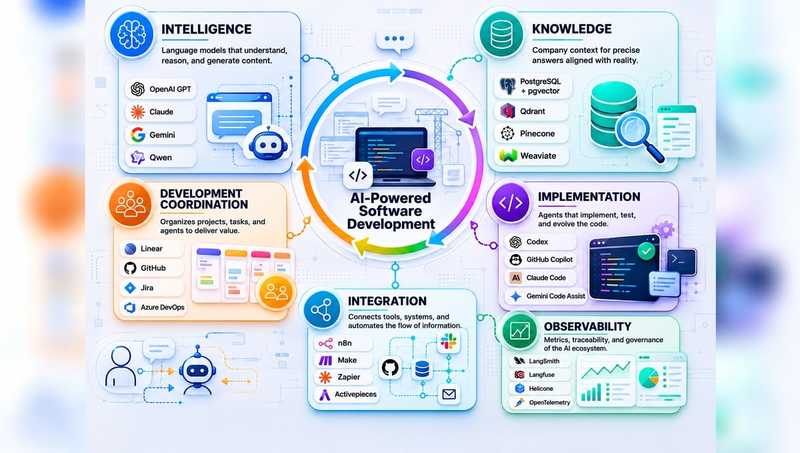
There is a comfortable fantasy going around product teams: that all it takes is a good enough AI agent for software to start building itself. You describe the request, the agent understands it, touches the front end, adjusts the back end, writes tests, opens the pull request and prepares the delivery.
In practice, what usually happens is less magical. The generalist agent makes mediocre decisions on several fronts, mixes responsibilities, loses the thread of context in the middle of the task and produces code nobody can audit afterwards. The problem is rarely just the model's intelligence. It is the lack of structure around it.
This article goes deeper into an idea we covered in AI agents or traditional systems: which is better for your company?: mature AI architecture is hybrid. The agent interprets and proposes. The system validates, executes and records.
Now we go one level deeper. When the request justifies several agents working together, what separates a working software factory from a pile of prompts is one thing: orchestration with real engineering. Clear roles, checkpoints, contracts, governance and observability. Without that, multi-agents is just distributed chaos.
By the end, you will know when it makes sense to use a single agent, a deterministic workflow, multi-agents or a hybrid architecture, which risks need to be mitigated and how to structure this within the real engineering cycle.
Quick summary
For those in a hurry, the key points:
- Multi-agents is not about having many agents. It is about having an orchestrator that breaks down the request, distributes work to specialists and validates each step before moving on.
- The generalist agent fails from too broad a scope, not necessarily from lack of capability. Separating responsibilities by milestone improves precision, review and traceability.
- The most important piece is the boundary between agent and system: the agent decides or recommends, while the system validates, records and enforces limits.
- The choice between single agent, workflow, multi-agents and hybrid architecture depends on complexity, criticality and the need for auditing, not on fashion.
- The risks are predictable: hallucination, conflict between agents, loss of context, cost, security gaps, missing logs, code regression and a false sense of autonomy.
- Without observability, any agent architecture is an expensive black box. Logs, a decision trail, checkpoints and cost metrics are not optional.
The problem with the generalist agent
Imagine asking a single person to be, at the same time, an interface designer, a database architect, a security specialist, a QA analyst and a code reviewer. Even if they are talented, they tend to carry too much context and switch between very different kinds of reasoning.
That is exactly what happens with a single implementing agent receiving a broad request. It analyzes the requirement, touches the interface, adjusts business rules, creates a route, changes the schema, writes a test and reviews its own work. The result has predictable structural problems:
- Less precise decisions, because each area requires a different kind of reasoning.
- Mixed responsibilities, which makes it hard to understand which part of the output came from which intention.
- Low traceability, since everything happens in a continuous flow with no checkpoints.
- Hard reviews, because reviewing a change that touched seven layers at once is more expensive than reviewing focused deliveries.
- Regression risk, when a change in one layer breaks something the agent already considered done.
The point is not that a generalist agent never works. For small, well-defined tasks, it is useful, fast and cheap. The point is that it does not scale well with complexity, dependencies between areas and the need for auditing.
The proposal: specialists organized by milestones
The alternative is to treat development like a real technical team, in which each agent has a defined role and a scope narrow enough to be good at it. Organizing by milestones mirrors the natural phases of a delivery.
| Milestone | Sub-agent responsibility |
|---|---|
| Front end | Interfaces, componentization, responsiveness, API integration and UX quality |
| Back end | Data modeling, CRUDs, routes, business rules and external integrations |
| QA | Functional tests, flow validation, bug reproduction and scenario coverage |
| Security | Vulnerabilities, permissions, authentication, data protection and tool exposure |
| Review, Merge and Commit | PR review, code standards, commit organization and delivery preparation |
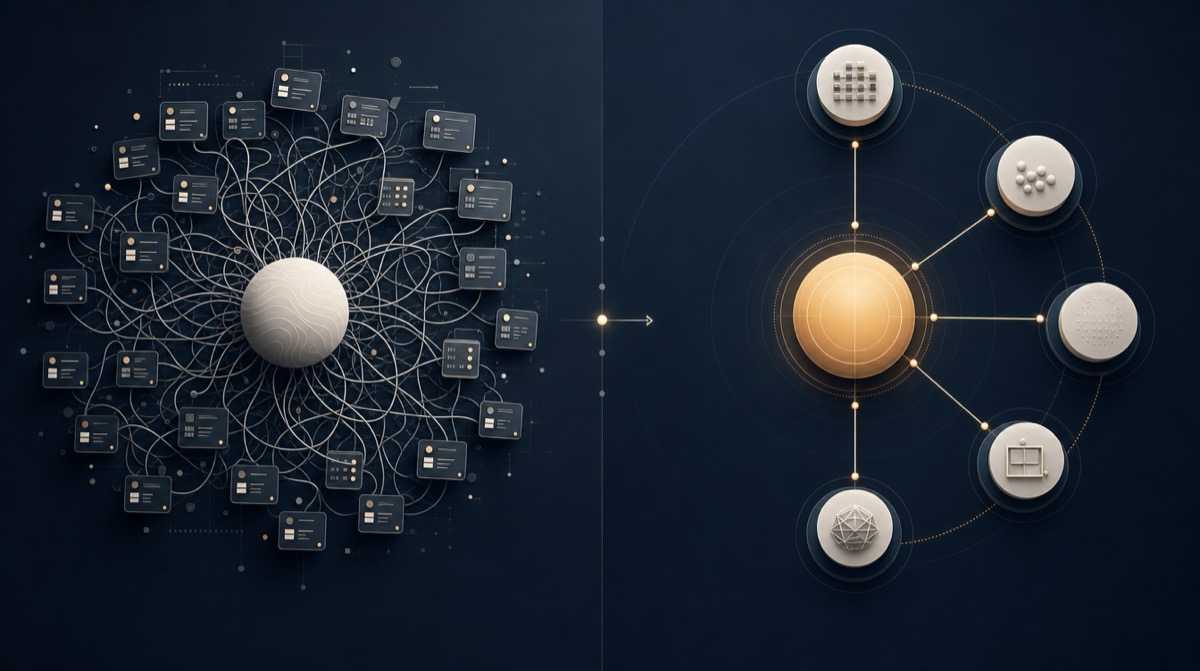
Each sub-agent operates with a smaller, more relevant context. This reduces hallucination, improves decision quality within the domain and makes review easier. Since each step produces an isolated deliverable, it can be checked before the next one starts.
This is the logic behind more mature agent architectures: it is not enough to "give tools" to the model. You need to define roles, inputs, outputs, definitions of done and limits of action. MCP, for example, helps standardize access to tools and data, but it does not replace the responsibility of designing the right flow.
The orchestrator is where the engineering lives
Specialist sub-agents alone solve nothing. Without coordination, you swap one confused agent for five disconnected agents. The piece that turns this into a system is the orchestrator.
The orchestrator's job looks less like "AI doing magic" and more like technical management:
- interprets the main request and translates it into an execution plan;
- breaks the problem into smaller, ordered steps;
- decides which sub-agents should act and in what sequence;
- respects dependencies, such as not releasing the front end before an API contract exists;
- validates whether each step was really completed before releasing the next one;
- coordinates reviews, tests, security and handoffs;
- consolidates the final delivery and ensures coherence between the parts.
Note the central point: the orchestrator does not blindly trust the sub-agents. It demands proof of completion. That structured distrust is what separates an auditable factory from a pipeline hoping things work out.
In technical stacks, this role may show up as a workflow, a queue, a job, an agent orchestrator, an execution graph or a runtime layer. Tools like LangGraph come in precisely when the application needs explicit state, branching, checkpoints, loops and execution control.
The boundary between agent and system
Here is the idea that connects this article to the previous one. In a mature architecture, the agent interprets and proposes, but the system is what validates, executes and records.
When a back-end sub-agent decides to create a migration, it should not have the final word on whether that is correct. Validation comes from a deterministic layer: automated tests run, linters check standards, the schema is validated against rules, and only then does the change move forward.
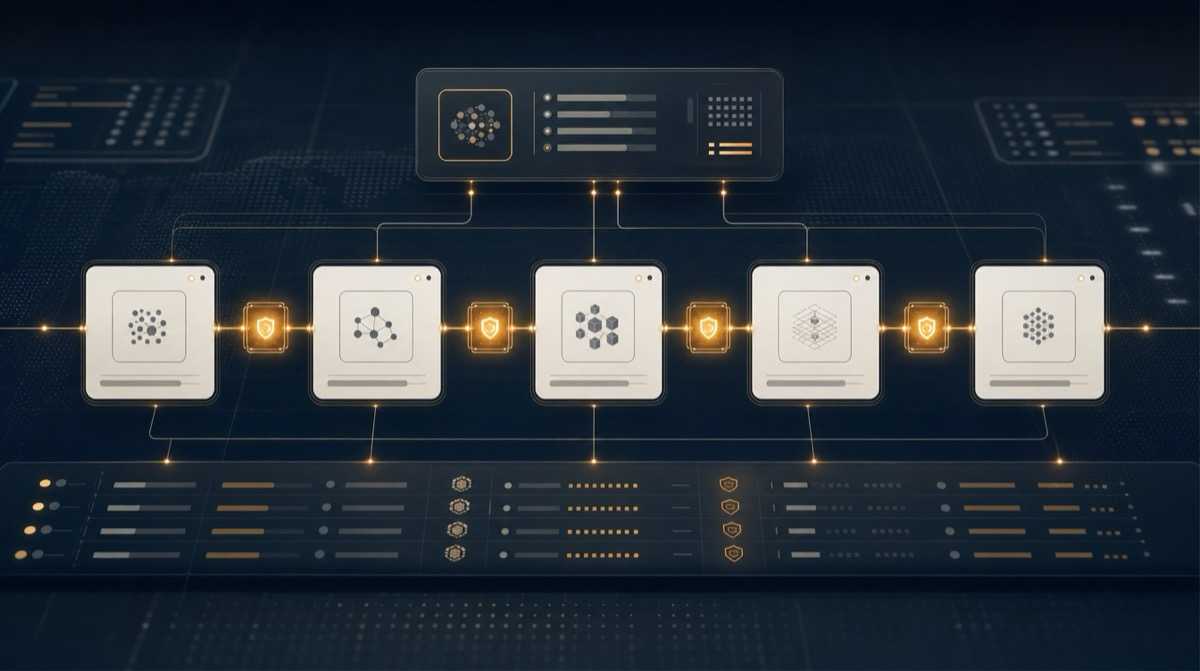
The agent suggests the change. The system decides whether it gets in.
This separation has three practical effects. First, agent errors are contained before they reach production. Second, everything is recorded because the validation step naturally generates logs. Third, you gain real governance because there is a non-AI point that can say "no" reliably and repeatably.
Without this boundary, multi-agents is just a generalist agent sliced into pieces, with the same risks and more points of failure. That is why patterns like secure tool calling, per-tool permissions, logs and human approvals remain an essential part of the architecture.
Decision matrix: what to use in each situation
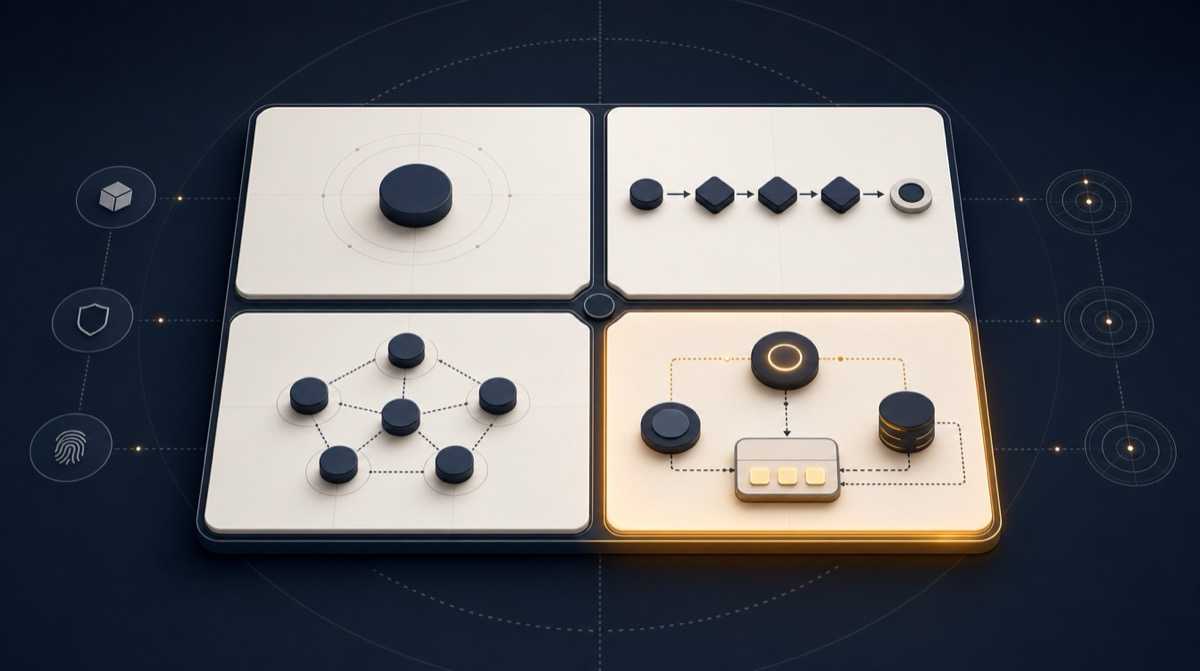
Not every problem calls for multi-agents. In fact, most don't. The right choice depends on how complex, critical and auditable the task needs to be.
| Approach | When it makes sense | When to avoid it |
|---|---|---|
| Single agent | Small, well-defined tasks, prototyping, exploration, one-off scripts and low cost of error | Flows with multiple interdependent layers or auditing requirements |
| Deterministic workflow | Repetitive processes, stable rules, predictability, compliance and known steps | Tasks that require interpreting ambiguous language or contextual judgment |
| Orchestrated multi-agents | Complex requests with distinct phases, specialists and step-by-step traceability | Simple tasks or environments without orchestration, checkpoints and contracts |
| Hybrid architecture | Most real production cases: the agent interprets, the system validates and executes | Quick proofs of concept where validation infrastructure is not yet worth it |
The rule of thumb is simple: start with the simplest approach that solves the problem. Increase complexity only when the pain justifies it. Multi-agents without orchestration is usually worse than a single agent used well.
The risks nobody puts on the sales slide
Every agent architecture carries concrete risks. Ignoring them does not eliminate the problem; it just moves the cost to production.
Hallucination. The agent invents an API that does not exist, a field that is not in the schema or a behavior that is not real. The mitigation is deterministic validation after the agent, automated tests as gatekeepers and context restricted to each sub-agent's domain.
Conflict between agents. The front-end sub-agent assumes a response structure different from the one the back end implemented, and both are "right" within their own scope. The mitigation is to treat contracts between steps as the source of truth: versioned schemas, types and specifications.
Loss of context. In long flows, information from the beginning gets lost in the middle, and the agent makes decisions misaligned with the original request. The mitigation is to keep a canonical state in the orchestrator and reinject that state at each step.
Cost. Several agents, each with several calls, scale cost fast. Multi-agents can cost much more than a deterministic workflow for the same result. The mitigation is to use AI only where there is real ambiguity, let deterministic code do the repetitive work and measure cost per delivery.
Security. An agent with broad access to systems is an attack and error surface. The mitigation is to apply least privilege per sub-agent, review permissions per tool and not allow sensitive actions without validation outside the AI.
Missing logs. If you cannot reconstruct why the agent did what it did, you cannot debug or audit it. The mitigation is to treat LLMOps as an architectural requirement: logs, evals, cost metrics, a decision trail and prompt versions.
Code regression. A change in one step silently breaks something that already worked. The mitigation is a test suite at each checkpoint and blocking progress when something regresses.
False sense of autonomy. The system looks autonomous, so human supervision relaxes. The mitigation is to define human checkpoints at critical points and make it clear that partial autonomy is not full autonomy.
How X-Apps would structure this in a real project
When we evaluate an agent scenario for a client, the first question is not "which agents are we going to create?". It is: does this problem really need agents, or would a workflow solve it better and cheaper?
A good part of serious applied AI work is preventing AI from being used where traditional engineering delivers more with less risk. When multi-agents is justified, the structure usually follows a few principles:
- We start with the agent/system boundary. Before defining sub-agents, we define where the deterministic validation layers sit.
- We model sub-agents from the engineering flow that already exists, not from an idealized org chart.
- We treat contracts between steps as code. Schemas, types and API specifications are versioned.
- Observability comes in from day one. Decision trail, handoff logs and cost-per-delivery metrics are part of the project.
- We integrate into the real cycle, with version control, CI, PR review, environments and rollback.
- We define checkpoints with human supervision at the most critical points, especially where security and sensitive business rules are at stake.
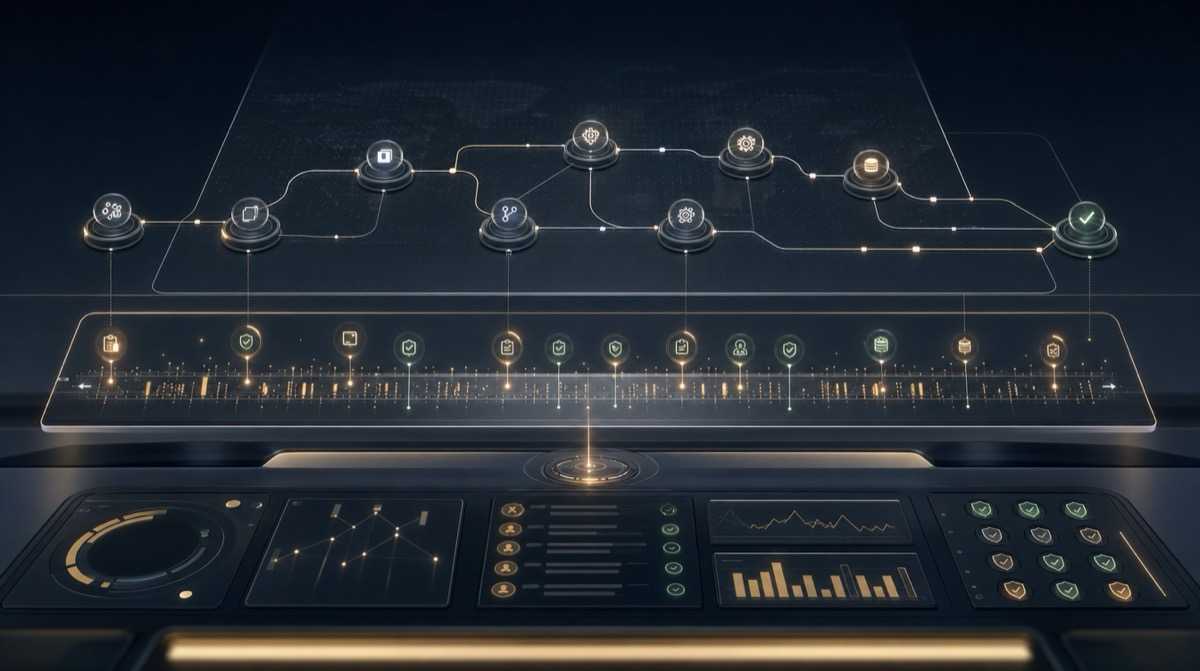
In practice, a delivery can follow this flow:
- The orchestrator interprets the request and separates milestones.
- The back-end agent proposes changes to data, routes and rules.
- The system validates schema, types, lint and tests.
- The front-end agent consumes contracts that are already defined.
- QA tests flows, edge cases and regressions.
- Security reviews permissions, sensitive data and tool exposure.
- The review agent consolidates the diff, commits, risks and merge instructions.
- A human approves critical points before moving on to deploy.
The goal is not to deliver an impressive demo. It is to deliver an agent system that the engineering team can operate, audit and evolve afterwards.
Where this creates competitive advantage
A software factory with well-orchestrated agents does not eliminate engineering. It changes where engineering puts its energy.
The team stops spending so much effort on repetitive tasks of reading, variation, preparation and initial checking. In exchange, it needs to design contracts, tests, permissions, logs and decision points better. It is a healthy trade: less mechanical work, more architecture.
This approach connects directly with projects for software development with AI, AI agents for companies and an AI agent factory, because the real gain is not in automating everything at once. It is in creating a pipeline where agents and systems collaborate with clear limits.
The mindset shift that matters
The conceptual leap is to stop thinking of agents as isolated executors and start treating them as an operational structure. The question stops being "which agent solves this?" and becomes:
What is the ideal flow for several specialized agents to solve this problem with quality, under control and in an auditable way?
The future of development with AI is not just in creating stronger agents. It is in creating well-organized agent systems, with real orchestration, clear roles, checkpoints, governance and observability.
The model's intelligence is becoming more and more accessible. The engineering around it is what creates lasting value.