Índice do artigofaltam 6 min de leitura
AI changed the speed. It did not change the laws of engineering.
We recently finished building two products from scratch. Together they exceed 60,000 lines of code, and these were not 60,000 "tutorial" lines. It was a real product: decisions, trade-offs, deploys, edge cases, bugs, deadlines, risk and cost.
When we wrote this text, in March 2026, we had been working with the most advanced AI coding tools available: Cursor, Claude Code and experiments with Antigravity. The tools and models have changed since then; the pattern described here has not. For the stack, we made pragmatic choices for performance and flow: Vite, Vercel and Convex. The result is inevitable: the feeling of speed is fascinating. On some days, it feels like you put a turbo on the team.
But the turbo does not change physics.
At some point, complexity stops being "a detail we will fix later" and becomes the center of the problem. That is when we noticed a pattern that the hype market usually ignores, and that this chart (which captures our experience very well) shows precisely.
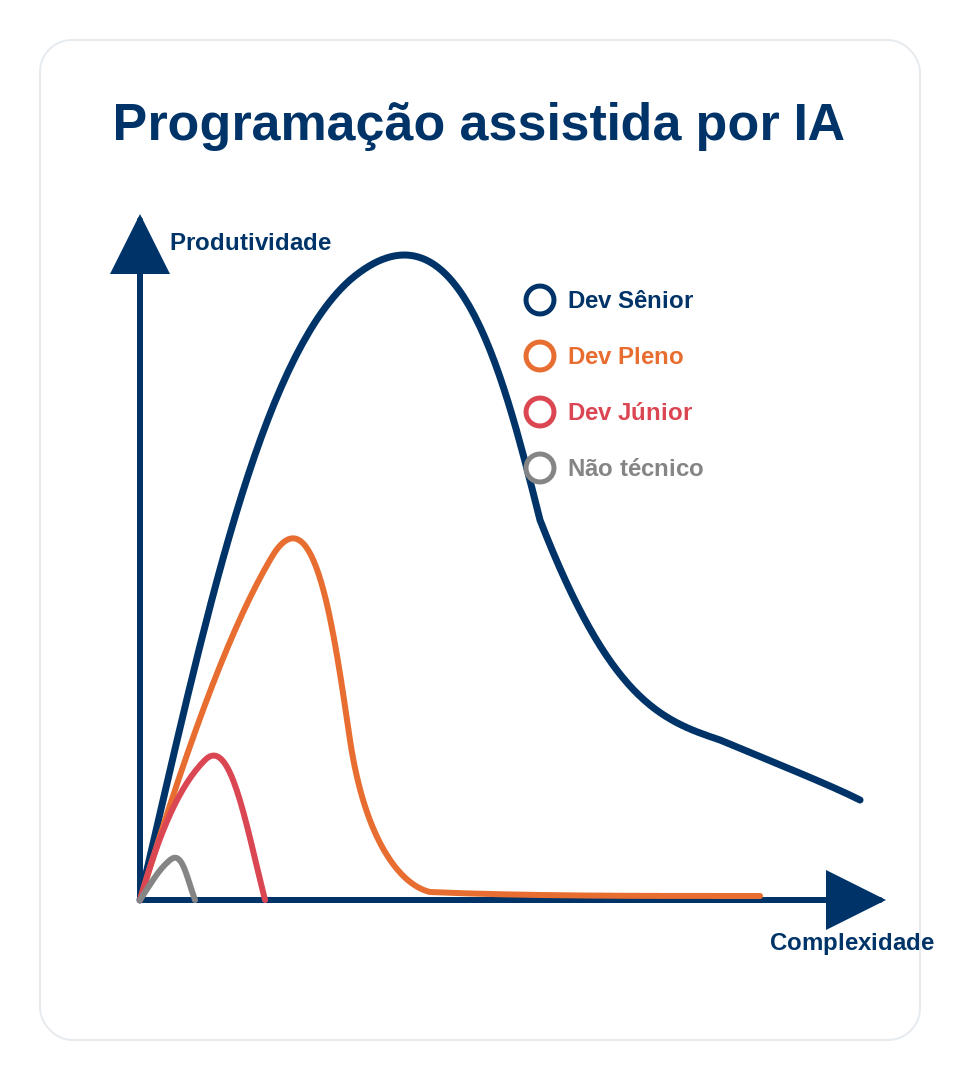
The reading is simple:
- The X axis is complexity (from "isolated feature" to "living system").
- The Y axis is real productivity (how much you can deliver and sustain).
- The curves change with experience: Senior, Mid-level, Junior, Non-technical.
What changes is not only speed. It is reach. It is the point where the curve breaks.
What you will take from this text
- An honest map of what AI really speeds up, and of what it speeds up in the wrong direction.
- Why productivity drops when the product starts "becoming a product".
- How to avoid the "functional Frankenstein" and build an asset that does not rot.
- A practical (and unglamorous) playbook to sustain speed with control.
Scene 1: the leverage peak
The first phase is addictive.
You describe a goal, the AI returns a structure, you adjust it, run it, see it working. In hours you have:
- routes, pages and components getting off the ground;
- initial integrations with services;
- validations, input masks, forms;
- endpoints and handlers that look "almost done";
- "draft" tests that feel like great progress.
For a senior developer, this is pure leverage: the AI becomes a "boilerplate printer" and an iteration accelerator. For a mid-level developer, it becomes a throughput multiplier. For a junior, it becomes a kind of exoskeleton. And for a non-technical person, it feels like a superpower.
At this moment, the product has no history. No scars. No implicit contracts. No accumulated debt.
AI shines because the ground is still clean.
Scene 2: context becomes the enemy
The drop does not happen all at once. It starts with small signs:
- small pattern inconsistencies ("one screen uses X, another uses Y");
- silly regressions in places that "were not even touched";
- code that works today but becomes unstable tomorrow (the famous "it works, but I do not trust it");
- changes that require touching 6 files because nothing has clear boundaries;
- architectural decisions that look great in each prompt, but terrible as a whole.
And then comes the most dangerous symptom:
You spend more time explaining context than solving the problem.
The AI starts fighting the context it helped generate. What was "delivery" becomes "negotiation": you ask for A, it answers A plus 3 other things; you correct it, it corrects and breaks a critical detail; you ask for consistency, it introduces a new "better" pattern.
This is when the curve plummets.
The most expensive illusion: "generating code" ≠ "sustaining software"
Here is the point that separates a prototype from an asset:
Software in production is not code that works.
It is code that keeps working when the world changes.
And the world always changes:
- requirements change;
- volume changes;
- business rules change;
- dirty data comes in;
- an external dependency fails;
- the team changes;
- urgency changes.
The difference between "generating" and "sustaining" is where the ROI lives. That is where the hype breaks.
Because AI can speed up writing. But the total cost is in maintenance: diagnosis, refactoring, tests, observability, risk, predictability.
The complexity cliff (and why it exists)
There is a technical explanation and an operational one.
The technical explanation
LLMs do not "understand" a codebase the way a human does. They work with the available context and statistical patterns. As the project grows, what matters becomes distributed:
- implicit contracts (the "right way" to do things);
- invariants (what must not break);
- cross dependencies;
- side effects (what changes when you touch X).
You see this in practice when any simple change becomes a chain of impacts.
And in this scenario, "knowing what is going on" is worth more than "being able to generate more lines".
The operational explanation
Complexity is not "too much code". Complexity is:
- conformity (needing to fit into what already exists),
- coupling (one point pulls another),
- invisibility (you cannot see everything at once),
- change (everything is always moving).
When the product enters this phase, speed can only be sustained with discipline. And discipline is not optional. It is the price.
The false sense of capability (especially for Junior and Non-technical profiles)
The chart is harsh for a reason: it shows a real risk.
Junior and non-technical profiles can quickly reach "looks done". And that is dangerous because it creates an internal narrative:
"If I got this far, I can finish it."
But their curve is short. They hit complexity before the product is minimally viable for production, and usually without realizing they hit it.
The typical result is a Frankenstein:
- functional enough for a demo;
- unstable enough to cause losses;
- impossible to maintain without rewriting;
- expensive enough to kill the ROI.
It is not the profile's fault. It is the physics of the system.
And that is why the most important "gap" today is not between "knowing how to code" and "not knowing how to code".
It is between:
- generating code
vs
- exercising judgment over the code.
Why AI does not replace experience: it makes it indispensable
The strategic conclusion is simple:
AI does not replace experience; it makes it indispensable.
In the hands of someone who does not understand architecture, AI becomes a machine that produces technical debt at high speed.
In the hands of someone with an operational and diagnostic mindset, it lets a lean team deliver like a much larger structure, as long as you know how to navigate the downslope of the curve.
The senior is not just "faster". They are more resilient.
They have three advantages that do not show up in the prompt:
- They create boundaries (interfaces, modules, contracts, patterns).
- They smell risk (the bug that does not exist yet, but will).
- They know how to pay the right cost (refactor today so you do not bleed tomorrow).
A practical playbook to sustain speed with AI
If you want to use AI to build a real product (not just a demo), here is what worked best for us, and what became a survival rule.
1) AI starts at the specification, not the code
Before asking for implementation, ask for:
- scope and out of scope;
- interface contracts;
- flows and states;
- edge cases;
- acceptance criteria;
- "what can break".
When you force thinking before execution, AI stops generating rubble and becomes a clarity accelerator.
2) Work in small (and versioned) slices
The bigger the "batch" of change:
- the lower the traceability,
- the higher the risk,
- the higher the cost of diagnosis.
AI loves big commits. Engineering hates them.
3) Define invariants and keep them visible
Invariants are local laws: "this can never happen".
If they are not clear (in types, tests, validations, short docs), the AI will break them without noticing, and you will only see it when it becomes an incident.
4) Test what gives confidence, not what gives a feeling
AI generates tests easily, but that does not mean it generates the right tests.
Prefer tests that protect:
- API contracts;
- business rules;
- edge cases;
- critical money/data flows.
The rest is foam.
5) Observe the system as a product, not as a repository
If you do not measure:
- errors,
- latency,
- failure rate,
- useful logs,
- anomalous behavior,
you are driving in the dark. And AI increases the speed, so driving in the dark gets worse.
6) Have an explicit "engineering moment"
Every cycle needs a point where the goal is not "ship a feature", but:
- clean up coupling,
- consolidate patterns,
- reduce complexity,
- pay down the principal.
Without it, you are just piling up interest.
7) Remember the production axiom
When it breaks in production:
- it is not the AI that joins the call,
- it is not the AI that answers the client,
- it is not the AI that carries the pager.
Responsibility is still human. And that changes everything.
What external measurements say about this curve
Our experience is one case, not a statistic. Public studies help separate feeling from measurement, and their message matches the chart:
- On a small, isolated task, the gain shows up. In GitHub's experiment published in September 2022, 95 developers wrote an HTTP server in JavaScript, and the group with Copilot finished 55% faster. That is the peak of the curve: clean ground, closed scope.
- On large, mature code, the picture changes. In the METR study published in July 2025, 16 experienced developers worked on 246 real tasks in their own open source repositories, and with AI they took 19% longer. Beforehand, they expected to gain 24%; afterwards, they still believed they had gained 20%.
- Measurement ages fast. METR itself now marks that result as outdated for current tools. In February 2026, it warned that the next experiment, with 57 developers, gave an unreliable signal, among other reasons because more developers refused to take part since they did not want to work without AI.
The takeaway: the gain exists, but it depends on the size and maturity of what is being changed, and the user's perception is not a metric. Measure it in your own context.
What this curve teaches those who sustain software
These 60,000 lines are not "a cool experiment".
They are a lab and a method.
They show where AI really pays off, and where it only brings costs forward. For any software that needs to be maintained after launch, the goal is to keep the product from getting stuck at the bottom of the curve, where maintenance cost swallows the automation gain and technical debt makes the business unviable.
AI changed the speed. But it did not change the laws of engineering and ROI.
Control needs to be strategic, not just algorithmic.
An honest question (to close)
Have you felt your operation's productivity drop as the AI solution became more complex?
If so, at what point did the curve break: in the code, the tests, the architecture, the deploy… or in the team's understanding of what was built?
Sources and reading
- Controlled experiment with 95 developers measuring the speed gain with GitHub Copilot (September 2022; includes the "55% faster" result on a specific task). The GitHub Blog
- METR study with 16 experienced developers in mature open source repositories (July 2025; 19% longer with AI, now marked by METR itself as outdated). METR
- METR update on the new experiment design and the limits of measurement (February 2026). METR
- "Lost in the Middle" (LLM limitations when using long contexts; degradation when the relevant information is "in the middle" of the context; useful to understand why large context is fragile). ACL Anthology
- Technical debt as an "interest" metaphor (the extra cost of evolving a system when internal quality deteriorates). martinfowler.com
- "No Silver Bullet", Fred Brooks (why essential complexity remains and there is no single magic leap that simplifies everything). Worrydream
- Vibe coding vs AI-assisted engineering (a case for spec-first, review and guardrails for production). Medium