Índice do artigofaltam 13 min de leitura
Updated on November 11, 2026: the original version, from August 4, compared Claude Opus 5, Kimi K3 and Fable 5. Since then, Opus 5.5, Sonnet 5.5, Fable 5.2 and Kimi K3.1 Pro have been released, and the leaderboard and prices have changed. The numbers below are the current ones; anything from August is dated.
Bottom line: the question that matters is not "which AI is the best". It is which combination of AIs produces the best result for your case. No single model wins on quality, speed and cost at the same time.
A working prototype that used to take weeks is now born, tested and refined in hours. But model options change almost every week, and choosing a tool has become an architecture problem, not a matter of preference.
This article shares the analysis we did internally at X-Apps to define our prototyping stack. We cross-referenced the most relevant public frontend benchmark with real subscription and API prices, and arrived at a layered setup that balances quality, speed and cost. It is the same reasoning we applied when comparing Claude Design, Figma and Canva for graphic design: tools do not compete for the same stage of the work, and treating the choice as a single contest leads to the wrong decision.
Executive summary
| Verified fact | What it changes in the decision |
|---|---|
| Claude Opus 5.5 leads LMArena WebDev with 1,818 points (leaderboard of November 9, 2026) | It is the default for anything that will be shown to a client |
| Claude Sonnet 5.5 is in 2nd place, with 1,774, for half the price of Opus 5.5 | Best single tool through the API for a lean budget |
| Kimi K3.1 Pro is 130 points behind the leader, at the same price as Sonnet 5.5 | In August, Kimi K3 was 29 points behind; Kimi's cost advantage has shrunk |
| Fable 5.2 costs twice as much as Opus 5.5 per token, and Fable 5.1 scores below it on frontend | A more expensive model does not mean a better prototype; use it as an exception |
| Cerebras advertises about 3,000 tokens per second and costs US$ 0.50 per reference prototype | The independent measurement is lower, but still the fastest for GPT-OSS-120B; average visual quality |
| Alibaba's Token Plan Standard costs US$ 18 per month with Qwen3.8-Max and a 1 million token context | A cost floor with very good quality for first versions |
| On Claude, chat and Claude Code share the same allowance | Intense prototyping on the subscription competes with the rest of the operation |
The right question is not "which is the best AI"
Prototyping software has three different bottlenecks, and each one calls for a different model capability:
- Deciding. Interpreting the brief, structuring screens, states and components, and keeping visual consistency across dozens of pieces.
- Generating. Producing the volume of code for variations, CRUDs and scaffolding without consuming the premium budget.
- Iterating. Applying the fix, reloading and testing again, fast enough not to break the review flow with the client.
When someone asks "which AI makes the best prototype", they are almost always talking about only one of these bottlenecks. That is why answers on the internet seem to contradict each other: they are all right within their own slice. The mature decision is to build a stack in which each model does what it does best.
Who is who in the comparison:
| Platform | Role in the stack | Reference price |
|---|---|---|
| Claude Opus 5.5 | Technical direction and final approval | US$ 100 (Max) or US$ 200 (Ultra) per month; US$ 4 / US$ 20 per million tokens on the API |
| Claude Sonnet 5.5 | Best-value single alternative through the API | US$ 2 / US$ 10 per million tokens |
| Kimi K3.1 Pro | Alternative with weights published under its own license, outside the Claude ecosystem | US$ 2 / US$ 10 per million tokens |
| Qwen3.8-Max | Volume: variations, CRUDs, scaffolding | US$ 18/month (Token Plan Standard) |
| Cerebras GPT-OSS 120B | Iteration speed | US$ 0.50 per reference prototype |
Claude Fable 5.2 completes the picture as an exception resource, and its section explains why it does not enter the standard cycle.
The benchmark that matters for prototypes
LMArena Code Arena WebDev is the most relevant benchmark for anyone building visual prototypes: people compare, side by side, web pages and applications generated by AI models and vote for the best one, without knowing which model produced each. By August 2026 there were already more than 510,000 accumulated votes.
Overall leaderboard published on November 9, 2026, with the official position of each variant:
| Position | Model | Score | Votes |
|---|---|---|---|
| 1 | Claude Opus 5.5 (Max) | 1,818 | 4,009 |
| 2 | Claude Sonnet 5.5 (xHigh) | 1,774 | 5,493 |
| 3 | Gemini 4 Carbon (High) | 1,768 | 2,128 |
| 4 | GPT-6 Astra (Max) | 1,767 | 8,117 |
| 5 | Claude Fable 5.1 (Max) | 1,745 | 9,453 |
| 9 | Claude Opus 5 (Max) | 1,691 | 19,593 |
| 10 | Kimi K3.1 Pro (Max) | 1,688 | 4,591 |
| 13 | Qwen3.8-Max (0902) | 1,677 | 21,354 |
| 17 | Kimi K3 (Max) | 1,657 | 22,114 |
In August, the same leaderboard had Opus 5 in front with 1,705, Kimi K3 with 1,676, Qwen3.8-Max with 1,668 and Fable 5 with 1,630. An honest reading of the current table has four layers:
- Opus 5.5's lead is clear, but its vote base is still small. It has about 4,000 votes, against almost 20,000 for Opus 5. The gap to second place, 44 points, is bigger than the one Opus 5 had in August, but it is worth following the leaderboard as votes accumulate.
- Sonnet 5.5 changed the value equation. It is 44 points behind the leader and costs half as much as Opus 5.5 per token. In August, that role belonged to Kimi K3.
- Kimi lost ground. K3.1 Pro scores 1,688, 130 points behind Opus 5.5 and 86 behind Sonnet 5.5, which costs the same per token. Qwen3.8-Max got the 0902 version, which already has more than 21,000 votes and scores 1,677; the August version remains at 1,670, in the same range.
- The most expensive models in the table are not the best at this task. Fable 5.1 and GPT-6 Astra cost US$ 10 per million input tokens and US$ 50 for output, more than twice as much as Opus 5.5, and score 73 and 51 points below it. Fable 5.2, launched on November 9, does not appear on the leaderboard yet. A frontend benchmark does not measure everything, but it is a warning against the intuition that a higher price means a better prototype.
It is worth noting the limit of the evidence: WebDev measures human preference for the visual result, not architecture, maintainability or adherence to long instructions. The practical observations throughout this article come from our team's use in real projects, and are flagged as judgment, not measurement.
The four roles in the stack

Claude Opus 5.5, the technical director
A 1 million token context, output of up to 128,000, and the best combination we have seen of visual consistency, fidelity to references and ability to follow extensive instructions. Anthropic itself points to Opus 5.5 as the starting point for most workloads, and it costs less than Opus 5: US$ 4 per million input tokens and US$ 20 for output, versus US$ 5 and US$ 25. When the prototype will be shown to a client, Opus creates it and Opus approves it.
Day to day, it is the model that generates the least rework: it keeps the design system coherent across screens, respects screenshots as references and organizes components in a way that survives the project's evolution. That is why it sits at both ends of our flow, planning and final evaluation.
The catch is not quality, it is the allowance. On the Claude subscription, usage on the web, desktop, mobile and Claude Code comes out of the same limit. A full day of intense prototyping competes for quota with the rest of the operation, and that is exactly what pushes volume and iteration toward cheaper API models.
Claude Sonnet 5.5 and Kimi K3.1 Pro, the challengers
In August, the answer to "what if I can only pay for one tool?" was Kimi K3, 29 points behind the leader, with a subscription costing about a fifth of the price (Allegretto at US$ 39 versus US$ 200 for Max 20x). In November, the strongest answer through the API became Claude Sonnet 5.5: second place on WebDev, a 1 million token context and US$ 2 per million input and US$ 10 for output, half the price of Opus 5.5.
Kimi K3.1 Pro also became cheaper than its predecessor on the API, US$ 2 and US$ 10 versus US$ 3 and US$ 15 for K3, with a context of 1,048,576 tokens and a highspeed variant at US$ 4 and US$ 20. But the leaderboard changed: it is 130 points behind Opus 5.5 and 86 behind Sonnet 5.5, which costs the same. It still makes sense when the company wants a model whose weights it can download and run on its own infrastructure, outside a single vendor's ecosystem: Moonshot published the weights on Hugging Face under the Kimi K3.1 Pro License, its own license, and it is worth reading the terms before commercial use.
In our August tests, K3 came very close to Opus 5 in initial visual quality and fidelity to references, one step below in complex debugging and very long instructions. That judgment is about the previous generation and has not been redone for K3.1 Pro.
On subscriptions, Kimi reorganized its plans: Moderato, Allegretto and Allegro are now listed as legacy plans, kept for existing subscribers, and the help page lists Go, Plus, Pro, Max and Ultra as the current plans in China. Anyone subscribing now should check the pricing page for the plan and price available in their region.
Qwen3.8-Max, the volume generator
For US$ 18 a month on Alibaba's Token Plan Standard, or from US$ 1.65 per million input tokens on the API, Qwen3.8-Max became our factory for repetitive parts: layout variations, derived components, scaffolding, processing large lists. 1 million token context, multimodal, function calling.
The quality is very good, without reaching Opus's consistency in long projects. But long-term consistency is not the requirement for an admin CRUD or the third variation of a dashboard. Paying Opus prices for these tasks is waste with no return.
Cerebras, the accelerator
GPT-OSS 120B served by Cerebras is not the most capable model in the comparison, and it does not need to be. Cerebras advertises about 3,000 tokens per second for it in its own documentation. That is the vendor's number: Artificial Analysis, which measures independently, recorded 1,851 tokens per second in August and, in the last-five-days panel read on November 11, measures between about 650 and 1,770 tokens per second depending on the configuration measured, in a metric that includes time to first token, with 1.79 seconds to the first response token. Even so, it is the fastest provider of this model in the same measurement. The create, run, fix and repeat cycle becomes very short, and that changes the pace of the refinement session.
At US$ 0.35 per million input tokens and US$ 0.75 per million output, it is also the cheapest by a wide margin. The 131,000-token context on the paid plan (65,000 on the Free Trial) is enough for prototypes, tight for large codebases. We explain how this speed works under the hood in the article on Cerebras's ultra-fast inference.
What about Claude Fable 5.2? The specialist on standby
Fable 5.2, launched on November 9, costs exactly twice as much as Opus 5.5 per token: US$ 8 versus US$ 4 for input and US$ 40 versus US$ 20 for output. Anthropic positions it for demanding reasoning and long work with agents. On WebDev, the previous version, Fable 5.1, scores below Opus 5.5. In August the relationship was the same: at the Opus 5 launch, Anthropic reported Opus 5 within 0.5% of Fable 5's peak on CursorBench 3.2, at half the cost per task.
The practical conclusion: Fable does not enter the standard prototyping cycle. It is called in as an exception, when the problem defeats everything else:
- an architectural bug that Opus did not solve in two attempts;
- a broad refactor across several modules;
- a complex migration with many simultaneous constraints;
- an agent running long sequences of steps without supervision.
In these scenarios, double the price pays for itself in wrong decisions avoided. As a default way of working, it is cost with no return.
What it really costs
Amounts converted at the PTAX selling rate (the Brazilian Central Bank's reference exchange rate) of R$ 5.584 (Brazilian reais) per dollar on November 10, 2026, without taxes and without IOF (Brazil's tax on foreign exchange transactions).
Subscriptions
| Plan | US$/month | Approximate in R$ | What it delivers |
|---|---|---|---|
| Token Plan Lite (Alibaba) | 6 | 34 | Cheapest entry in the comparison; US$ 3 for new subscribers until November 30, 2026 |
| Token Plan Standard (Alibaba) | 18 | 101 | Qwen3.8-Max for professional use |
| Token Plan Pro (Alibaba) | 43 | 240 | Expanded Qwen allowance |
| Claude Max | 100 | 558 | 5x Pro usage every 5 hours and per week; Fable included up to half of the weekly limit |
| Claude Ultra | 200 | 1,117 | 10x Pro weekly usage, with no 5-hour limit for verified accounts |
Claude's plans have also changed since August. Back then, the top line was Max 5x for US$ 100 and Max 20x for US$ 200. Today there is Max, with 5x Pro usage, and Ultra, with 10x Pro weekly usage, and both include a monthly API credit on Anthropic's platform, of US$ 100 and US$ 200. Kimi's subscription plans were left out of this table because the August ones became legacy, as explained above.
Pay-as-you-go API
To compare models of different sizes, we use a reference prototype: 1 million input tokens plus 200,000 output tokens, without cache. That is the order of magnitude of an average prototype with a few rounds of iteration.
| Model | Input (1M) | Output (1M) | Reference prototype | In R$ |
|---|---|---|---|---|
| Cerebras GPT-OSS 120B | US$ 0.35 | US$ 0.75 | US$ 0.50 | R$ 2.79 |
| Qwen3.8-Max | US$ 1.65 to 2.00 | US$ 4.95 to 6.00 | US$ 2.64 to 3.20 | R$ 15 to 18 |
| Kimi K3.1 Pro | US$ 2.00 | US$ 10.00 | US$ 4.00 | R$ 22 |
| Claude Sonnet 5.5 | US$ 2.00 | US$ 10.00 | US$ 4.00 | R$ 22 |
| Claude Opus 5.5 | US$ 4.00 | US$ 20.00 | US$ 8.00 | R$ 45 |
| Claude Fable 5.2 | US$ 8.00 | US$ 40.00 | US$ 16.00 | R$ 89 |
The range is the most important data point in the table: the same reference prototype costs R$ 2.79 on Cerebras and R$ 89 on Fable 5.2, a 32-fold difference. No single-tool decision survives that range: either you pay too much for volume, or you deliver too little quality on the piece the client sees.
The Qwen3.8-Max range goes from the global price to the price in the Singapore international region. The prices in this table are from November 11, 2026, and new models come out almost every month. To redo the math with the current table, the page on the best AI model for coding, in our comparison, calculates in reais the monthly cost of a coding agent at three usage volumes, with the source of each price.
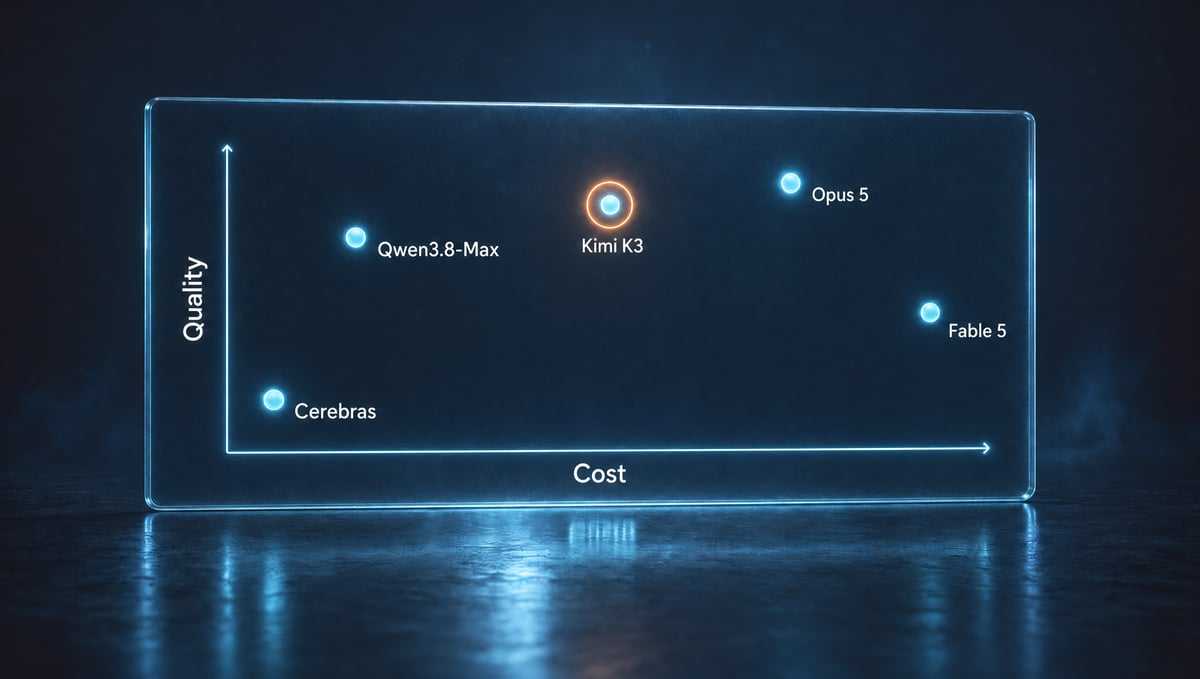
The map above is from the August version. Its logic still holds, with the names swapped: Opus 5.5 at the top, Sonnet 5.5 as the best balance, Qwen3.8-Max and Cerebras at the cost floor and Fable expensive with no frontend gain.
The cost that does not show up in the tables
The total cost of a prototype is not the subscription. It is the subscription, plus human time, plus rework, plus the waiting time between iterations. Each model attacks a different part of that bill:
- Opus reduces rework, because it makes fewer mistakes in consistency and instructions;
- Cerebras shortens the wait, because it iterates in seconds;
- Qwen makes volume cheaper, because it produces the repetitive parts for a fraction of the price;
- Fable avoids architectural dead ends in the rare cases where everything else has failed.
It is this complete bill that justifies building a stack instead of picking a single winner.
The X-Apps stack in four steps
After testing each platform on its own, we arrived at a layered cycle:
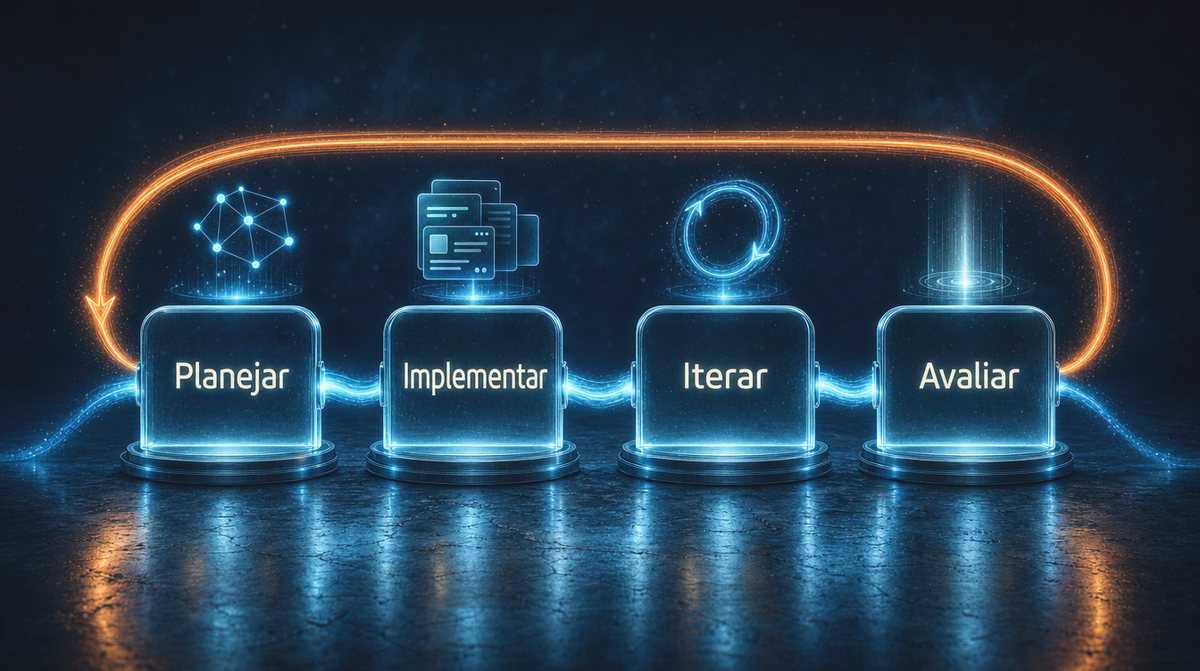
- Plan with Opus 5.5. Interpret the brief, define the architecture of screens, states, components and design system. This is the step that determines how much rework there will be later.
- Implement with Qwen or Cerebras. The skeleton, CRUDs, variations and scaffolding come from the cheap models, following the plan from the previous step.
- Iterate with Cerebras. Adjustments, fixes and experiments in cycles of seconds, without interrupting the review session.
- Evaluate with Opus 5.5. Visual judgment, consistency review and final approval of everything that will be presented.
Fable 5.2 stays outside the cycle, called in only when a problem resists all four steps. When the budget cannot cover Opus in every round, Sonnet 5.5 can take over planning for internal pieces, and Opus keeps the final evaluation.
In practice: Opus decides what should change. Cerebras implements how to change it, at high speed. Qwen generates the variations. This orchestration is what separates a company that uses AI from one that gets the most out of it.
Which to choose based on your budget
If the decision is for a single tool, the budget defines the answer:
| Monthly budget | Recommendation | Why |
|---|---|---|
| Up to US$ 20 | Alibaba's Token Plan Standard (US$ 18) | Hard to beat on price. Ideal for first versions, CRUDs and dashboards. |
| About US$ 40 | Claude Sonnet 5.5 through the API | Second place on WebDev, 98% of the leader's score, 1M context and US$ 4 per reference prototype: about ten prototypes a month. |
| About US$ 100 | Claude Max | A prototype shown to a client calls for Claude, and the plan includes Opus 5.5 and Fable up to half of the weekly limit. |
| About US$ 200 | Claude Ultra | At this level, the bigger allowance, with no 5-hour limit, and Opus's consistency pay off. |
Once there is a recurring volume of projects, the combined stack costs less than any single subscription used for everything: the expensive model is reserved for where it changes the result.
From prototype to product
A well-made prototype validates the idea, flow and interface in days. It does not validate architecture, security, scale or integration with the rest of the operation, and that is where most AI projects get stuck. The full path, with what changes between the demo and the system in production, is detailed in from prototype to product in production.
AI does not replace design and engineering experience: it amplifies it. A model generates code faster, but it still needs someone who knows what to ask for, how to evaluate the result and when to switch tools. That is the expertise that turns AI output into a product that works.
Further reading
- Claude Design, Figma and Canva: which delivers the most quality in graphic design
- Built an app with AI? The path from prototype to product in production
- Cerebras and ultra-fast inference with open models
References
- LMArena Code Arena, WebDev leaderboard, public dataset lmarena-ai/leaderboard-dataset, leaderboard of November 9, 2026
- Anthropic, API pricing table and models overview
- Claude, subscription plans
- Kimi API, inference pricing and Kimi subscription plans
- Alibaba Cloud, personal Token Plan and Model Studio pricing
- Cerebras, GPT-OSS 120B documentation
- Artificial Analysis, GPT-OSS 120B providers
Benchmarks and prices verified on November 11, 2026, with a PTAX exchange rate of R$ 5.584 from November 10. The model catalog changes fast, so confirm the values in the official documentation before closing a budget. The practical per-criterion assessments reflect the X-Apps team's use in real projects and are flagged as judgment, not benchmark.
Update history
August 4, 2026: original publication, with Claude Opus 5, Kimi K3, Qwen3.8-Max, Cerebras and Claude Fable 5, the WebDev leaderboard and August prices, at an exchange rate of R$ 5.105.
November 11, 2026: WebDev leaderboard redone with the November 9 dataset (Opus 5.5 in 1st with 1,818, Sonnet 5.5 in 2nd, Kimi K3.1 Pro in 10th); reference models switched to Opus 5.5 (US$ 4 / US$ 20), Sonnet 5.5, Fable 5.2 (US$ 8 / US$ 40) and Kimi K3.1 Pro (US$ 2 / US$ 10); the best-value API role moved from Kimi to Sonnet 5.5; Claude plans updated to Max and Ultra; Kimi's August plans marked as legacy; Alibaba's Token Plan Pro price updated from US$ 68 to US$ 43, after a reduction announced by Alibaba; the 3,000 tokens per second are now attributed to Cerebras, alongside the independent measurement by Artificial Analysis; costs in reais redone with the PTAX of R$ 5.584.
Frequently asked questions
On the LMArena Code Arena WebDev leaderboard published on November 9, 2026, Claude Opus 5.5 leads with 1,818 points, followed by Claude Sonnet 5.5 with 1,774. As a single tool with the best value through the API, Sonnet 5.5 delivers second place for half the price of Opus 5.5. For a mature operation, the answer is not one model but a combination: Opus to decide, fast and cheap models to generate volume and iterate.
On the LMArena WebDev benchmark, no. On November 9, 2026, Kimi K3.1 Pro scored 1,688 points, 130 below Opus 5.5. In August, Kimi K3 was 29 points behind the leader at the time, Opus 5, but Anthropic's new generation pulled ahead. K3.1 Pro costs half as much as Opus 5.5 per token, the same price as Sonnet 5.5, which scores above it.
As a default, no. Fable 5.2 costs twice as much as Opus 5.5 per token, US$ 8 versus US$ 4 for input, and on WebDev the previous version, Fable 5.1, scores below Opus 5.5, with 1,745 versus 1,818. It pays off as an exception: architectural bugs that Opus could not solve, broad refactors and long sequences of steps with agents.
In subscriptions, Alibaba's Token Plan Standard, at US$ 18 per month with access to Qwen3.8-Max, is hard to beat. In APIs, Cerebras delivers the lowest cost in the comparison, about US$ 0.50 per reference prototype. Cerebras advertises about 3,000 tokens per second on GPT-OSS-120B; the independent measurement by Artificial Analysis is lower, but still puts it as the fastest provider of that model. Visual quality is average.
It is a public benchmark in which people compare, side by side, web pages and applications generated by AI models and vote for the best one, without knowing which model produced each. By August 2026 it had already accumulated more than 510,000 votes, which makes it the most relevant public gauge of AI-generated frontend quality.
Not directly. The prototype validates the idea, flow and interface in days. To become a product it needs architecture, security, testing, infrastructure and integration, which is the engineering work that turns a demo into a reliable system.