Índice do artigofaltam 8 min de leitura
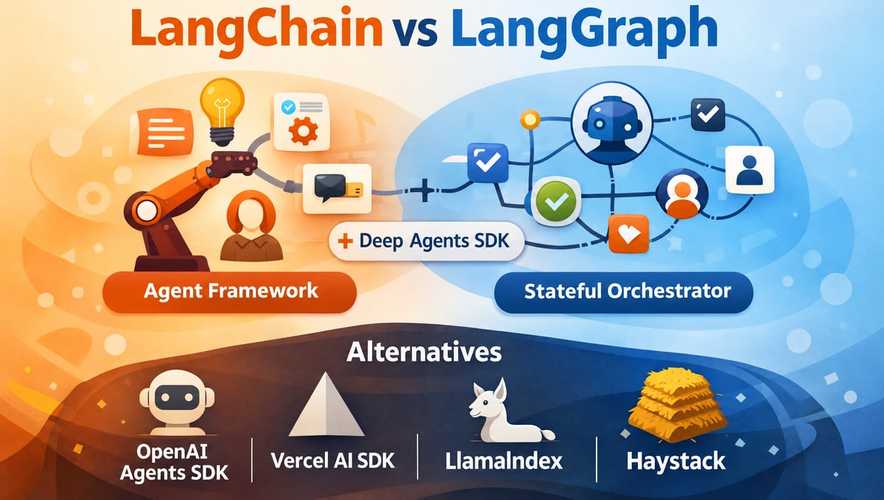
"LangChain and LangGraph are not competitors. They operate at different layers of the same agent architecture."
If you are searching for LangChain, LangGraph or LangChain vs LangGraph, the real question is rarely just conceptual. It is architectural: which technology speeds up delivery today without compromising reliability when the agent leaves the proof of concept and goes into production?
The short answer is this: LangChain is the framework and ergonomics layer; LangGraph is the orchestration and runtime layer. In mature teams, the two often coexist. You start with ready-made abstractions in LangChain and turn to LangGraph when you need explicit state, checkpoints, memory, loops, branching, human-in-the-loop and long-running workflows.
This guide was written to clearly answer the most common searches about these technologies: what LangChain is, what LangGraph is, what the difference between LangChain and LangGraph is and when to use each in production.
What you will learn
- What LangChain is and what LangGraph is.
- How the two technologies relate in practice.
- When to use LangChain, when to use LangGraph and when to use both.
- How to think about architecture, state and observability in AI agents.
- Which mistakes to avoid when designing agentic workflows in production.
Short answer: LangChain vs LangGraph
If you need an objective answer to make a quick stack decision, use this rule:
| Scenario | Most natural choice |
|---|---|
| I want to build an agent with tools quickly | LangChain |
| I want a stateful runtime with fine control of the flow | LangGraph |
| I want to start fast but keep a path to production | LangChain on top of LangGraph |
| I need loops, branching, human approval and resumption | LangGraph |
| I need planning, subagents and a file system | Deep Agents on top of LangGraph |
The best way to think about the current ecosystem is in layers:
Application / API / UI
        ↓
LangChain (agents, tools, models, middleware)
        ↓
LangGraph (state, nodes, edges, checkpoints, durable execution)
        ↓
Persistence, observability and deployment
What LangChain is
LangChain is a high-level open source framework for building applications and agents with LLMs. Its value lies less in "inventing a runtime" and more in standardizing the development experience: integration with models, tools, structured output, middleware, memory, retrieval and agent loops.
In practice, LangChain is strong when you want to:
- get a working agent up quickly;
- connect models and tools without building much infrastructure;
- switch providers with less coupling;
- keep a relatively stable development API;
- evolve from a simple flow to a more sophisticated agent without rewriting everything from scratch.
In the current ecosystem, the create_agent abstraction is the most important entry point. It delivers a production-ready agent, with a tool loop and support for extensions. The technical point many people miss is this: the agent created with LangChain already runs on top of LangGraph. In other words, LangChain gives you ergonomics; the runtime underneath is still graph-oriented.
What LangGraph is
LangGraph is the low-level runtime and orchestration framework of the LangChain ecosystem for stateful agents and long-running workflows. It was designed for people who need to control the execution flow explicitly.
Instead of thinking only about an "agent loop", you start modeling the system as a graph:
- nodes represent processing steps;
- edges represent transitions;
- state carries context between steps;
- checkpoints let you pause, resume and inspect executions.
This model becomes especially valuable when the flow stops being linear and starts requiring:
- conditional branches;
- controlled retries;
- deterministic validations;
- human review;
- short- and long-term memory;
- durable execution across multiple interactions.
Another important differentiator is that LangGraph treats memory as part of the runtime architecture. Short-term memory lives in the thread state and can be persisted via a checkpointer; long-term memory can be stored and retrieved across sessions. For enterprise applications, this makes a real difference in reliability, auditing and user experience.
LangChain vs LangGraph: what is the real technical difference?
The most useful comparison is not "which is better?", but at which layer of the problem each technology works.
| Criterion | LangChain | LangGraph | What this changes in practice |
|---|---|---|---|
| Abstraction level | High | Low | LangChain speeds up the start; LangGraph gives fine control |
| Mental model | Agent and components | Graph, state and transitions | LangGraph requires thinking in explicit workflows |
| State | More abstracted | Explicit and persistent | LangGraph is better for durable flows |
| Loops and branching | Less visible | Native to the flow design | LangGraph handles non-linear behavior better |
| Human-in-the-loop | Available via the underlying runtime | Central to the design | Human approval feels more natural in LangGraph |
| Learning curve | Lower | Higher | LangChain is better for initial adoption |
| Ideal use case | Fast tool calling, copilots, simple automations | Complex orchestration, multi-agent systems, auditable workflows | The choice depends on how critical the flow is |
The most precise way to sum it up is this:
- LangChain answers the question: "How do I build an agent quickly and with good ergonomics?"
- LangGraph answers the question: "How do I operate a complex agent with state, control and predictability?"
LangChain vs LangGraph for RAG and multi-agent systems
Many searches about these technologies happen in the context of RAG and multi-agent systems, so it is worth separating the scenarios.
LangChain vs LangGraph for RAG
If your case is classic RAG (retrieve documents, build context and generate an answer), LangChain usually handles it very well. You gain implementation speed and enough integrations to ship a first product with little friction.
But when the problem evolves into agentic RAG, LangGraph starts to make more sense. Examples:
- the agent decides whether to retrieve context or answer directly;
- the flow tries one retriever, validates the answer and falls back;
- there is a review step before the final answer;
- the system needs to keep state across long interactions;
- there is a need for retries, routing and auditing.
LangChain vs LangGraph for multi-agent systems
For experiences with multiple specialist agents, LangGraph tends to be the better foundation. This is because multi-agent is rarely just "one agent calling another". Usually there is:
- context handoff;
- isolation of responsibilities;
- routing rules;
- state synchronization;
- approval or stop points.
In this kind of design, modeling the flow as a graph tends to be clearer and safer than hiding the complexity inside prompts.
When to use LangChain
Use LangChain when the main goal is speed with enough flexibility.
It is a strong choice for:
- MVPs and proofs of concept;
- agents with few tools;
- internal copilots;
- LLM-assisted automations;
- applications that do not yet require an explicit state machine;
- teams that want to start fast and learn the domain before investing in heavier orchestration.
It is also the right choice when the team is still answering basic questions like:
- which tools the agent really needs;
- where the context bottlenecks are;
- which provider/model delivers the best cost-benefit;
- which steps truly need to be deterministic.
In short: do not start complex without a reason. If the problem is still simple, LangChain is usually the best entry point.
When to use LangGraph
Use LangGraph when your main concern is operational control and reliability in production.
It stands out when you need:
- a workflow with multiple steps and explicit rules;
- durable execution in long tasks;
- pause/resume between calls;
- persistent memory;
- human validation before executing sensitive actions;
- hybrid orchestration between deterministic logic and model reasoning;
- supervision of specialized agents;
- clearer traceability of the system's state.
In practice, LangGraph is the natural path for cases like:
- customer service with strict policies and approval;
- agents that operate tickets, documents or internal processes;
- research and synthesis pipelines with multiple phases;
- agents that need to resume work after interruptions;
- flows with more demanding auditing, governance and observability.
Where Deep Agents comes in
Today, the LangChain ecosystem has a relevant third layer: Deep Agents.
It does not replace understanding LangChain and LangGraph, but it adds a more batteries-included experience for complex tasks. It is useful when you want capabilities such as:
- planning;
- a task list;
- subagents;
- a virtual file system;
- context management;
- more robust memory.
If LangChain speeds up the start and LangGraph gives you the runtime, Deep Agents acts as an opinionated harness for heavier scenarios.
Recommended architecture for production
A pragmatic architecture for teams that want to evolve without rework usually follows this design:
1. Interface and application layer
Your API, dashboard, chat or integration with Slack, WhatsApp or email stays separate from the agentic logic. This makes testing easier and decouples input channels.
2. Agent layer in LangChain
Use LangChain to compose the model, tools, middleware, structured output and context rules. This is where you gain productivity.
3. Orchestration layer in LangGraph
When a flow becomes critical, extract that part into an explicit graph with state. This is especially useful for processes with validation, retries, human review and multiple steps.
4. Persistence and memory
Define early on what is:
- execution state;
- short-term memory;
- long-term memory;
- business data;
- audit log.
Mixing these layers is one of the most common mistakes in agent projects.
5. Observability and evaluation
Agents without tracing and continuous evaluation become an expensive black box. Use observability from the start to understand:
- which tools are called;
- at what point the flow fails;
- where the cost explodes;
- when the agent gets stuck in a loop;
- which prompts and policies need adjusting.
Example 1: simple agent with LangChain
Below is a conceptual example of a simple agent with tool calling. It shows the kind of problem where LangChain shines.
from langchain.agents import create_agent

def get_order_status(number: str) -> str:
    """Returns the status of an order."""
    return f"Order {number}: being picked"

agent = create_agent(
    model="YOUR_MODEL",
    tools=[get_order_status],
    system_prompt=(
        "You are an operations assistant. "
        "Use tools when you need external data."
    ),
)

response = agent.invoke(
    {
        "messages": [
            {"role": "user", "content": "What is the status of order 12345?"}
        ]
    }
)

print(response)
This pattern is usually enough for many enterprise copilots and light automations.
Example 2: stateful workflow with LangGraph
Now compare it with a flow in which the agent needs to go through generation, review and a conditional decision.
from typing import TypedDict
from langgraph.graph import StateGraph, START, END

class State(TypedDict):
    question: str
    draft: str
    approved: bool

def generate_draft(state: State):
    return {"draft": f"Preliminary answer to: {state['question']}"}

def human_review(state: State):
    # In production, a real approval gate can live here
    return {"approved": True}

def next_step(state: State):
    return END if state["approved"] else "generate_draft"

graph = StateGraph(State)
graph.add_node("generate_draft", generate_draft)
graph.add_node("human_review", human_review)

graph.add_edge(START, "generate_draft")
graph.add_edge("generate_draft", "human_review")
graph.add_conditional_edges("human_review", next_step)

app = graph.compile()

result = app.invoke(
    {
        "question": "Summarize this week's critical tickets",
        "approved": False,
        "draft": ""
    }
)

print(result)
The gain from LangGraph is not "writing more code". The gain is making the flow explicit, making the state visible and preparing the system for interruptions, validations and controlled evolution.
Common mistakes when choosing between LangChain and LangGraph
1. Treating LangChain and LangGraph as rival technologies
This is the most frequent mistake. In practice, they complement each other. An experienced developer often uses LangChain to compose and LangGraph to orchestrate.
2. Starting with LangGraph without a real need
If the problem is still simple, starting at the lowest level can create complexity too early. Not every agent needs a custom graph.
3. Hiding critical logic inside the prompt
When business rules, compliance or approval live only in the prompt, the system becomes fragile. Important steps should become explicit state, transitions or validations.
4. Confusing conversation history with application memory
History does not replace persistent memory, and persistent memory does not replace transactional data. Each layer has a different responsibility.
5. Ignoring observability
Without tracing, metrics and evaluation, you do not know whether the agent is improving or just behaving differently.
Quick decision checklist
- I want to launch a working agent quickly: start with LangChain.
- I need fine control of flow and state: use LangGraph.
- I have multiple steps, retries and human approval: use LangGraph.
- I want planning, subagents and more robust context: evaluate Deep Agents.
- I want a balance between speed and scalability: use LangChain and extract the critical flows into LangGraph.
FAQ
Does LangGraph replace LangChain?
No. LangGraph is the low-level runtime/orchestrator. LangChain remains the framework layer that makes building agents easier.
Can I use LangGraph without LangChain?
Yes. You can use LangGraph directly when you want to control models, tools and flow yourself.
Is LangChain suitable for production?
Yes, especially when the flow does not yet require fine control of state. In addition, LangChain agents already run on top of LangGraph.
When is it worth adopting LangGraph from the start?
When the production requirements are clear from day one: persistence, resumption, human approval, branching, auditing and long-running workflows.
Is Deep Agents mandatory?
No. It is useful when you want a more opinionated layer for complex tasks with planning, subagents and context management.
Conclusion
The best decision between LangChain and LangGraph depends less on personal preference and more on the operational nature of your flow.
If you want implementation speed, a good agent abstraction and freedom to integrate models and tools, LangChain is the natural choice.
If you want operational reliability, explicit state, persistent memory, human-in-the-loop and truly complex workflows, LangGraph is the right foundation.
In most mature teams, the final answer is not "LangChain or LangGraph". It is LangChain to speed up construction, LangGraph to sustain complexity in production.
If your decision has moved past technical research and into product planning, see how X-Apps structures AI agents for companies and AI integrations with MCP, APIs, ERP and CRM with architecture, governance and evolution in production.