Índice do artigofaltam 8 min de leitura
Animating by duration means saying how long the motion takes. Animating by physics means saying how the object behaves and letting the time be the consequence. The choice between the two models decides more about how the interface feels than the library you pick.
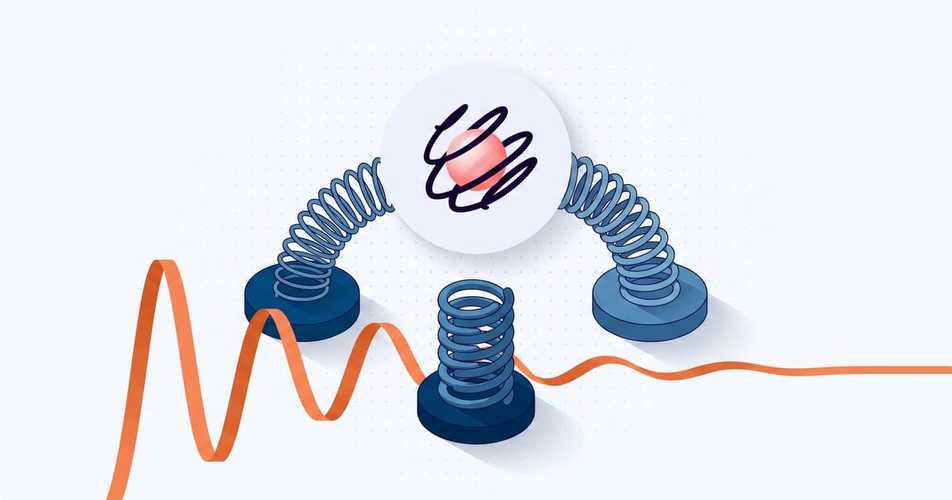
Almost every animation library asks for two things: how long it lasts and what the acceleration curve is. react-spring asks for neither. It asks what the spring's tension is, how much friction there is and what the object's mass is, and the duration of the motion comes from that.
This article explains what that difference changes in practice, where it wins, where it gets in the way, which platforms the library covers and how to interpret the project's maintenance history before putting it into a product that needs to last.
Article summary
- react-spring defines motion by tension, friction and mass, not duration, which makes it strong in interruptible interaction such as drag and drop.
- The library is MIT-licensed and maintained by the Poimandres collective, the same group behind react-three-fiber and zustand.
- In the stable version 10.1.2, the same hooks API serves the browser, React Native, three.js, Konva and Zdog. Version 11, in beta, cuts React Native, Konva and Zdog and keeps web and three.js.
- Maintenance comes in bursts: between October 2025 and April 2026 the repository received three commits, in May 2026 it received 98, in July none, and between September and October another 76.
react-spring animates by physics, not by duration
react-spring is an animation library for React described by its own repository as a cross-platform library that puts spring physics first. In practice, you declare where the value comes from and where it goes, and the library calculates each frame by simulating a spring attached between the two points.
The simplest possible code makes the difference clear: useSpring({ from: { opacity: 0 }, to: { opacity: 1 } }) returns a style object you apply to an animated.div. There is no duration at all in that declaration. The motion ends when the spring stops oscillating.
Duration and springs solve different problems
The real advantage of physics appears when the animation is interrupted midway. If the user drags a card and releases it before the end, a duration-based animation has to decide what to do with the remaining time, and the usual solution is to restart a new animation from the current position, which produces a noticeable jump. A spring does not have this problem: it already carries the velocity of the gesture and continues from there, because velocity is part of the system's state.
The disadvantage is symmetrical and just as concrete. If the requirement is for three elements to enter the scene 200 ms apart and for the sequence to end at exactly 1.2 seconds, physics is the wrong tool. You will keep tweaking tension and friction until you get close to the desired time, when you could have simply written the time.
| Situation | Spring physics | Duration and easing |
|---|---|---|
| Drag and drop | Continues with the gesture's velocity | Needs to recalculate from the position |
| Interruption midway | Redirects without a jump | Chains a new animation |
| Sequence with fixed timing | Time is a consequence, not a parameter | Time is declared directly |
| Syncing with audio or video | Hard to guarantee | Predictable by design |
| Fine-tuning by a designer | Requires understanding three parameters | Curve and time are familiar |
Conceptual comparison between the two animation models, based on the react-spring documentation.
Spring physics loses in three of the five rows, and that is what defines its domain. It is not a superior model to duration: it is the right model for interfaces manipulated by gesture, and the wrong model for anything that needs a clock.
Real adoption lies in the per-target package
There is a reading trap in react-spring's numbers, and it applies to anyone comparing libraries by downloads. The package called react-spring is an umbrella that installs everything, and the documentation itself recommends installing only the desired target. So looking only at the main name underestimates the library by a factor of about five.
Source: npm registry, downloads for the week of November 3 to 9, 2026, and the GitHub API for the pmndrs/react-spring repository, read on November 11, 2026.
With 6.8 million weekly downloads of the web package, react-spring is among the most used animation libraries in the React ecosystem. This matters for a practical reason: when something breaks in production, there is a critical mass of people who have already been through the same problem.
The same API spans the browser, React Native and three.js
In the 10 line, which is the stable one today, react-spring is the only one of the most adopted animation libraries that treats React Native and 3D rendering as targets with their own package, with the same hooks API. The README lists five supported targets, each in its own package.
| Target | What it is for |
|---|---|
| @react-spring/web | Browser, animating styles of DOM elements. It is the package most projects use. |
| @react-spring/native | React Native apps, with the same hooks syntax used on the web. |
| @react-spring/three | 3D scenes via react-three-fiber, animating the position, rotation and scale of objects. |
| @react-spring/konva | 2D canvas graphics via react-konva. |
| @react-spring/zdog | Pseudo-3D illustration via react-zdog. |
Source: official README of the pmndrs/react-spring repository, read on August 28, 2026, and the npm registry, which on November 11, 2026 shows all five packages at version 10.1.2.
For a team that maintains a web product and an app with the same domain code, this reduces an entire category of rework: the animation logic becomes portable along with everything else. The problem is that this advantage has an expiration date.
Releases come in bursts, and that should factor into your decision
react-spring is not abandoned and is not continuously maintained. It is maintained in bursts, and that is the characteristic that should weigh most in the decision to adopt it in a long-lived product. The repository's public history shows the pattern clearly.
-
Last version before the pause
Published on September 18, 2025, at the end of a month with five commits in the repository.
-
Seven months with three commits
One commit in December, one in February, one in March. No version published on npm in the entire period.
-
The burst
98 commits in a single month and two versions published on consecutive days, May 21 and 22, 2026.
-
Stabilization and the next major
The current stable version comes out on June 24, 2026, three days after the first beta of 11.
-
Two months with five commits
No commits in July and five in August, with no new version on npm.
-
Second burst
36 commits in September and 40 in October. The second beta of 11 comes out on October 1, adding usePresence and usePresenceList and marking useTransition as deprecated.
As of November 11, 2026, version 11 had no stable release and the last commit was from October 27. The correct reading of this timeline is not fear, it is planning. If your project depends on quick bug fixes in dependencies, or if you need guaranteed compatibility with the next React version the day it comes out, the burst pattern is a risk to mitigate, either by pinning the version or by keeping an internal fork. If the product's animation is stable and you do not need new features, the pattern is irrelevant: code that works does not stop working because nobody committed in February.
Who maintains it: the Poimandres collective
react-spring belongs to Poimandres, an open source collective that appears on GitHub as pmndrs and maintains some of the most used projects in the React ecosystem, including react-three-fiber, for 3D, and zustand, for state management. This is different from a single-maintainer project, for better and for worse.
On the plus side, the project does not die if one person changes jobs, and the contributor list shows three names with a relevant volume of accumulated work instead of just one. On the minus side, a collective project rarely has someone contractually responsible for responding to issues on a deadline, and the work happens when some maintainer has availability. The burst pattern from the previous section fits this arrangement.
react-spring or a state-driven library: where each one fits
The most frequent comparison is with declarative animation libraries tied to component state. They overlap a lot, and the criterion that really separates them has two axes: how much exact timing matters and how much the user interferes with the motion.
The lower-right quadrant is react-spring's natural territory: a card you drag, a sheet you pull up from the bottom, an item you release halfway that continues with the gesture's inertia. Outside it, there are more direct options, and the lower-left quadrant is the cheapest reminder of all: not every animation needs a library.
When react-spring is not the right choice
Four cases call for something else.
A team unfamiliar with physics. Tuning tension, friction and mass until the interface feels right is trial-and-error work that reading documentation does not solve, and designers used to easing curves have no vocabulary to request adjustments in this model.
Automatic layout animation. Making an element animate smoothly between two positions calculated by the browser, without you declaring the coordinates, is a ready-made feature in other libraries and manual work here.
A project that is not React. The library is built around hooks, and there is no way to use it outside React.
A React Native app meant to last. The 10 line still works, but 11 removes this target and the maintainers themselves recommend Reanimated for animation in React Native. Starting a new app on a version that will have no successor is signing up for a migration.
How to decide
- Does the interface have drag, pull or release gestures? That is the case where physics pays for itself.
- Does any animation need to end at an exact time? If yes, that part should not use a spring.
- Does the product have a 3D scene with react-three-fiber? The same API serves the browser and 3D, in version 11 too. For React Native, only the 10 line works, and 11 cuts that target.
- Can your process tolerate a dependency that goes months without publishing a version? If not, pin the version and plan for maintenance.
If you answered yes to gestures and do not need fixed timing, react-spring is the choice most aligned with the problem. If your product's animation is entrances, exits and screen transitions, there are paths with fewer parameters to calibrate.
Sources and method
The research for this article was done on August 28, 2026, from primary sources. Versions, publication dates and license come from the npm registry and the pmndrs/react-spring repository. Stars, contributors and commit history come from the GitHub API, with the monthly count done over all commits since June 1, 2025. Supported targets and installation method come from the official README. Downloads refer to the week of August 18 to 24, 2026.
November 11, 2026 update: downloads (week of November 3 to 9), stars, versions and commit counts were reread from the npm registry and the GitHub API. The cut of React Native, Konva and Zdog in version 11 comes from the 11.0.0-beta.0 release notes and pull request 2526 in the repository; usePresence and the deprecation of useTransition come from the 11.0.0-beta.1 notes.
No performance tests were run by X-Apps for this article. react-spring and the other projects mentioned are external, with no commercial relationship with X-Apps.
Frequently asked questions
It is an animation library for React based on spring physics, in which motion is defined by tension, friction and mass instead of duration and an easing curve.
Yes. The pmndrs/react-spring repository is under the MIT license, which allows commercial use, modification and redistribution without payment.
The recommendation is to install the target package, such as @react-spring/web for the browser. The react-spring umbrella package still exists in the 10 line, but it stops being published from version 11 onward, currently in beta.
Yes. The stable version 10.1.2 covers react-dom, react-native, react-three-fiber, react-konva and react-zdog, with the same hooks API. Version 11, in beta since June 2026, keeps only the browser and react-three-fiber and drops React Native support.
The Poimandres collective, known by the handle pmndrs, which also maintains react-three-fiber and zustand.
It is not better, it is different. Physics responds well to interaction that can be interrupted midway, such as dragging; duration is more predictable when exact timing matters, as in a choreographed sequence.