Índice do artigofaltam 10 min de leitura
"The third era is not the era in which the agent 'sometimes succeeds'. It is the era in which reliability over longer tasks starts to become operationally relevant."
At some point between 2024 and early 2026, something changed in the way software is built. It was not a gradual change. It was a change of category. And if you work in technology, you have probably already felt the first signs without knowing exactly what to call them.
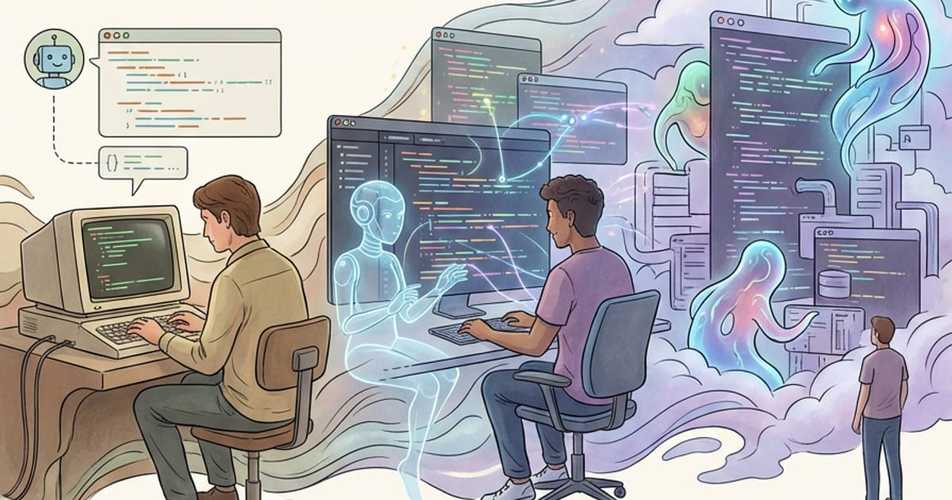
The best way to understand what happened is through a timeline that Michael Truell, CEO of Cursor, laid out publicly: software development with AI has evolved through three distinct eras. The first was autocomplete, the Tab key predicting the next line. The second was synchronous agents, prompt-and-response loops where the AI generated code but the human still had to guide, wait and review at every step. The third, which we are entering now, is the era of Cloud Agents: autonomous agents that run in the cloud, take on complex tasks on their own and work for minutes, hours or even days with minimal human intervention. (Cursor)
This transition does not depend on a single demo or a single tool. It already shows up consistently in publications from Cursor, Stripe, OpenAI and Anthropic, in METR's studies and even in regulatory decisions by the European Union. The discussion is no longer product curiosity: it has become an operational question about how software will be built in 2026.
Let's look at the facts.
The three eras, in context
In the first era, AI was a typing assistant. You wrote code and the model tried to predict what would come next, one line at a time. It was useful but limited, the equivalent of a spell checker for programmers.
In the second era, which is where most teams still operate, the interaction got richer. Tools like Claude Code, GitHub Copilot and Cursor itself in agent mode allowed iterative conversations: you described what you wanted, the AI generated code, you reviewed it, asked for adjustments and so on. The problem is that this dynamic created a new bottleneck. AI started producing code very fast, but it shifted the exhausting burden of reviewing, testing and validating everything it generated onto the human. Verification became the real bottleneck.
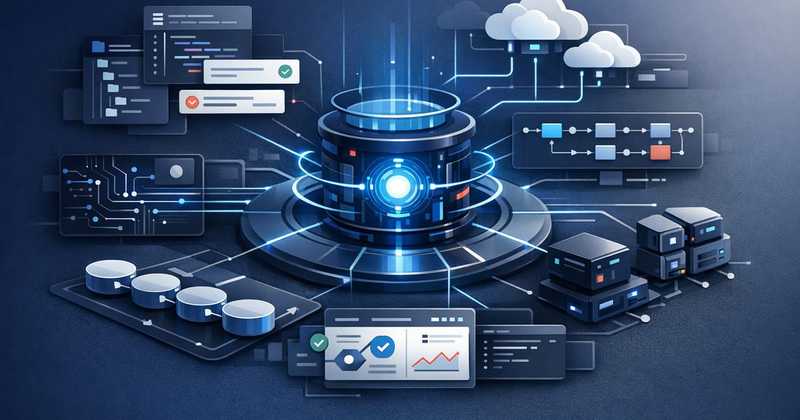
The third era solves exactly this pain. Instead of just generating code and dropping it in the developer's lap, the Cloud Agent takes the task end to end. It clones the repository into an isolated virtual machine, installs dependencies, starts the local server, runs the application and tests the result in practice. What comes back to the developer is not just a code diff, it is a proof of execution: screen recordings, terminal logs, live previews and a Pull Request ready for review.
Cursor's own numbers confirm the speed of this transition. In March 2025, the company had about 2.5 times more Tab (autocomplete) users than agent users. Just over a year later, the ratio had completely flipped: there are twice as many agent users as Tab users, with more than 15x growth in agent usage in a single year. (Cursor)
The Stripe case: thousands of PRs without a single human line
When one of the largest financial infrastructure companies in the world adopts a new way of working, the signal is hard to ignore.
Stripe built an internal system called Minions, "one-shot" coding agents designed to execute tasks end to end. The typical flow starts with a message in Slack and ends in a Pull Request that has already passed CI and is ready for human review. These agents work in pre-warmed virtual environments that boot in about 10 seconds, using the same development tooling that lets human engineers operate at the company's scale. (Stripe Dev)
The result? According to Stripe itself, more than a thousand Pull Requests per week are already produced by this system, without a single line written directly by humans. It is not a lab experiment. It is real production, merged code, running for millions of users.
Stripe went further and introduced the concept of blueprints: workflows defined in code that drive the agent's execution, mixing deterministic routines with more flexible agentic loops. This represents an important turning point: it is not about abandoning structured processes, but about moving them to a more robust and programmable layer.
What the data says, including what is uncomfortable to hear
This is where intellectual honesty matters. The third era is not a synonym for automatic productivity.
METR, an independent organization that evaluates AI capabilities, ran a controlled experiment with experienced developers working on their own open source repositories. The result was surprising: with the AI tools available in early 2025, task completion time increased by 19%. The same organization also warned that many PRs that "pass" benchmarks like SWE-bench would not necessarily be approved in real production. (METR)
This data point does not invalidate the third era, it puts it in context. The technology is advancing fast, but the real gain depends on the system around it: environment, tests, documentation, tooling, processes. That is exactly why understanding the lessons of this new phase matters so much.
Outside software engineering, the push for autonomy has already become an executive topic. IBM reported bringing agentic AI to 270,000 employees, estimating a productivity impact of US$ 4.5 billion. Capgemini reported that the use of agents and multi-agent systems rose from 10% in 2024 to 21% in 2025, with organizations at the deployment stage reporting an average ROI of 1.7x. These are not coding-agent numbers specifically, but they show the discussion has left the lab and entered the budget. (IBM)
1. The real leap is not "writing code", it is extending the autonomy horizon
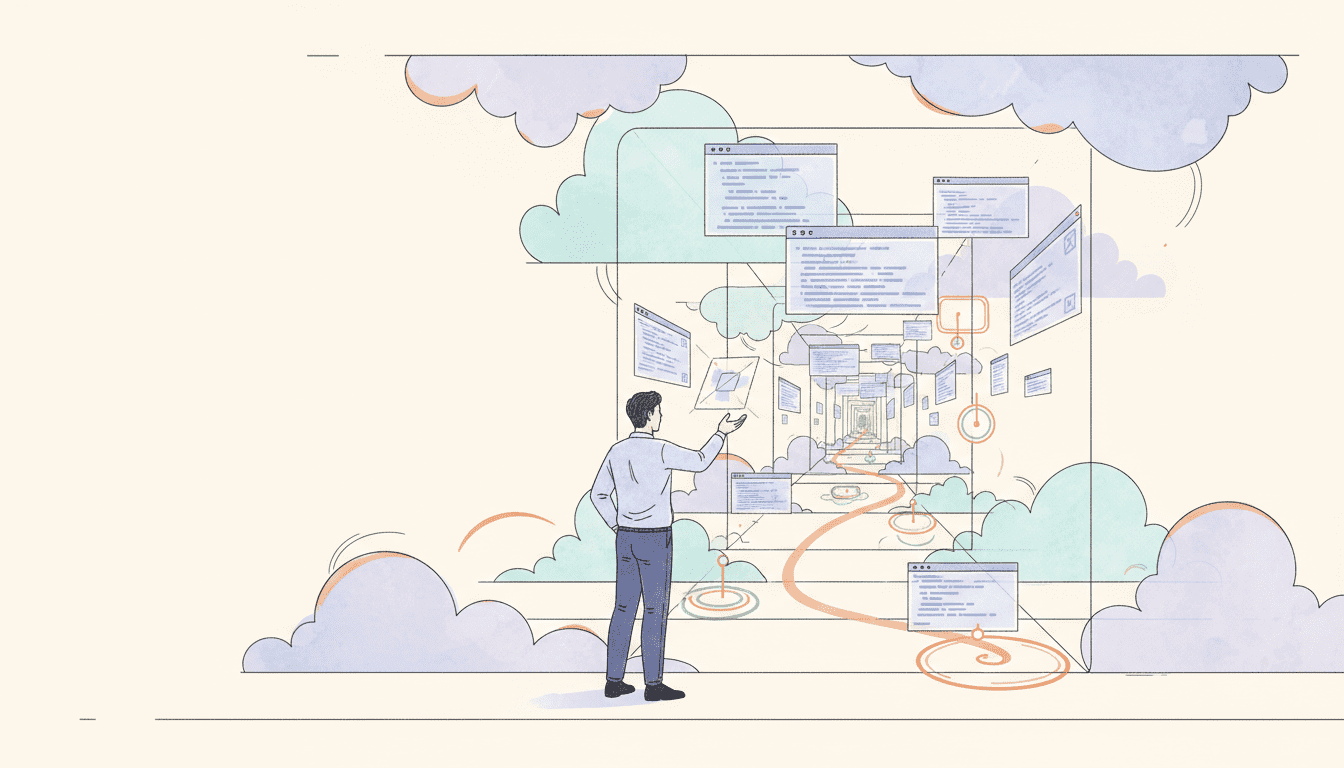
The best way to understand this new phase is not to think about one-off intelligence, but about task horizon: how long an agent can stay coherent, follow the goal, check its own work and recover from errors without losing the thread.
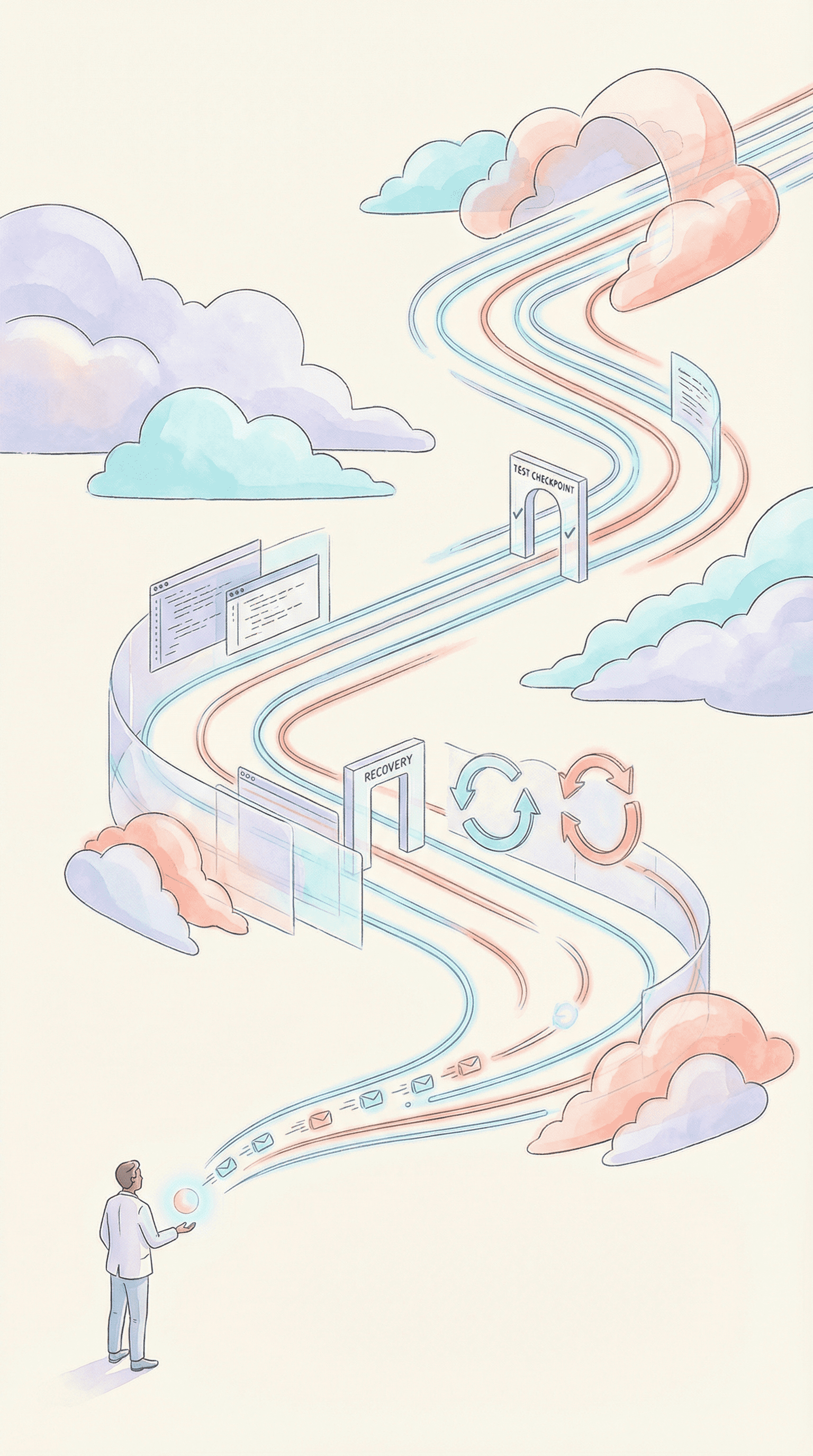
OpenAI demonstrated this in impressive fashion. In February 2026, the company reported an experiment in which Codex received an empty repository, a specification and full autonomy to build a design tool. The agent ran for about 25 uninterrupted hours, consumed roughly 13 million tokens and generated around 30,000 lines of code, sticking to the specification, running checks and fixing failures along the way. (OpenAI Developers)
METR offers the most useful framing to measure this evolution: the task horizon, the length of tasks agents can complete with a given reliability, has been doubling about every seven months. But there is a crucial detail: the horizons at 80% reliability are much shorter than those at 50%. In other words, "succeeding sometimes" is different from "working in an operationally reliable way". (METR)
The practical lesson: teams that still measure AI only by autocomplete quality or how impressive a demo looks are looking at the wrong indicator. The new internal benchmark is not "how many lines the AI suggests", but how long the agent can operate autonomously and reliably.
2. The chat loop is giving way to asynchronous execution with reviewable artifacts
In the second era, the human guided the agent almost step by step. That produced good results, but kept a bottleneck in place: continuous human attention. The third era breaks this by trading long conversations for asynchronous execution with evidence of work.
In practice, what defines this new phase is the agent's ability to receive a goal, work alone for minutes or hours in an isolated environment and come back with auditable evidence of what was done. The point is not one specific demo, but the change of interface: less real-time conversation, more asynchronous execution with proof of work.
Cursor is explicit about the change: synchronous agents require the developer in the loop all the time and compete for resources on the local machine. Cloud Agents remove both constraints by running on their own VMs, iterating for hours and returning with logs, video recordings and live previews instead of just diffs. (Cursor)
OpenAI describes the same pattern in Codex: when it finishes a task, the system delivers committed changes in its own environment and provides verifiable evidence through citations of terminal logs and test results, so the user can audit what was done without depending on a "conversational black box". (OpenAI)
Anthropic is also pushing in this direction. Claude Code already emphasizes multiple tasks in parallel, visual diffs, preview servers, PR monitoring and work across different surfaces: terminal, IDE, desktop and web. The product stops being a copilot sitting next to the editor and starts to look like a dispatch and review center for agentic work. (Anthropic)
The dominant interface for AI programming will not be just chat. It will be the combination of task queues, isolated environments, reviewable artifacts, CI, previews, logs and PRs. Anyone who keeps thinking only about the prompt box will underestimate the transformation.
3. Prompts do not scale; scaffolding does
Perhaps the biggest lesson shared by Cursor, Stripe, OpenAI and Anthropic is this: the differentiator is no longer "writing the right prompt" but designing the right environment.
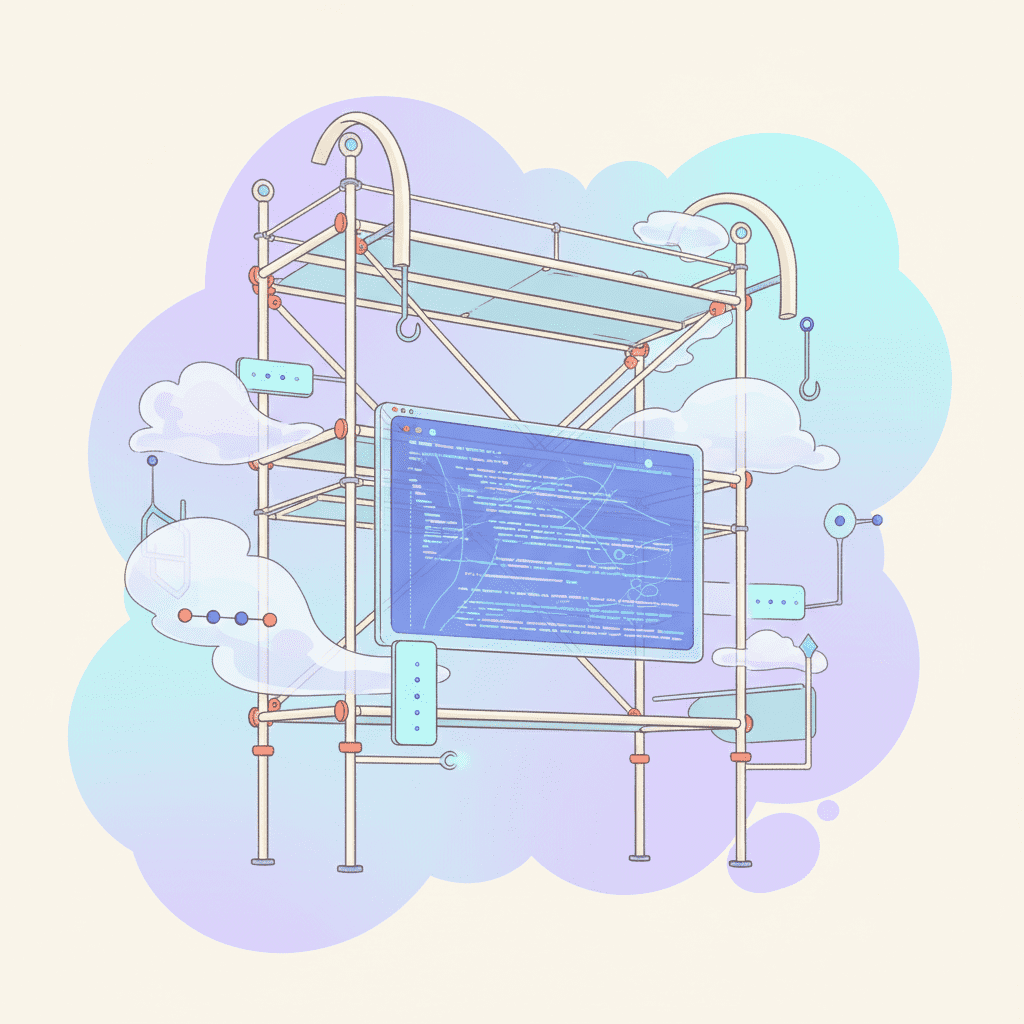
OpenAI reaches this conclusion in its piece on "harness engineering". The company reports that, when building an entire product with a small team backed by Codex, human work stopped being about writing code and became about designing systems, scaffolding and feedback loops. The big problem was not the agent's inability, but an underspecified environment: it lacked the tools, abstractions, internal structure and feedback mechanisms that would make the goal legible and executable. In five months, the repository reached about a million lines of code and about 1,500 PRs with a very lean team, but the gain came from the harness, not from "heroic prompts". (OpenAI)
Anthropic makes the same point, almost bluntly, in its account of building a C compiler with a team of Claudes working in parallel. The author says most of the effort went into designing tests, environment and feedback, and that the verifier had to be almost perfect. Otherwise, the agent would solve the wrong problem. It is an elegant way of putting something many teams still underestimate: autonomy without robust verification only produces speed in the wrong direction. (Anthropic)
This also explains why files like AGENTS.md and CLAUDE.md have become so important. In Codex, AGENTS.md works as a layer of persistent, hierarchical instructions that guides the agent before work starts. In Claude Code, CLAUDE.md, automatic memories, custom commands and hooks play a similar role: turning culture, standards and checklists into reusable operational context. (OpenAI Developers)
The lesson is direct: the "moat" of the third era is not only in the model. It is in the harness. Teams that only buy licenses will experiment. Teams that encode process, tests, tools, instructions and acceptance criteria will scale.
4. The agent only works well on what it can see, test and verify
One of the most important passages OpenAI published this year works almost as an operating principle: from the agent's point of view, what it cannot access in context simply does not exist. Google Docs, Slack messages, tacit knowledge: none of that was visible to Codex. For it to become useful context, it had to be turned into versioned artifacts inside the repository: documentation, schemas, executable plans, rules and architecture maps. (OpenAI)
That lesson led OpenAI to make the application and observability "legible" to the agent. Codex began using Chrome DevTools to inspect and drive the interface, and to work with logs, metrics and traces in an ephemeral local stack. With that, requests like "make sure this critical flow stays under 800ms" stop being just textual intent and become something the agent can measure, test and iterate on.
Anthropic pushes in the same direction with MCP (Model Context Protocol), an open standard to connect AI applications to external data sources and tools in a secure, two-way manner. In Claude Code, this shows up in practice: the agent can read design docs in Google Drive, update tickets in Jira, pull data from Slack or use the company's own tooling via MCP. (Model Context Protocol)
In practice, this means equipping agents with external tools for testing, observability, documentation and issue tracking via MCP, so they can run real flows in the cloud before opening a Pull Request. The core point is not the specific tool, but the ability to turn integrations into a verifiable operational surface.
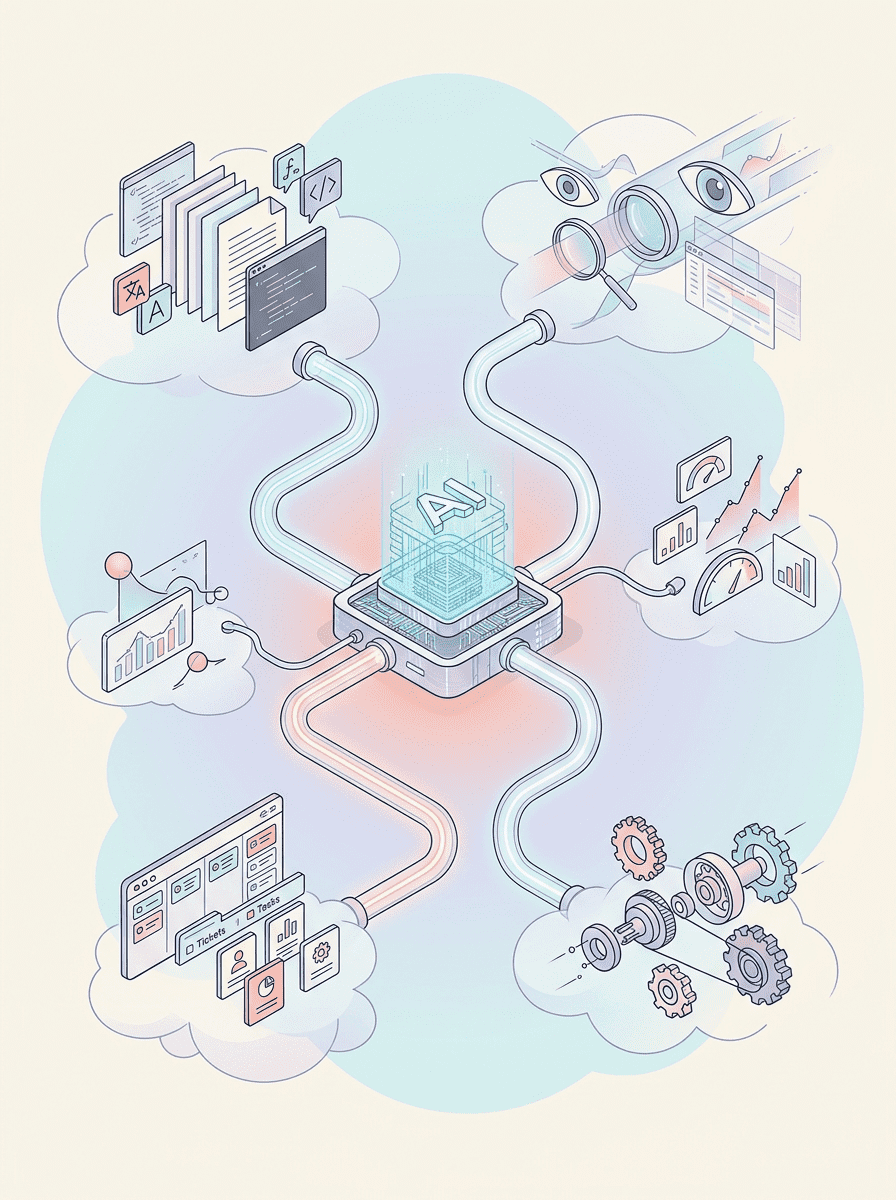
The lesson: the quality of agents depends less on "magic" and more on the organization's ability to turn scattered knowledge into an operational surface. Having a repository is not enough. You need a repository, a toolchain and a context layer that agents can navigate.
5. The engineer does not disappear, they move up a layer
The lazy narrative about AI in software talks about replacement. The correct narrative talks about a shift in the layer of work.
Cursor describes three traits of teams already working in this new mode: agents write almost 100% of the code, humans spend more time breaking down problems, reviewing artifacts and giving feedback, and multiple agents are launched in parallel instead of a single agent being "carried" to the finish line. (Cursor)
OpenAI tells a similar story. In its agent-generated repository, humans stopped contributing code directly, but they did not leave the process. They prioritize work, translate feedback into acceptance criteria, validate results and, when the agent fails, treat that as a symptom of something missing in the system: a tool, guardrail, documentation, rule, linter or context structure. Human work shifts from execution to engineering the system that makes execution reliable. (OpenAI)
This move up a layer comes with a tough demand. Cursor itself warns that, at industrial scale, a flaky test or a broken environment that a human developer would work around locally starts to interrupt all agent runs. OpenAI is also explicit: end-to-end autonomy depended heavily on that repository's specific structure and tooling and should not be assumed to generalize without similar investment.
There is also the regulatory axis. The European Union's AI Act entered into force in August 2024 and applies in stages. The obligations for high-risk systems were postponed by the AI Omnibus package, in force since July 27, 2026. Those for systems listed in Annex III, such as those used in recruitment and selection, were scheduled for August 2, 2026 and now apply on December 2, 2027. Those for AI embedded in regulated products were scheduled for August 2, 2027 and now apply on August 2, 2028. (European Commission; Regulation (EU) 2024/1689, art. 113) The postponement changes the calendar, not the direction: even for companies outside the EU, the more agents write code, handle data and trigger systems, the greater the need for audit trails, permission limits, human review, traceability and open integration standards. (European Commission)
The third era does not reduce the importance of technical leadership. It increases it. The organization that wins is not the one that "lets agents loose", it is the one that knows how to orchestrate them with clear criteria, evidence and limits.
How to start without falling into demo theater
The safest way into this transition is not to try to automate all of engineering at once. It is to start with a narrow, verifiable and repetitive flow.
Choose tasks where the gain is clear and verification is objective. Writing tests for modules without coverage, fixing lint, resolving merge conflicts, updating dependencies, generating release notes, small refactors. This is exactly the kind of work that shows up both in Claude Code's documentation and in Stripe's accounts of where agents perform best.
Treat the repository as an interface for agents. Create and maintain instruction files like AGENTS.md or CLAUDE.md, document architecture decisions, build commands, review criteria and conventions. The goal is not to "explain everything", but to give the agent a reliable map of what matters.
Harden your environment before demanding autonomy. Fragile tests, non-reproducible builds and little observability are not just DevEx problems, they directly sabotage agents. Cursor, OpenAI and Anthropic converge on this point.
Start with asynchronous agents, but keep human review mandatory. Stripe, Cursor and OpenAI converge on the same pattern: strong autonomy in execution, human review at the output.
Measure what really matters. Cycle time, merge rate, rework, escaped defects, review time and number of human interventions per task. The temptation to measure only generated lines or token consumption produces theater, not productivity. The gap between strong benchmarks and mixed real-world results has already shown this.
Conclusion: the factory matters more than the tool
The third era of AI programming does not begin when a model writes an impressive file. It begins when engineering stops treating AI as glorified autocomplete and starts treating it as an operational workforce within a system designed for reliable autonomy.
That is why Cursor and Stripe are such important signals. They are not just saying that "AI codes". They are showing something deeper: that software work is being repackaged around goals, artifacts, harnesses, isolated environments, automated verification and human review at higher layers of abstraction.
The right question from now on is not whether your company will use AI to program. The right question is: will your engineering keep using AI as a reactive tool, or will it build the infrastructure (technical, cultural and operational) that enables truly useful agents?
References
- The third era of AI software development - Cursor
- Minions: Stripe's one-shot, end-to-end coding agents - Stripe Dev
- Enterprise AI Agents: Beyond Productivity - IBM
- Measuring the Impact of Early-2025 AI on Experienced Open-Source Developer Productivity - METR
- Run long horizon tasks with Codex - OpenAI Developers
- Measuring AI Ability to Complete Long Tasks - METR
- Introducing Codex - OpenAI
- Claude Code best practices - Anthropic
- Harness engineering: leveraging Codex in an agent-first world - OpenAI
- Building a C compiler with a team of parallel Claudes - Anthropic
- Custom instructions with AGENTS.md - OpenAI Developers
- Model Context Protocol Specification
- AI Act enters into force - European Commission
- AI Omnibus enters into force - European Commission