Índice do artigofaltam 10 min de leitura
The thesis in one sentence: when a client asks for software, they describe the solution they were able to imagine, not everything their business allows them to build. Whoever builds exactly what was asked delivers a system. Whoever investigates what lies behind the request can deliver a new business.
The scene repeats itself at every software development company: a client arrives with an objective request, along the lines of "I need to turn this spreadsheet into a system". The spreadsheet has existed for years, it works and it supports an entire operation. Everyone there knows it has reached its limit. The quote they want is for digitizing what already exists.
This article was born from a real discovery meeting at X-Apps. The initial request was to turn a risk assessment spreadsheet into a system. In one hour of conversation, the project changed in nature: the form with formulas became the draft of a product with a historical database, automatic recommendations, a monthly subscription and the potential to connect the participants of an entire industry. The client had not asked for any of that, because they had not yet seen it. And that is exactly the point: the brief describes the past of the process, not the future of the business.
In the next sections, we show how to read a request that way: the risk of building literally what was asked, the questions that reveal the product hidden in the process, the difference between digitization and digital transformation, the monetization paths and an evolution roadmap in three horizons, from MVP to platform.
Why so many companies want to turn a spreadsheet into a system
The spreadsheet is the first software of almost every process. It starts as a simple control, gains tabs, formulas and macros, passes from hand to hand and, without anyone formally deciding it, becomes the operational heart of the company. Pricing, vendor evaluation, risk management, team scheduling, commissions: somewhere, each of these processes is running on a spreadsheet right now.
The problem is that a spreadsheet scales up to a point and then starts charging interest:
- parallel versions circulating by email and WhatsApp, with no one knowing which is the official one;
- formulas only one person understands and that break silently;
- no reliable history: each entry overwrites the previous one;
- zero access control: whoever opens the file sees and edits everything;
- no integration with the company's other systems;
- critical business knowledge trapped in cells, with no documentation and no owner.
When the pain gets bad enough, the company looks for someone who builds custom software and arrives with the solution already in mind: reproduce the spreadsheet in screens, with login and a database. It is a legitimate request and, often, it really is the right first step. The mistake is not in the request. It is in treating it as the final specification.
The risk of building exactly what was asked
A brief is a solution hypothesis, not a closed requirement. When the development company accepts that hypothesis without investigating, the result tends to be software that is born outdated: a faithful copy of the spreadsheet, with the same conceptual limitations, now with a project cost.
This path has three problems:
- The value ceiling is low. The system improves the operation with multiple users, permissions and an audit trail, but it still does only what the spreadsheet did. The company pays for development and gets efficiency, when it could get efficiency and an asset.
- The software is born as a permanent cost center. Without a product thesis, every future evolution is an expense. There is no designed path for the system to generate revenue, valuable data or competitive advantage.
- The opportunity cost is invisible. No one misses the platform that was never built. Until the day a competitor, or a startup, launches exactly the product that was hidden inside the client's process.
It is worth saying clearly: not every spreadsheet hides a platform. Many projects really should be a well-done digitization, and this text is not an argument for inflating scope. It is an argument for making that decision consciously, after looking at the second possibility, and not out of inertia.
The questions that reveal the business problem behind the feature
The difference between executing a request and discovering a product lies in the quality of the questions in the first meeting. These are some of the ones we use in discovery sessions:
About the process:
- What happens before the spreadsheet is filled in? And what happens to the result afterward?
- What decision does this spreadsheet support? How much does getting that decision wrong cost?
- How often does the process run and who takes part in each step?
About the knowledge:
- What business rules are encoded in the formulas, weights and classification ranges?
- What exists only in the head of whoever operates it and has never been written down?
About the market:
- Who else has this same problem? Other areas of the company? Other companies? The client's own customers and suppliers?
- If this analysis were a stand-alone service, would anyone pay for it? How much?
In the meeting that inspired this article, it was questions like these that changed the scope. The risk assessment spreadsheet carried, in its formulas and weights, years of expert knowledge. That was not a form: it was proprietary methodology. And proprietary methodology is the classic raw material of a digital product: hard to copy, easy to scale through software and valuable to the whole market facing the same problem.
Digitization and digital transformation: the difference that defines the project
Digitization is reproducing in software a process that already exists, the way it exists. Digital transformation is redesigning the process based on what software makes possible: accumulated data, automation, intelligence and new revenue models. The first improves today's operation. The second creates capabilities that did not exist.
| Question | Digitization | Digital transformation |
|---|---|---|
| What the software does | Repeats the current process in screens | Redesigns the process and creates new capabilities |
| Where the value lies | Operational efficiency | Efficiency, data and new revenue |
| How the value evolves | Stays flat after delivery | Grows with use, because every record feeds the database |
| Role in the budget | Cost center | Digital asset with revenue potential |
| Question it answers | "How do we stop suffering with the spreadsheet?" | "What can this process become?" |
The central point: this choice should be made at the start of the project, with both options on the table. The MVP can, and often should, start with digitization. The difference is starting there knowing where the product can evolve, with an architecture that does not close those doors.
How spreadsheet rules become product intelligence
The transition from spreadsheet to product happens in four moves. Using the risk assessment case as an example:
1. From formulas to a rules engine. The spreadsheet's formulas, weights and ranges become a data model and a versioned rules engine. The methodology stops living in fragile cells and becomes an auditable, testable and evolving component of the software.
2. From data entry to a historical database. The spreadsheet forgets: each entry overwrites the previous one or becomes yet another lost file. The product remembers: each assessment feeds a database that makes it possible to compare operations, track evolution over time and see patterns no cell would show.
3. From result to recommendation. A number on its own, such as "risk 7.2", shifts the work of interpretation to the user. A mature product delivers the next step: which factors weighed most in the result, what to do to improve and how that operation compares with the others. With a structured historical database, AI techniques have ground to work on: case classification, pattern detection and recommendations that learn from the archive. It is the difference between a report and advice, and this is where artificial intelligence solutions applied to the business come in.
4. From single user to network. Every risk assessment has more participants than it seems: who assesses, who is assessed, who requires the assessment (such as banks, insurers, certifiers and large contracting companies) and who fixes the problems identified. When the product starts serving more than one of these roles, it stops being a tool and starts becoming the industry's meeting point. That is the seed of a platform.
An important detail: none of this requires starting with sophisticated AI. It requires a data model that accumulates history from day one and rules kept separate from the code. If AI is on the radar, it is worth reading our guide on AI agents or traditional systems to calibrate expectations.
Monetization: how an internal system becomes a source of revenue
While the software is treated as digitization, the question is "how much does it cost?". When it is treated as a product, a better question comes up: "how much can it earn?". Four models cover most cases:
| Model | How it works | When it makes sense |
|---|---|---|
| Subscription (SaaS) | A monthly fee for access, with plans by company size or by module | The value is continuous and usage is recurring |
| Usage-based billing | You pay per assessment, analysis, report or document processed | Usage is occasional, seasonal or per project |
| Certification | The result becomes a seal, score or report with market value | The market trusts the methodology and requires proof |
| Marketplace | The product connects different sides of the market and charges a commission | There are two sides with an economic interest in meeting |
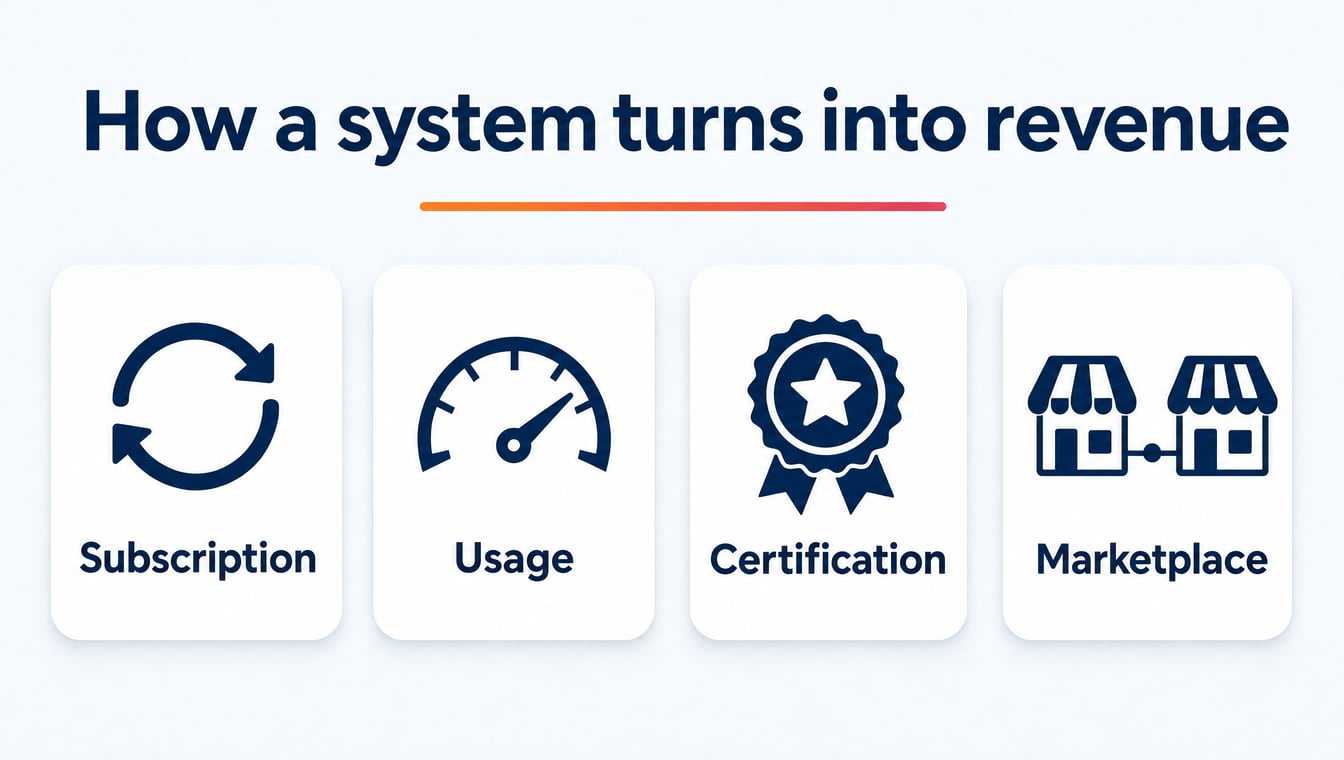
The models are not mutually exclusive; they tend to be phases. In the risk assessment case: the system starts as an internal tool, becomes a subscription for other companies with the same pain, the standardized report gains certification value in the industry and, with assessed companies and solution providers inside the product, a marketplace is born in which whoever has a flagged risk finds whoever solves it. On the financial mechanics of that last phase, we have a specific article on payment splitting and commissions in marketplaces.
A warning from those who have seen this curve up close: monetization is not decided at the end. Billing, plans, usage limits and permissions have a deep impact on the architecture. A system designed without that hypothesis is expensive to turn into a SaaS later.
MVP, product and platform: evolution in three horizons
No one should try to build the whole platform in the first contract. The healthy path is to evolve by horizons, each paying for itself before the next:
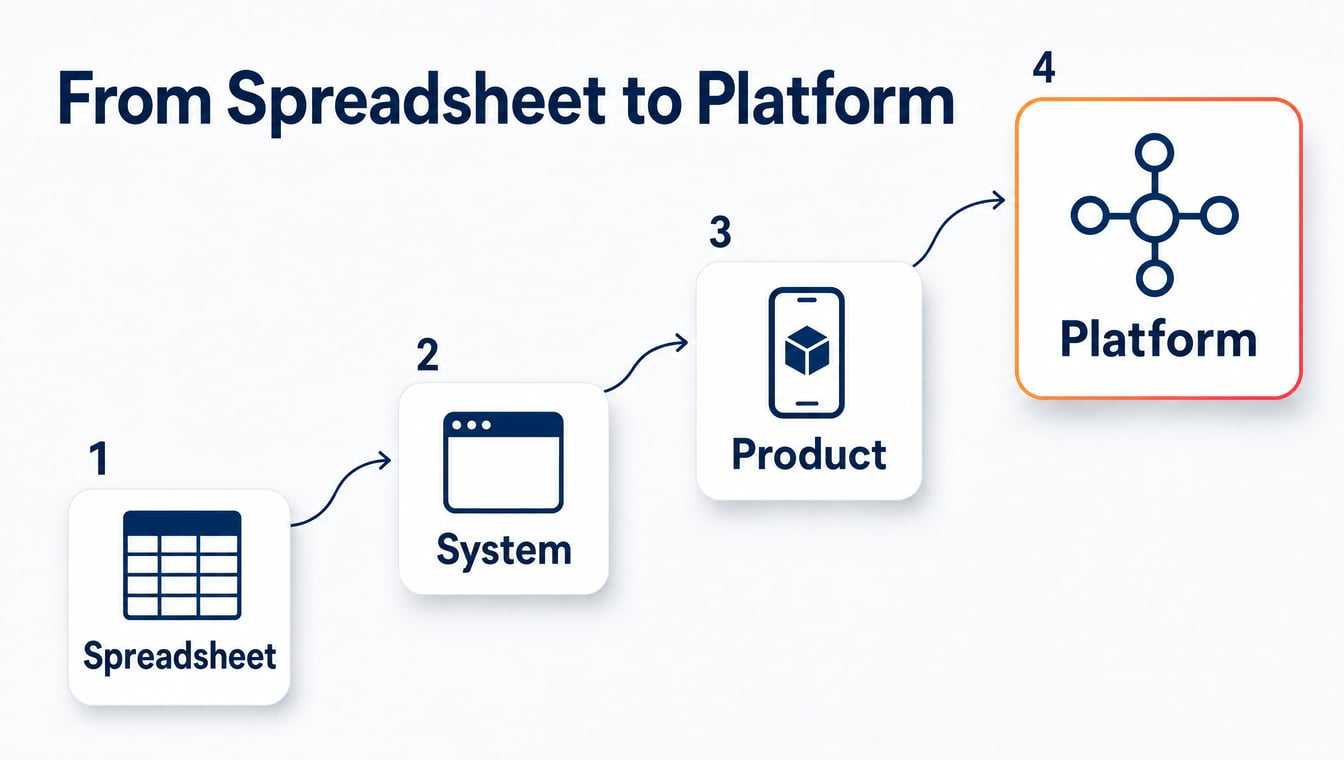
Horizon 1: the MVP that solves the pain. It digitizes the core of the process with quality: the main flow, access profiles and the first reports. It delivers value in a few months and replaces the spreadsheet day to day. The most important silent decision of this horizon is the architecture: history accumulating from the first record, rules separated from the code and a foundation ready to serve more than one organization in the future.
Horizon 2: the product that accumulates intelligence. With the system running and data coming in, comparisons, recommendations, alerts and integrations arrive. This is where the experience starts to justify a subscription, and the software becomes worth more with every month of use.
Horizon 3: the platform that organizes the industry. The product opens up to other participants: the client's customers, suppliers, partners, auditors. An API, cross-organization permissions and network revenue models come in. It is the horizon that turns the company that owns the product into a reference in its market.
The golden rule: horizon 1 needs to fit today's budget without closing the doors to horizon 3. The difference between a disposable MVP and an MVP with a future rarely lies in the initial price; it lies in architecture decisions made by people who have seen the whole movie. On what happens when that foundation is neglected, it is worth reading an AI project without architecture.
The consultative role of the team that builds the software
There is a practical difference between hiring a dev shop that just executes and hiring a product partner. The dev shop asks "what do you want us to build?". The partner asks "what problem are we solving and what business could be born from it?". Both questions produce similar quotes at the start and completely different results three years later.
In practice, consultative work shows up in concrete deliverables before development:
- a discovery session that investigates process, knowledge and market, not just screens;
- a clickable prototype that materializes the product vision before writing code;
- a roadmap by horizons, with the MVP sized for the current budget;
- an estimate that talks about return and break-even, not just hours and features;
- architecture decisions justified by the product's future, not by present convenience.
That is how we structure projects at X-Apps: the client arrives with a request, and the first deliverable is a product assessment of that request. Sometimes it confirms the original scope. Other times, it changes the size of the opportunity.
Frequently asked questions about turning a spreadsheet into a system
How much does it cost to turn a spreadsheet into a system?
It depends on what is inside the spreadsheet: flows, user profiles, integrations and reports weigh more than the number of tabs. A lean digitization costs a fraction of a complete product with intelligence and billing. The healthy path is to size a horizon 1 MVP and leave the rest for the following phases. For price references, see how much it costs to build an app.
How long does a project like this take?
A well-scoped MVP is usually ready in a few months. What stretches the timeline is not the number of screens, but integrations with legacy systems, poorly documented business rules and undefined scope. The discovery and prototype phase exists to reduce exactly these risks.
Should every spreadsheet become software?
No. If the process is unstable, runs only a few times a year, involves a single person or is well served by an off-the-shelf tool, the spreadsheet or an existing SaaS may remain the right answer. The sign that the time has come is the combination of volume, recurring errors, dependence on one person and important decisions supported by the file.
What is the difference between digitizing a spreadsheet and creating a digital product?
Digitizing is reproducing the current process in software, gaining control, history and multiple users. Creating a product is redesigning the process so that it accumulates data, generates recommendations and can be sold to other market participants. The first improves the operation; the second creates an asset.
Do I need to abandon the spreadsheet all at once?
No, and you generally should not. A healthy migration happens in phases: the system takes over the main flow, imports the relevant history and coexists with the spreadsheet at the edges until each function has been absorbed. Cutting everything at once creates team resistance and unnecessary operational risk.
How do I know whether my internal system can become a SaaS?
Three strong signs: other companies have exactly the same pain; your way of solving it carries a proprietary methodology that is hard to copy; and the data accumulated through use becomes more valuable every month. If all three show up, it is worth designing the product thesis and testing willingness to pay before investing heavily.
Don't no-code tools or AI solve this more cheaply?
For validating hypotheses and automating simple flows, yes, and we use these tools when they are the fastest means. For a product with proprietary rules, multiple organizations, billing and scale, cheap can turn out expensive: platform limits, locked-in data and migration rework. We wrote about this balance in vibe coding, AI and the cost of regressions.
Conclusion: the brief is the start of the conversation, not the end
The request to "turn a spreadsheet into a system" is one of the biggest entry points for technology projects in Brazil. Fulfilling that request literally is easy, and that is exactly why so many companies receive software that is correct and irrelevant: a spreadsheet with a login.
The alternative costs one more meeting and a few better questions: what this process decides, what knowledge it carries, who else needs it and what it can become in three horizons. Sometimes the answer is "a good digitization, and that's it". Often, it is a product with a subscription, data and recommendations. Once in a while, it is the platform that will organize an entire industry.
The only way to find out is to treat the brief as a starting point. If your operation runs on spreadsheets, or if you have already asked for a quote for a web application and received back only a list of screens and hours, there may be a whole product waiting for the right question.
What lies behind your spreadsheet?
X-Apps helps companies turn processes, spreadsheets and early ideas into digital products with an evolution and monetization strategy: product discovery, a clickable prototype, a roadmap by horizons and development with an architecture ready to grow.