
Índice do artigofaltam 11 min de leitura
The rule of thumb: interfaces age, and the core should not age with them. App, website and dashboard change their look with every design cycle; business rules, data, authentication and integrations need to last ten years or more. API-first architecture separates these two lives: what the user sees stays light and replaceable, and what the company knows stays concentrated in an API that any new interface, partner or AI agent can consume.
Every week a company comes to us with a similar story: the app launched three or four years ago, the vendor changed, the design aged and the technology of the time went out of fashion. The decision to rebuild comes easily, until the question nobody wants to answer comes up: how much of what was paid for survives the switch?
When the answer is "almost nothing", the problem was rarely the app. It was where the business intelligence lived. If calculation rules, records, permissions and integrations were stitched into the screens, changing the interface means throwing away the entire system and starting from scratch, paying again for what had already been built.
This guide explains the alternative that protects that investment: API-first architecture, in which the company's biggest digital asset is not the app but the API layer that concentrates what the business knows how to do. You will understand what it is, when to adopt it, when not to, and how to migrate without rewriting everything at once.
What API-first architecture is
API-first architecture is the approach in which the system starts from the services layer, not from the screen. Before designing interfaces, the team defines the API contract: which resources exist (customers, orders, contracts, appointments), which operations are allowed, who can perform each one and which rules apply. The app, website, admin dashboard and integrations are built afterward, as consumers of that contract.
In practice, three decisions define an API-first project:
- Business logic lives in the API, never in the interface. The app asks "can I approve this order?" and displays the answer; the server decides. No important rule exists only inside a screen.
- The contract comes before the code. The API is specified in an open standard, such as OpenAPI, and treated as a product: documented, versioned and stable. Frontend, mobile and integration teams work in parallel against that contract.
- Every consumer is treated as external. The company's own app uses the same front door a partner or third-party system would use: with authentication, permissions and limits. This eliminates shortcuts that turn into debt.
This is not an experimental idea. Amazon made this model mandatory internally as early as 2002, when it required all teams to expose data and functionality only through service interfaces, and that decision is cited as the foundation that made it possible to create AWS years later. Stripe and Twilio built billion-dollar businesses in which the entire product is an API. What changed in 2026 is that this logic is no longer exclusive to big tech: it has become a prerequisite for any company that intends to connect AI, new channels and partners to its own system.
The warning sign: when the app concentrates all the logic
The anti-pattern that destroys digital investment has an informal name: the vault app. It is the app (or web system) that keeps inside itself everything the company knows: the discount rule sits in a function of the checkout screen, the registration validation is duplicated in three forms, the ERP integration was built directly from the interface code, and the database is only understood by that code.
This design seems harmless while the product is young. The bill arrives at moments of change:
- Switching vendors leaves you hostage: no other team can reuse what exists, because nothing has a contract, documentation or a clear boundary.
- Launching a second channel (a website in addition to the app, a dashboard for operations, a partner portal) requires reimplementing the same rules, which start to diverge with every adjustment.
- Integrating a new system (CRM, ERP, payment provider, logistics) requires touching the core of the interface, at the risk of breaking what already works.
- Connecting AI simply does not happen: no agent can operate a business whose intelligence exists only in buttons and screens.
- Redesigning, the most mundane change in a product's life cycle, drags along rules and integrations that had no reason to change.
If your company has already paid twice for the same business rule on different platforms, you already know the cost of this model. It does not show up in the proposal for the first project; it shows up in the one for the second.
The API as the company's digital asset
The inversion API-first proposes is almost accounting before it is technical: treat the services layer as the asset, and interfaces as a renewable expense. A well-built app lasts three to five years before it needs a makeover. A well-designed API goes through generations of interfaces intact, accumulating value with every new integration.
What exactly lives in this asset:
- Business rules: pricing, discounts, eligibility, approval flows, regulatory calculations. This is the company's operational knowledge turned into testable code, in a single place.
- Data: the model that describes customers, contracts, products and history, with consistency guaranteed at the point of entry. Data accessible through an API is data any future system can use.
- Authentication and identity: who the user is, how they prove it, single sign-on, tokens, sessions. Solved once, it works for every channel.
- Permissions: what each profile can see and do, enforced on the server. This prevents an access rule from existing "only on the screen", where any malicious client can get around it.
- Integrations: ERP, CRM, payments, invoices, logistics, messaging. Each external connection comes in once and is available to every consumer.
- Automations: scheduled routines, webhooks, queues, events. The system works on its own, without depending on someone logged into an interface.
- Intelligence: models, analytics and, increasingly, the tools AI agents use to carry out real tasks inside the business.
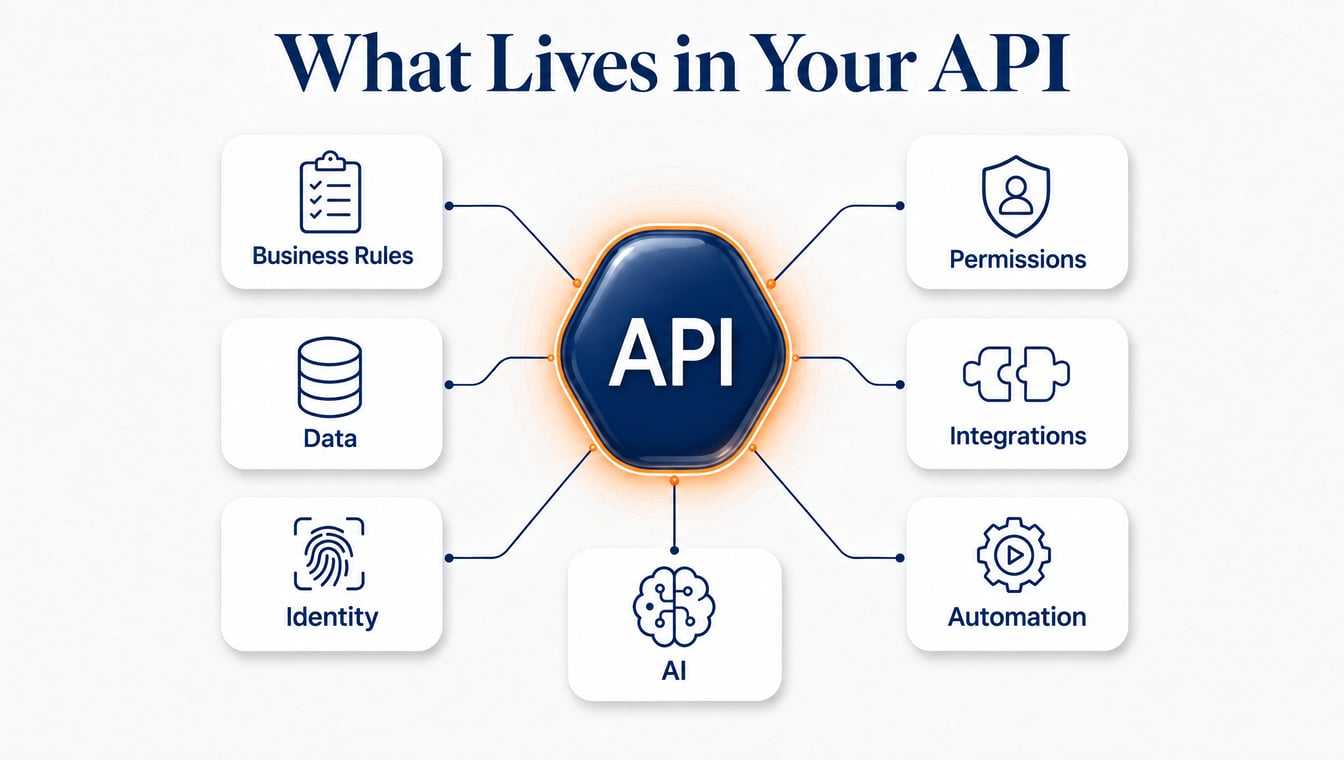
Looking at this list explains the central argument of this article: your first app may change; your business rules and data need to remain usable. When these seven items live in an API with a clear contract, changing the interface is a project of weeks with controlled risk. When they are scattered across screens, it is a rewrite with total risk.
There is also an effect few proposals mention: in due diligence, investors and buyers assess how much of the technology survives the departure of the current vendor. A documented, tested core accessible through an API is an auditable asset that adds value to the company. A tangle of logic trapped in interfaces is a migration liability.
One core, many interfaces: how it works in practice
The resulting architecture is simple to draw: a core of APIs in the center and, around it, consumers plugged into the same contract. The iOS and Android app, the website, the operations admin dashboard, the partner portal, a self-service kiosk and AI agents all make the same calls, each with its own credentials and permissions.
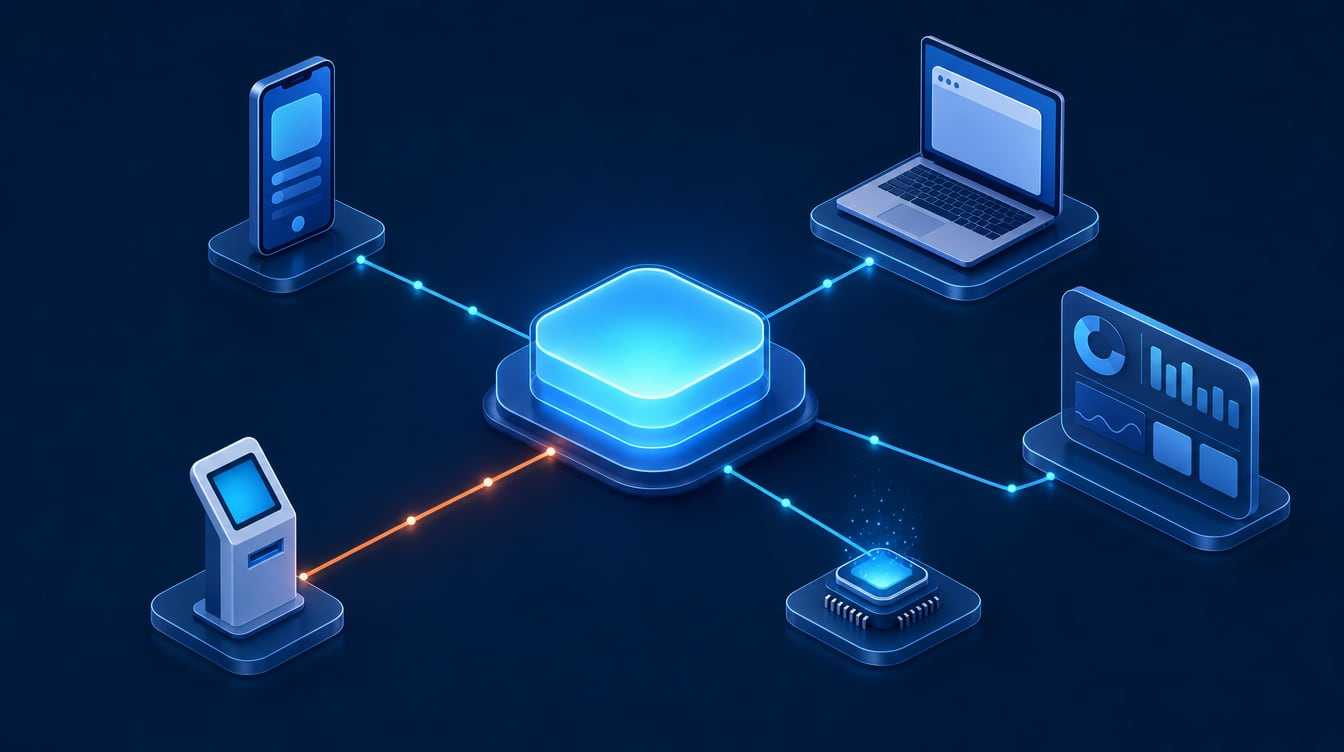
A concrete everyday example: the order the customer creates in the app, the order the call center types into the dashboard and the order an AI agent triggers from a WhatsApp conversation all go through the same API operation. Stock validation, shipping calculation and the discount rule run only once, in the same place, with the same log. If the rule changes on Tuesday, it changes for every channel on Tuesday.
This brings three valuable properties:
- Consistency: there are no "versions" of the same rule diverging between channels.
- Auditability: every relevant action passes through a point with identity, permission and logging. Security and compliance (including LGPD, Brazil's data protection law) are applied in the core, not reimplemented screen by screen.
- Replaceability: any consumer can be rebuilt, modernized or retired without touching the core. The app redesign becomes an interface project, not open-heart surgery.
It is worth naming what API-first is not. It is not a synonym for microservices: a well-organized monolith with a clean API in front of it is API-first, and for most companies it is the right starting point, as we discuss in the guide on architecture for microservices. Nor is it "having an API": almost every system has one. The difference lies in the API being the central product, with a contract, documentation and stability, instead of an improvised appendage of the interface.
API-first and AI: the connection that became urgent in 2026
For years, the argument for API-first was about channels and integrations. In 2026, it gained a second, more urgent chapter: AI agents can only really work in companies whose business is accessible through an API.
An agent that serves customers, schedules services or puts together quotes does not operate by clicking screens designed for humans; it operates by calling tools. That is exactly what tool calling and MCP, the Model Context Protocol exist for, the latter being an open standard that connects AI models to external systems and has been adopted by the leading providers in the market. In both cases, what the model consumes at the end is the same thing: well-defined operations, with a contract, authentication and permissions. In other words, an API.
The practical consequence is direct:
- A company with an API-first core: exposing a safe subset of operations to an agent is a project of weeks. The permissions that already apply to users apply to the agent, the logs already exist, and the team decides at a granular level what the AI can or cannot do.
- A company with logic trapped in interfaces: before any AI initiative, it has to build the services layer that should have existed from the start. The AI project becomes, in practice, a delayed architecture project, a scenario we detail in why AI projects fail without architecture.
That is why treating the API as an asset is no longer an engineer's precaution and has become business strategy: it is the same layer that will receive the next app, the next partner and the next agent. If your company is weighing AI agents or traditional systems, the answer on both paths leads to the same place: a well-designed services core.
What your company gains: business benefits
The table summarizes the difference between concentrating logic in the interface and concentrating it in the API, at the six moments that come up most in the real life of a digital product:
| Business moment | Logic trapped in the interface | API-first architecture |
|---|---|---|
| App redesign or replacement | Near-total rewrite, rules go with it | Interface project, core intact |
| Vendor switch | New team starts from scratch | New team consumes a documented contract |
| New channel (portal, kiosk, partners) | Reimplements and diverges | Plug in one more consumer |
| ERP, CRM, payments integration | Touches the core of the interface, high risk | Comes in once in the core, works for all |
| Adopting AI and agents | Blocked until a services layer is built | Expose existing tools with permissions |
| Audit, LGPD and due diligence | Invisible rules, hard to evidence | Single point with logs, tests and documentation |
There is also a continuous speed gain that does not fit in a table: with the contract defined first, backend, frontend and mobile teams work in parallel, and each new feature is born available to every channel at the same time. Annual industry surveys, such as Postman's State of the API, have been recording this change in mindset: APIs are no longer a technical detail and are now treated as products, with an owner, a roadmap and associated revenue.
When API-first is not the best path
No architecture is free, and recommending API-first for everything would be dishonest. Designing by contract adds an upfront cost in specification and infrastructure that not every project justifies:
- Throwaway prototypes and hypothesis tests: if the goal is to validate an idea in four weeks and throw it away, build the cheapest experiment possible. Formalizing an API contract for something that may not exist next month is waste.
- Internal tools with minimal scope: a souped-up spreadsheet, an internal form or a utility for a single team can live well as a simple application.
- Projects with no prospect of a second channel or integration: rare, but they exist. If the system will never talk to anything, the extra layer pays off little.
The important caveat: truly throwaway is rare. Most "temporary MVPs" that succeed become the company's definitive system, improvisation included. That is why, even in lean projects, we keep two minimal disciplines that cost little: no business rule inside a screen and an API skeleton from day one, even if it serves a single app. It is the middle ground that preserves the option to grow without paying the full price upfront, in line with what we advocate in the pillars of enterprise-scale app development.
How to adopt API-first without rewriting everything: a pragmatic roadmap
The most common objection from those who already have a running system is "I can't stop operations to redo the architecture". You don't have to. The mature path is incremental:

- Map where the logic lives today. List the rules that generate money or risk (pricing, approval, eligibility, regulatory calculations) and mark which ones exist only inside interfaces. This inventory sets the rescue order.
- Design the contract before the next screen. Starting with the next project, every new feature is born with an OpenAPI specification reviewed before development. The contract is the document that survives vendors.
- Centralize identity and permissions. Single authentication and access profiles enforced on the server are the foundation of everything that comes next, including AI.
- Strangle the legacy little by little. With each evolution, move one rule from the interface to the core and make the old screen consume the API. The strangler pattern replaces the risky rewrite with dozens of small, reversible migrations.
- Treat the API as a product. Explicit versioning, published documentation, a test environment for partners and monitoring of who consumes what. An API without usable documentation is a locked asset.
- Prepare the door for AI. With the core in place, defining which operations an agent can perform (and with which limits) becomes a governance decision, not an infrastructure project.
Teams that follow this roadmap usually reap the first return quickly: the internal dashboard or partner portal that previously "didn't fit the budget" becomes viable, because 80% of it already exists in the core.
Checklist: does your next project protect the investment?
Eight questions to ask your team or vendor before signing the next development contract:
- If we replace the app three years from now, what survives intact?
- Where exactly does each important business rule live? Is there any that exists only in the interface?
- Is there a documented API contract (OpenAPI or equivalent) that another team could consume without help?
- Does our own app consume the same API a partner would, with real authentication and permissions?
- How many places need to change when a price calculation changes? The right answer is one.
- Are the ERP, CRM and payment integrations in the core or stitched into some interface?
- Could an AI agent perform an operation of our business today, securely and with a log? What is missing for that?
- If the current vendor leaves tomorrow, does the existing documentation allow another team to take over within weeks?
If three or more answers are uncomfortable, your product's problem is not the next feature in the backlog: it is where its intelligence is stored.
Frequently asked questions about API-first architecture
What does API-first mean in one sentence?
It is the approach in which the system starts from the services contract that concentrates rules, data and integrations, and the interfaces (app, website, dashboard) are built afterward, as replaceable consumers of that core.
What is the difference between API-first and code-first?
In code-first, the team programs first and the API "appears" as a byproduct of the implementation, reflecting internal code decisions. In API-first, the contract is designed and reviewed beforehand, as a product, and the implementation follows the contract. The practical difference lies in who dictates the shape: the consumer (API-first) or the implementation (code-first).
Is API-first the same as microservices?
No. API-first defines how the system is consumed; microservices define how it is divided internally. A monolith with a well-designed API is API-first, and it is usually the right start. Microservices are a possible evolution when scale and teams justify them.
Does API-first make the first project more expensive?
It adds an upfront specification cost, typically small compared with the total, and pays that cost back at the first moment of change: a second channel, an integration, a vendor switch or AI adoption. What really drives cost up is paying twice for the same business rule on different platforms.
My company already has a finished app with the logic built in. Do I need to rewrite it?
Not all at once. The recommended path is the strangler pattern: new features are born in the API core, and existing rules migrate gradually, prioritizing those with the highest value and risk. A full rewrite is the last option, not the first.
What does treating the API as a product mean?
It means giving the API what every product has: an owner, documentation, versioning, a roadmap, a test environment and a stability commitment to those who consume it. It is the opposite of the improvised API that changes without notice and only the original team understands.
Conclusion: the app passes, the asset stays
The question that sums up this guide is not technical: what does your company want to own five years from now? Interfaces will change; that is their nature. Business rules, data, identity, integrations and the tools AI will operate make up the real digital asset, and an asset is kept in a structure built to last: an API with a clear contract, documented and treated as a product.
Those who hire development with this lens change the questions at the negotiating table: they stop comparing only screens and deadlines and start demanding to know where the logic will live, how the contract will be documented and what survives a vendor switch. If you want to keep going along these lines, see our basic guide to APIs for companies for the fundamentals and the comparison of development engagement models to understand how we structure deliveries that preserve this asset.
Want a digital product ready to evolve?
X-Apps designs systems with API-first architecture from the first sprint: a documented rules core, centralized integrations and the door ready for new apps, partners and AI agents. Your investment remains usable with every change of interface, vendor or technology.