

Índice do artigofaltam 8 min de leitura
Article summary
- Gartner projects that by 2028 one in four candidate profiles worldwide may be fabricated, and 6% of the candidates surveyed have already admitted to interview fraud.
- The U.S. Department of Justice documented schemes of remote workers with stolen identities who got jobs at more than 100 American companies.
- Strong verification at the top of the funnel drives good candidates away and does not solve the problem: the right place is before the offer and before any system access.
- The most reliable signal is still an unscripted conversation about concrete work decisions, which is what our own selection process has used since 2021.
For a long time, the question about a candidate was whether they could do the job. For remote roles, an earlier question has appeared, one that sounds paranoid until the first time it happens: does this person exist, and is it really them on the call?
This is not a hypothetical problem. In a Gartner survey of 3,000 candidates, 6% said they had taken part in interview fraud, either posing as someone else or having someone else pose as them. These are people admitting, in a survey, something that is not comfortable to admit. The same firm projects that by 2028 one in four candidate profiles worldwide may be fabricated.
Source: Gartner, projection and survey of 3,000 candidates, published in August 2025.
This article is about where this verification fits in the process, what works and what only creates friction with honest candidates. It complements the other two pieces in this series, on where AI really helps in hiring and on what the law requires when the machine decides.
What is at stake is not a bad hire
The obvious consequence of a fraudulent hire is poor performance. The relevant consequence is something else: a remote employee receives credentials and access to repositories, databases and client systems, usually in the first week.
The U.S. Department of Justice announced coordinated actions against schemes in which people used stolen and fake identities to get remote jobs at American companies. According to the official documents, those involved obtained jobs at more than 100 companies, with help from facilitators in several countries. The actions included searches of 29 laptop farms spread across 16 states, plus the seizure of 29 financial accounts and 21 fraudulent websites.
For software houses, consultancies and any company that places professionals in client environments, this point is even more sensitive. The access granted is not only to your own environment: it is to that of a third party who trusted your due diligence.
Why the funnel went blind right now
Three changes happened at the same time, and the combination is the problem.
The first is that the whole process went remote, from first contact to signing. Nobody sees a document on the desk anymore, and the only evidence that a person exists is an image in a video window.
The second is volume. When each recruiter manages hundreds of applications, the time per candidate drops to a few minutes, and checking does not survive haste. Greenhouse's talent acquisition team reported exactly this: organizations need more interviews to make the same number of hires, because of the amount of spam and fraud in the market.
The third is that the traditional signs of authenticity became cheap to fabricate. A well-written résumé, a complete professional profile with a plausible history, a consistent photo and a social media presence no longer cost anything. The signal has become noise.
- Borrowed identityOne person does the interview, another takes over the work after the hire.
- Someone else's documentReal data from another person, used with consent or through theft.
- Invented historyCompanies and projects that do not exist, or exist without this person.
- Live assistanceSomeone off camera answering the technical questions during the call.
- Fully synthetic profileA person who does not exist, with a fabricated history and digital presence.
- Resold workThe hire gets paid and passes the work on to someone else, without saying so.
Notice that only two of these categories involve image generation technology. Most hiring fraud is still low-tech, and it is fought with process, not with a detector.
Where to place verification without ruining the funnel
The most common mistake is to react to the scare by asking for documents on the first form. This is expensive and solves little. A good candidate, who has other options, abandons an application that asks for an ID card (in Brazil, the RG) before knowing the salary range. And the fraudster, who has invested in the operation, sends the document without hesitation. Early demands filter exactly the opposite of what you want.
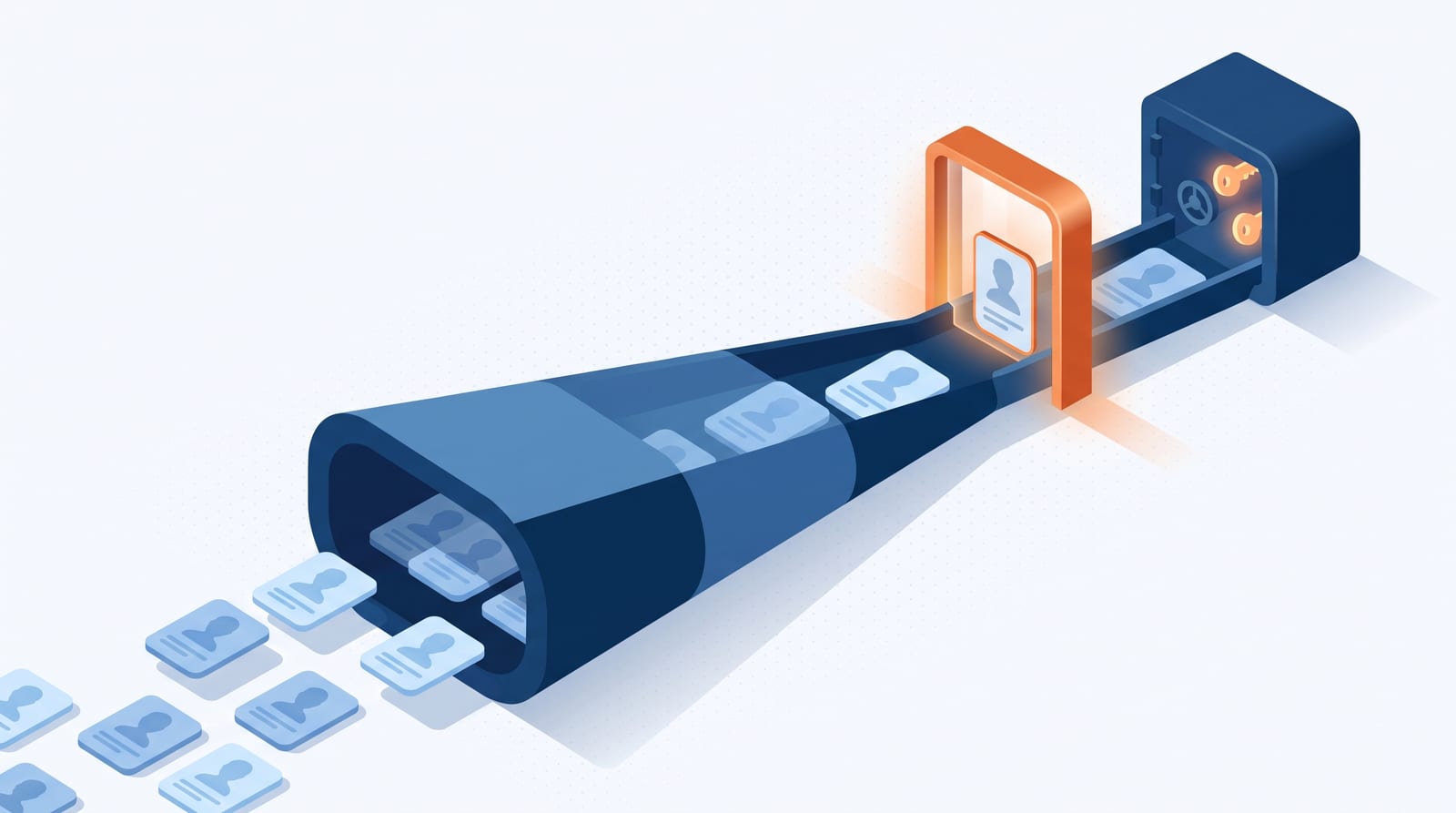
Strong verification belongs at the end of the process, when there is already mutual interest and the demand seems reasonable to both sides.
Early verification
High friction, low protection- Asks for documents from people who do not yet know if they want the job
- Drops conversion at the top of the funnel
- Stores sensitive data from hundreds of people who will never be hired
- Does not bother whoever prepared the fraud
Late verification
Low friction, high protection- The demand comes in when there is already an offer on the table
- Does not interfere with attracting candidates
- Collects sensitive data from only a few people, with a disposal deadline
- Blocks before the credential, which is what needs protecting
This order also solves a data protection problem. Under LGPD, Brazil's data protection law, an ID document is personal data and biometrics is sensitive personal data, which requires a proper legal basis, a stated purpose and a retention period. Collecting late and from only a few people reduces the legal risk of the verification itself, a cost almost nobody accounts for when designing the process.
A conversation about real work is still the hardest signal to fake
Lists of visual clues for manipulated video go out of date with every generation of tools and should not be anyone's main defense. What does not go out of date is how hard it is to sustain, without a script, a conversation about concrete decisions the person claims to have made.
Here our experience helps, because the instrument we have used since 2021 is exactly that. We select developers with a résumé, a self-assessment, a portfolio and a video interview, and what gets recorded from the conversations is always the same thing: how the person explains what they did. Notes like "not very comfortable talking about their professional experience" or "answers directly, without dwelling" only exist because the interview asks for a narrative, not a canned answer.
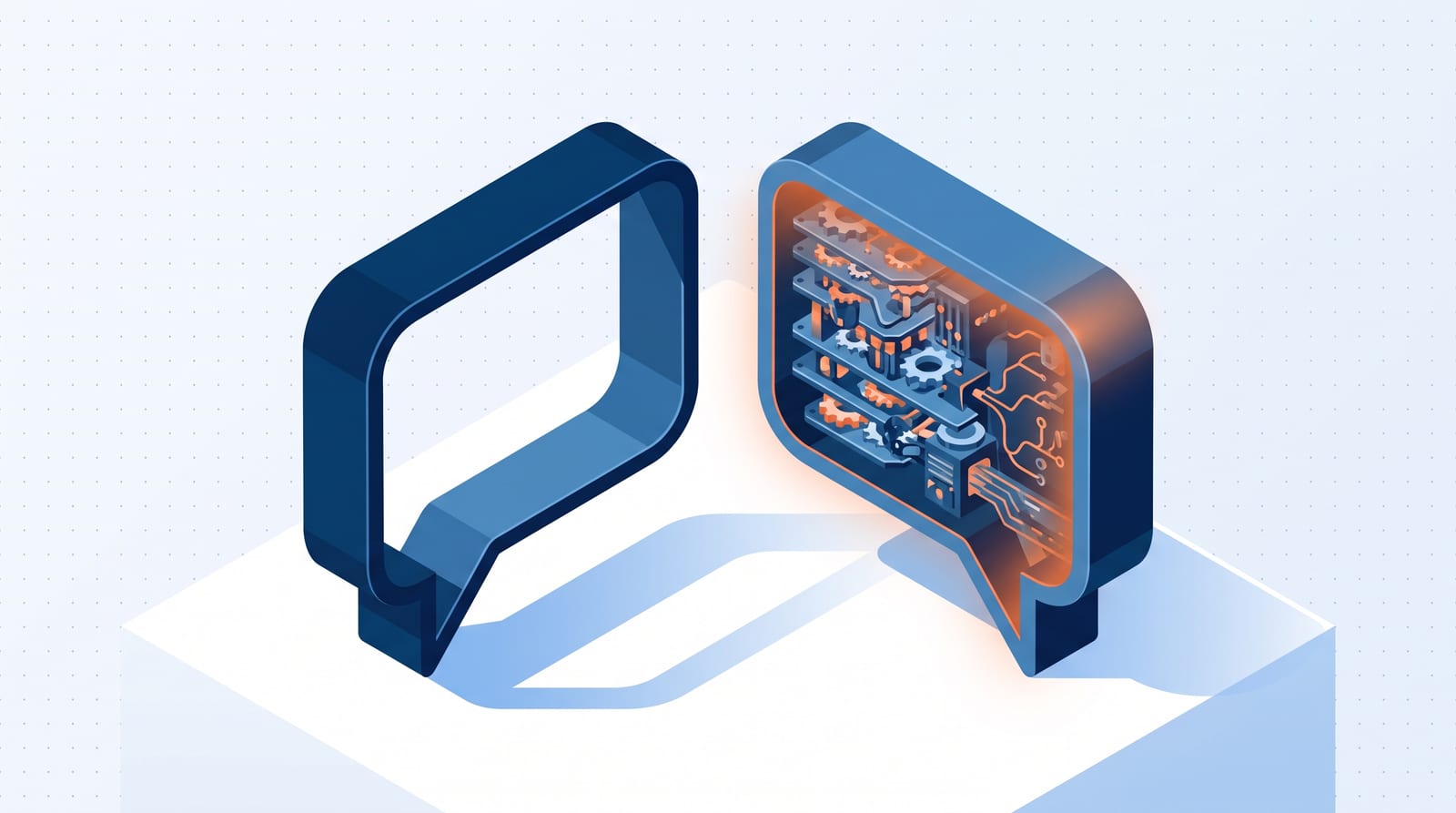
Both answers sound the same in the first sentence. The difference shows up on the third question, when one of them still has something to show inside.
Someone who lived through a project handles the unexpected questions well: why they chose that path, what went wrong in the middle, who disagreed, what they would do differently. Someone who memorized a script answers the first question well and the third one badly.
There is a second instrument, and it is the same one that solves the problem of predicting performance: the work sample. A short task, similar to the real work, followed by a conversation about the decisions made in it, checks competence and authenticity at the same time. Whoever did the work can explain every choice; whoever outsourced it gets stuck on the second question. In our selection, the decision about two finalists in 2025 was recorded in a sentence that sums up this principle: "we need to see it in practice".
Where AI helps, and where it creates a new problem
Separating the two is what decides whether the investment pays off.
It truly helps with consistency checks at scale: cross-checking the declared history against public sources, pointing out contradictory dates, detecting the same résumé text reappearing under different names and flagging mass applications coming from the same pattern. It is repetitive work with a verifiable answer, and it is where automation pays off.
It creates a problem when it becomes an authenticity detector that decides on its own. Two practical reasons. The first is that the false positive rate, even if low, applied to thousands of honest candidates, produces a volume of unfair accusations the company has no way to review. The second is that being rejected on suspicion of fraud is different from being rejected on profile: it is an accusation, with reputational consequences, and sustaining it requires a standard of proof that a score does not deliver.
The design rule that follows is short: an automatic suspicion signal serves to prioritize human review, never to discard. The correct output of this kind of system is "check carefully", not "rejected".
There is also a side effect already showing up in poorly calibrated processes: treating the use of writing tools as a sign of fraud. Writing a résumé with AI help has become standard practice, including among the best candidates. Mistaking that for dishonesty eliminates good people and catches no one.
A plan you can roll out this month
None of this depends on buying software. It is process design, and most of the gain comes from the simplest items.
- Define when verification happens, which should be before the offer and before any credential, never on the application form.
- Make the final interview unscripted, with follow-up questions about specific decisions and about what went wrong in the projects mentioned.
- Include a short work sample, followed by a conversation about the choices made in it.
- Check the consistency of the history against at least two independent sources, for the most relevant positions on the résumé.
- Separate granting access from hiring, releasing privileges in stages over the first weeks instead of everything on day one.
- Write down the disposal deadline for collected documents and stick to it, because the verification database becomes a liability if it is kept.
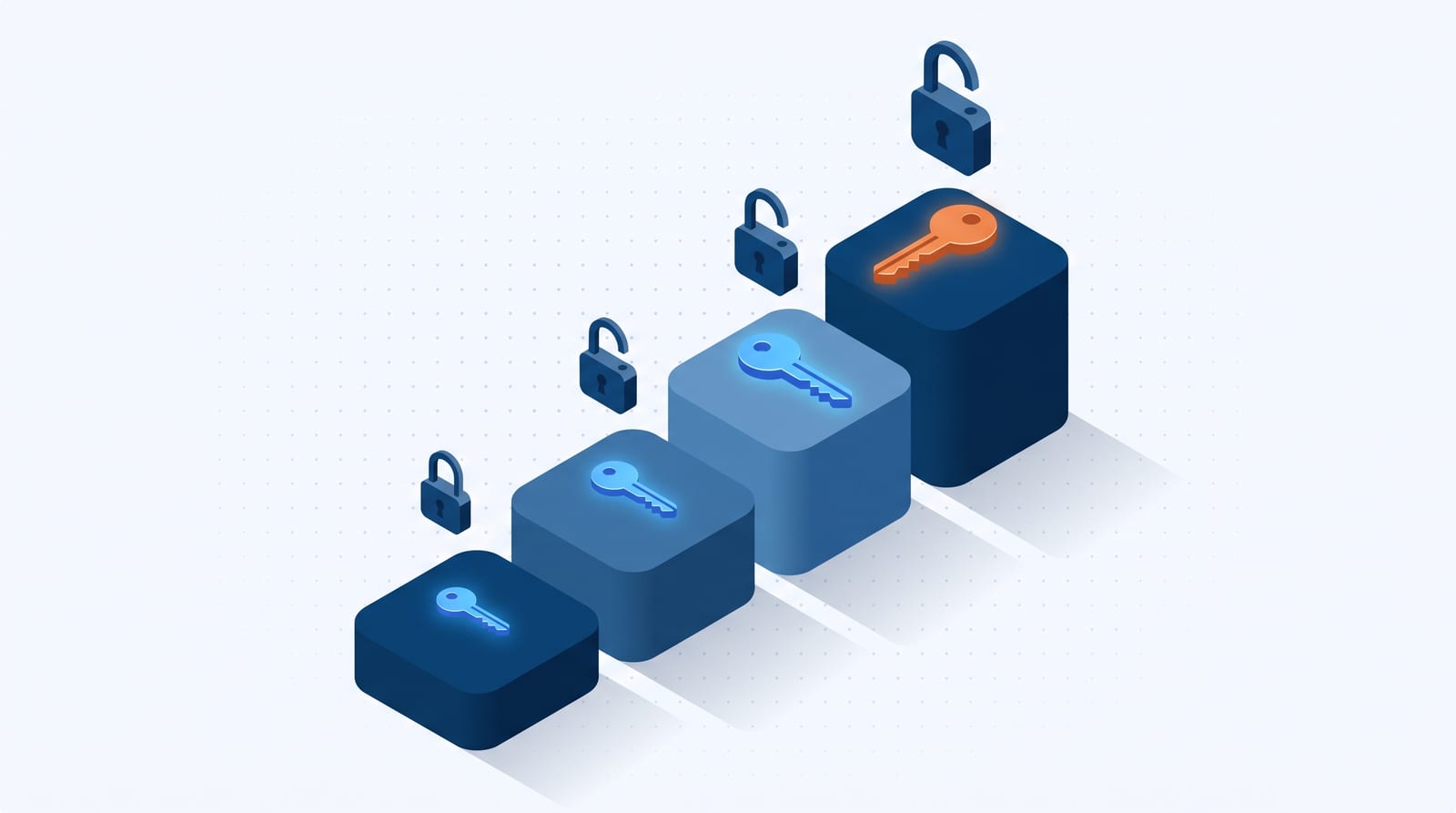
Access does not need to be granted all at once. Releasing it in stages over the first weeks turns what would be an incident into a manageable scare.
Item 5 is usually the most forgotten and the one that protects the most. It does not prevent fraud, it limits the damage when some gets through, which is a possibility any honest process has to consider. Hiring is a decision under uncertainty; treating the first month as part of the verification, and not as a period when everything is already settled, is what separates a scare from an incident.
What changes for companies that hire remotely
The uncomfortable conclusion is that the step of "confirming the person exists" has become part of the funnel, with an owner and a deadline, just like screening and interviewing. It was not there five years ago because the in-person process handled it without anyone noticing.
The good news is that the defenses that work are the same ones that improve hiring quality in general: a real conversation about real work, a practical test, gradual access and a record of what was verified. A company that does this hires better and, as a bonus, becomes much harder to fool.
The weak defense is precisely the easiest one to buy: a detector that promises to tell, with a score, who is authentic. It will be wrong against honest candidates more often than the company can review, and it will turn an unverified suspicion into an automated decision about a person, which is exactly where regulation tightens.
Sources and method
Reporting as of September 1, 2026. The projection of fabricated profiles and the percentage of candidates who admitted interview fraud come from a Gartner survey and projection with 3,000 candidates, published in August 2025. The information about remote worker schemes with fraudulent identities comes from official announcements by the U.S. Department of Justice. The observation about the rising number of interviews because of spam and fraud is from Greenhouse's talent acquisition team, in its March 2026 benchmark report.
The material about our own process comes from X-Apps' internal developer selection records, from June 2021 to January 2026, reproduced without identifying candidates. Gartner, Greenhouse and the companies cited in the American cases are external to X-Apps.
We do not have our own measurement of the incidence of identity fraud in our funnel, and this article does not claim any percentage for the Brazilian market, for which we found no reliable source.
Frequently asked questions
In a Gartner survey of 3,000 candidates, 6% admitted to taking part in interview fraud, either posing as someone else or having someone else pose as them. The firm projects that by 2028 one in four candidate profiles worldwide may be fabricated.
It goes far beyond poor performance. The U.S. Department of Justice documented schemes in which remote workers with stolen identities got jobs at more than 100 companies, with access to systems and internal data.
It does, and that is why strong verification should come at the end, before the offer or before access to systems. The top of the funnel should only have low-friction checks that do not ask for documents or sensitive data.
Visual signs go out of date quickly and should not be the only defense. The content is more reliable: an unscripted conversation about specific decisions in projects the person claims to have done, with unpredictable follow-up questions.
No, and treating it as fraud is a mistake. Using writing tools has become standard practice. What matters is verifying whether the experience described actually happened, not whether the text was written with the help of a tool.
Yes. Under LGPD, Brazil's data protection law, ID documents and biometrics are personal data, and biometrics is sensitive personal data. That requires a proper legal basis, a stated purpose, a defined retention period and disposal, which strengthens the case for collecting late and collecting the minimum.


