

Índice do artigofaltam 8 min de leitura
An agency with 10 clients does not have 10 accounts to run. It has 40, because each client has four networks. The cost calculation starts wrong right there, and everything else inherits the error.
Anyone who runs social media for other people knows the visible math well: the tool subscription, divided by the number of clients, compared with what you charge them. That math almost always works out, which is why it is the only one people do.
The math nobody does is the hours that vanish before any creative work happens: logging into each dashboard, asking for access again because the client changed the password, building the report by copying numbers screen by screen, discovering on Thursday that a client's account disconnected on Monday.
This article lays out both calculations. The price ladder comes from the public documentation of Zernio, a third-party Spanish company founded in 2025, with no corporate relationship to X-Apps, used here because it publishes prices by tier instead of hiding them behind a sales contact.
Article summary
- The billing unit is the connected account, not the client. Ten clients with four networks each are 40 accounts.
- On this ladder, 40 accounts cost US$ 138 per month, which works out to about US$ 13.80 per client. The price per account falls from US$ 3.45 to US$ 1.73 between 40 and 300 accounts.
- The client's shared password is a legal and operational liability. An authorized connection removes the liability and shortens contract onboarding.
- The most expensive item in the package is not posting, it is the report, and it is the first to pay for itself once it becomes an API read.
The wrong unit makes all the math go wrong
Before any number, you need to get right what you are counting. Tools of this kind charge per connected social profile, not per client served, because each profile is a separate authorization, token and usage quota.
On the pricing page checked in November 2026, a managed ad account also counts as a connected account, on the same ladder. A client with a Facebook Page, Instagram and a Meta ad account is three accounts, not two. Zernio's "profiles", on the other hand, which only group a client's accounts, are free and unlimited on current plans: what counts is each connected account (social network, ad account), not the grouping.
Agencies that build the proposal on the number of clients discover the difference on the first bill. Agencies that build it on the number of connected accounts discover something else: a client with only Instagram costs a quarter as much as a client with four networks, and maybe your price list should reflect that.
How much the visible part costs
The ladder we researched is graduated, which means each tier charges its own rate, not that the whole price jumps to a new level when you cross the line.
| Connected accounts tier | Price per account, per month |
|---|---|
| 1 to 2 | Free, no card |
| 3 to 10 | US$ 6 |
| 11 to 100 | US$ 3 |
| 101 and up | US$ 1, no cap |
Ladder published at docs.zernio.com/pricing, read on September 1, 2026 and checked again on November 11, 2026, with no change in values.
Applying the ladder to three operation sizes shows the practical effect: the total cost grows, and the cost per account falls significantly.
The takeaway for those who sell: in a portfolio of 10 clients with four networks each, the tool costs about US$ 13.80 per client per month. That number is rarely what decides a social media management contract, which means the tool's price has stopped being the interesting variable in the math.
The client's password is a liability, not a convenience
The cost nobody enters in the spreadsheet is access. As long as the agency logs into the client's account with a username and password, three things happen, and all of them cost.
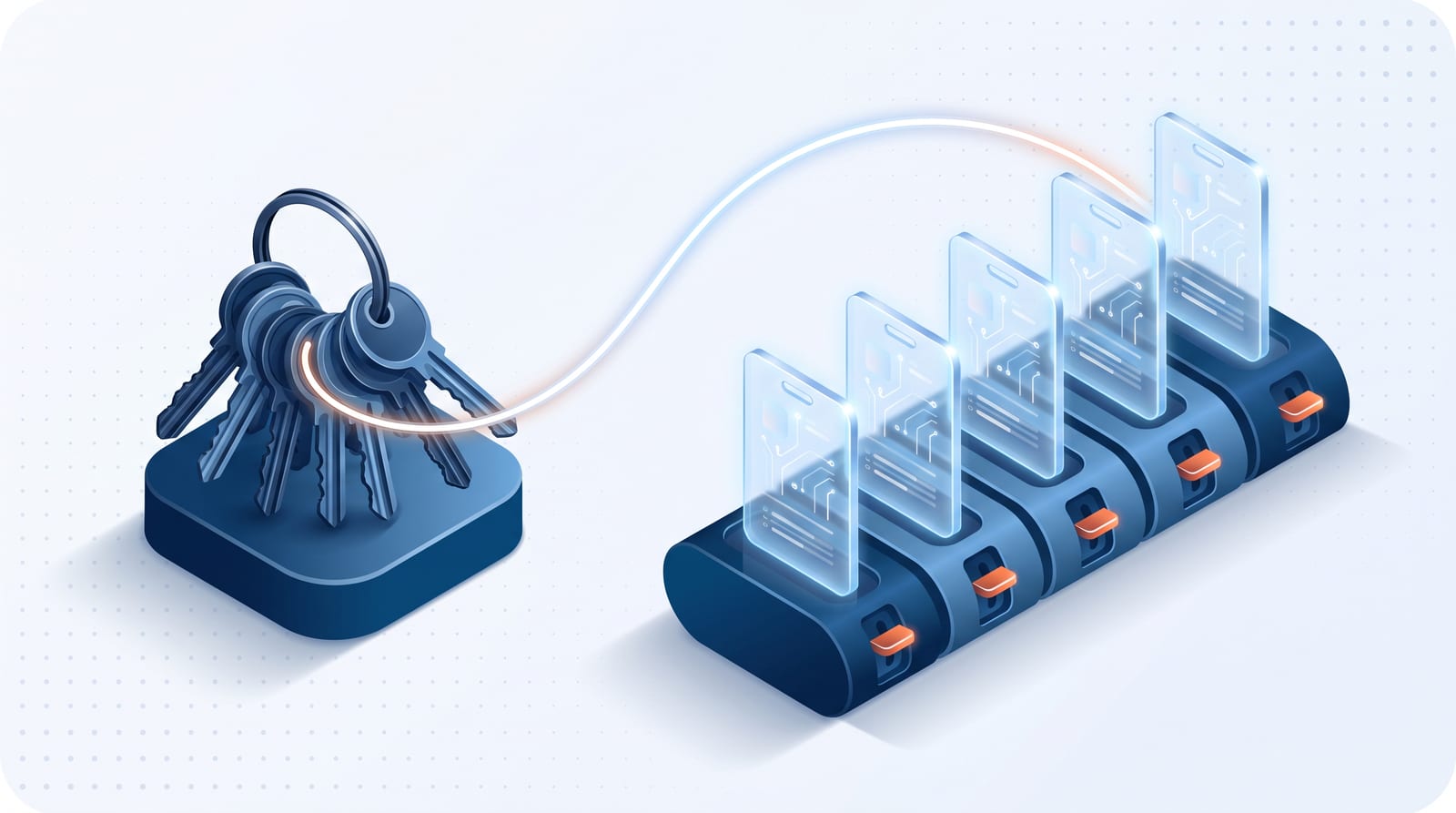
The first is operational: every password change on the client's side stops the operation, and someone has to call, ask and wait. The second is about departures: when an analyst leaves the agency, they take the passwords in their head, and revoking means changing the password of dozens of accounts that belong to other people.
The third is legal, and it is the one that comes up most in corporate contracts: storing a third party's credentials means being responsible for data that is not yours.
An authorized connection solves all three at once, because the client authorizes access without handing over credentials and can revoke it on their own. In the structure we researched, each client becomes an isolated container, and the access key can be restricted to specific containers: a call outside the scope is rejected with a 403.
The report is the most expensive item in the package
There is no universal number of hours per report, because it depends on the format each agency delivers. The cost structure, however, is always the same.
Building reports is work that scales linearly with the number of clients, generates no new information and always lands on the same days of the month, which is exactly when the team should be planning the next month.
Do the math with your own numbers, in this order:
- Hours per report, measured in a real month, including collection and assembly, not counting analysis.
- Multiplied by the number of clients, because manual collection has no economies of scale.
- Multiplied by the team's hourly cost, including payroll taxes and benefits, not the base salary.
- Compared with the cost of the tool, which in the 40-account tier is US$ 138 per month in total.
What integration gives back is collection, not analysis. Metrics per post and per account arrive by reading the API, the dashboard builds itself and the team delivers what the client really hired, which is the interpretation. Keep in mind the freshness windows we found so you do not promise the impossible: post metrics are cached for 60 minutes, follower counts update once a day, YouTube views arrive 2 to 3 days late and posts made from the app are synced roughly every 90 minutes.

What is not in the price per account
Several lines go on the bill and do not fit in the per-connected-account price. In the November 2026 check, they appear on the provider's pricing page, in lines separate from the per-account ladder. The table below shows the ones that weigh most for an agency; the page also lists other items, such as RCS and WhatsApp. None of them is a trap: they are all usage-based, and it is better to know them before settling the package price with the client.
| Item | How it is billed |
|---|---|
| X API pass-through | Per call, with no margin. A post with a URL at US$ 0.200 per request, a simple post at US$ 0.015, reading a post at US$ 0.005 per resource, reading a DM at US$ 0.010 and sending a DM at US$ 0.015 per resource. Configurable monthly cap, with a warning at 80% and a pause at 100% |
| Outgoing inbox messages | 10,000 free per month; above that, US$ 1 per 10,000 messages |
| Automations | 2,000 free runs per month; above that, US$ 2 per 1,000 runs, on the monthly bill for new sign-ups. Sign-ups from before the prepaid balance still have no automation charge for now |
| Managed ads | The first 500 active ads are free; above that, US$ 0.01 per active ad per month. Only ads running or under review count |
| Phone numbers | From US$ 3 to US$ 30 per month, depending on the country and type of number. In the US, US$ 3; in Brazil, from US$ 5 |
| SMS and calls | Calls from US$ 0.010 per minute in the US and Canada (US$ 0.04 to Brazil). SMS from US$ 0.008 per segment in the US, US$ 0.02 in Canada and US$ 0.07 to Brazil |
Consumption items published at docs.zernio.com/pricing and on the social, ads and phone pricing pages, read on November 11, 2026. On September 1, the phone number ceiling was US$ 21. New Zernio sign-ups now pay the X API pass-through, phone numbers, SMS and calls from a prepaid balance; connected accounts, inbox messages, automations and ads remain on the monthly bill. Earlier sign-ups pay everything on the monthly bill.
The only one that changes a project decision is the first. The more than tenfold difference between posting with and without a link on X means your connector's default rule has a built-in cost. An agency that reposts blog content for 40 clients makes that decision once and pays for it every month.
When to automate and when to leave it as it is
Not every manual operation deserves integration, and insisting where it does not fit is how you lose internal credibility for the next project. Two variables decide: whether the work repeats the same way across clients, and what an error costs.
The bottom-right quadrant is where the report lives, and that is why it is the first item in any project of this kind. Nobody gets fired over a chart with a swapped axis, and the work is identical for every client.
The top-right quadrant is where posting for regulated industries and big brands lives: it repeats, but mistakes are costly. It is solved with an approval queue, not autonomy, and the design for that is in Can an AI agent post on behalf of your company?.
What changes when the portfolio passes a hundred accounts
Above 100 connected accounts, two things change and one does not.
The price per account drops to US$ 1, which reduces the tool's cost to noise in the spreadsheet. The request limit is not the problem: on the ladder we checked in November 2026, it goes from 60 per minute on the free tier to 600 from the third account on, and only rises to 1,200 above 2,000 accounts. It is a limit for the whole team, not per account, and it does not change as the portfolio grows from 3 to 2,000 accounts, so it is worth measuring read volume before promising freshness. And the bottleneck moves: it stops being the tool and becomes the process.
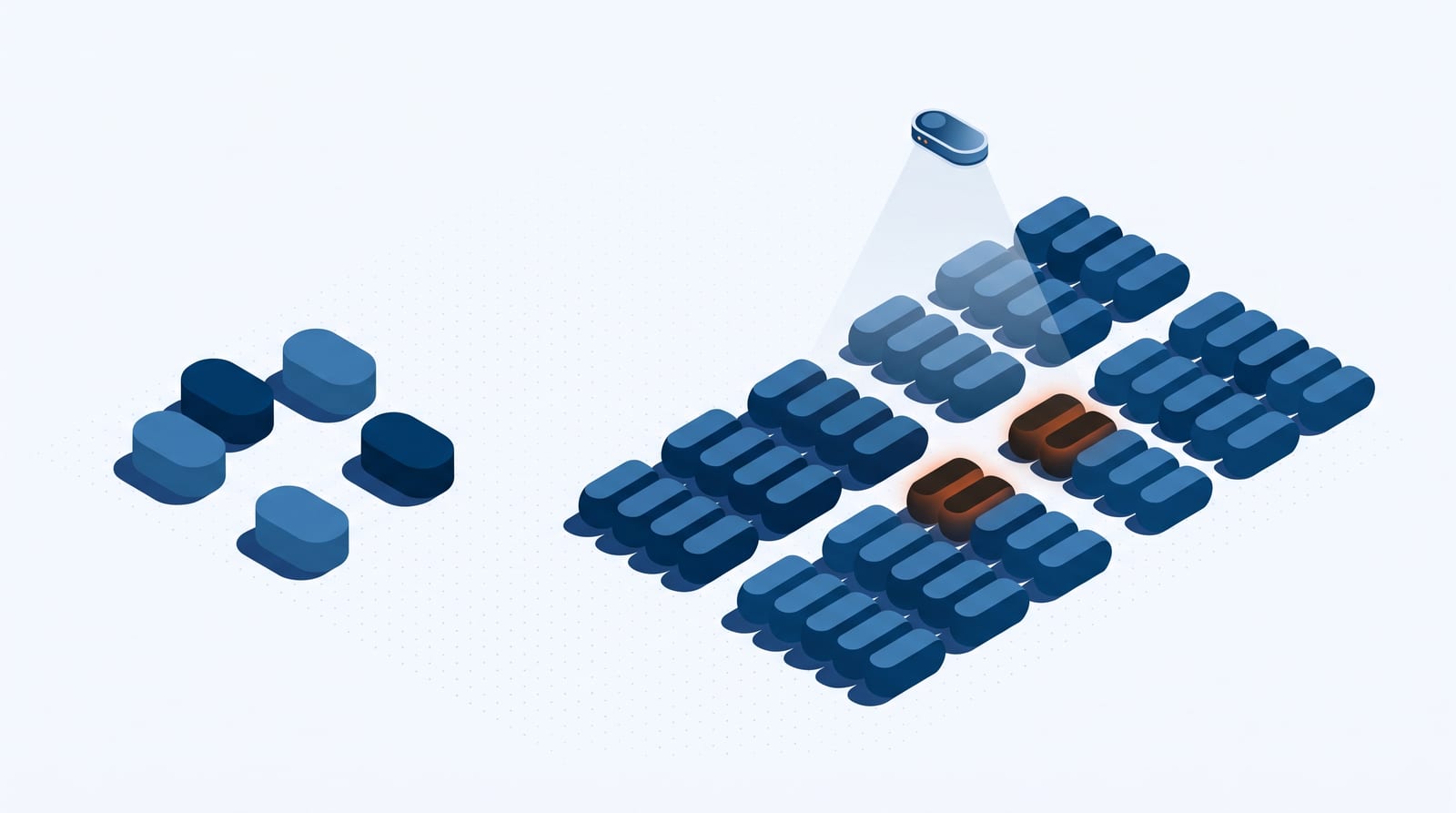
In a large portfolio, the question stops being how much the connection costs and becomes how many accounts are healthy right now. Expiring tokens, permissions revoked by the client and accounts disconnected from the phone stop being rare events when there are hundreds of accounts.
At this size, a preventive account health scan stops being a refinement and becomes what separates a professional operation from one that finds out from the client.
The adoption order that respects risk
There is no reliable day-by-day schedule for a project that has not been scoped yet, and anyone presenting one is selling predictability nobody has. What exists is an order, and it fits in five decisions.
- Count connected accounts, not clients, and redo the agency's price list with that unit
- Connect two accounts on the free tier and solve one entire report, for a single client
- Move access from passwords to revocable authorization, starting with corporate clients
- Set the spending cap for the X pass-through before turning on any automation on that network
- Only after that discuss automated posting, which is the visible part and the riskiest
The order puts the lowest-risk, highest-return item first on purpose. A report that builds itself is the internal proof that funds everything else, and it does not expose anyone's brand while it is being tuned.
Sources and method
The price ladder, consumption items and request limits come from Zernio's public documentation, read on September 1, 2026 and revised on November 11, 2026. In the revision, the phone number ceiling changed (it was US$ 21), and so did the billing of separate consumption (X API, phone, SMS and calls) for new Zernio sign-ups, which now comes from a prepaid balance (connected accounts, inbox messages, automations and ads remain on the monthly bill, and earlier sign-ups pay everything there). SMS to Canada was corrected to US$ 0.02 per segment; the previous version included it in the US floor of US$ 0.008. The consumption table also gained the lines for outgoing inbox messages, automations and DMs on X, which the previous version omitted. The text on the request limit was corrected to the page's exact tiers (600 from 3 to 2,000 accounts, 1,200 above that), and the social pricing page explicitly says an ad account counts as a connected account. The per-account ladder stayed the same. The values of US$ 138, US$ 338 and US$ 518 are a direct calculation from that ladder for 40, 120 and 300 connected accounts, with the first two free, and not published table values.
Zernio appears here because it publishes the full ladder by tier, which makes it possible to do the math without a sales contact. This is not a purchase recommendation: no comparison between vendors in the category was conducted for this article.
No estimate of hours, savings or implementation time appears in this text, because X-Apps has not run a measured pilot with this provider. The return calculations proposed use the reader's own numbers on purpose.
Primary sources consulted on September 1, 2026 and revised on November 11, 2026: docs.zernio.com (pricing, usage limits, analytics, data model glossary and account endpoints).
Frequently asked questions
No, and that is where the math goes wrong. This type of tool is priced per connected social profile, so a client with Instagram, Facebook, LinkedIn and TikTok is four connected accounts, not one. On the pricing page checked in November 2026, ad accounts also go on the same ladder: a Page, its Instagram and the Meta ad account add up to three.
On the price ladder we researched, US$ 138 per month: the first two are free, the next eight cost US$ 6 each and the remaining thirty US$ 3 each. The price per account falls as volume rises.
By using an OAuth connection, where the client authorizes access without handing over credentials and can revoke it whenever they want. Besides removing the liability, this shortens contract onboarding, because the access objection disappears.
For an agency, the main items are the pass-through cost of the X API per call (posting, reading and DMs), outgoing inbox messages above 10,000 per month, automation runs above 2,000 per month, active ads above 500, phone numbers, SMS and calls. The provider's pricing page also lists other items, such as RCS and WhatsApp. None of them fits in the per-connected-account price, and all of them go on the bill.
It is when the report has the same structure for several clients and only the numbers change. It is not when each client gets a different analysis, because then the work is the analysis, not the data collection.
Not necessarily. The most common path is to keep what works and connect via API only what is done by hand today, starting with the report and access.


