Índice do artigofaltam 10 min de leitura
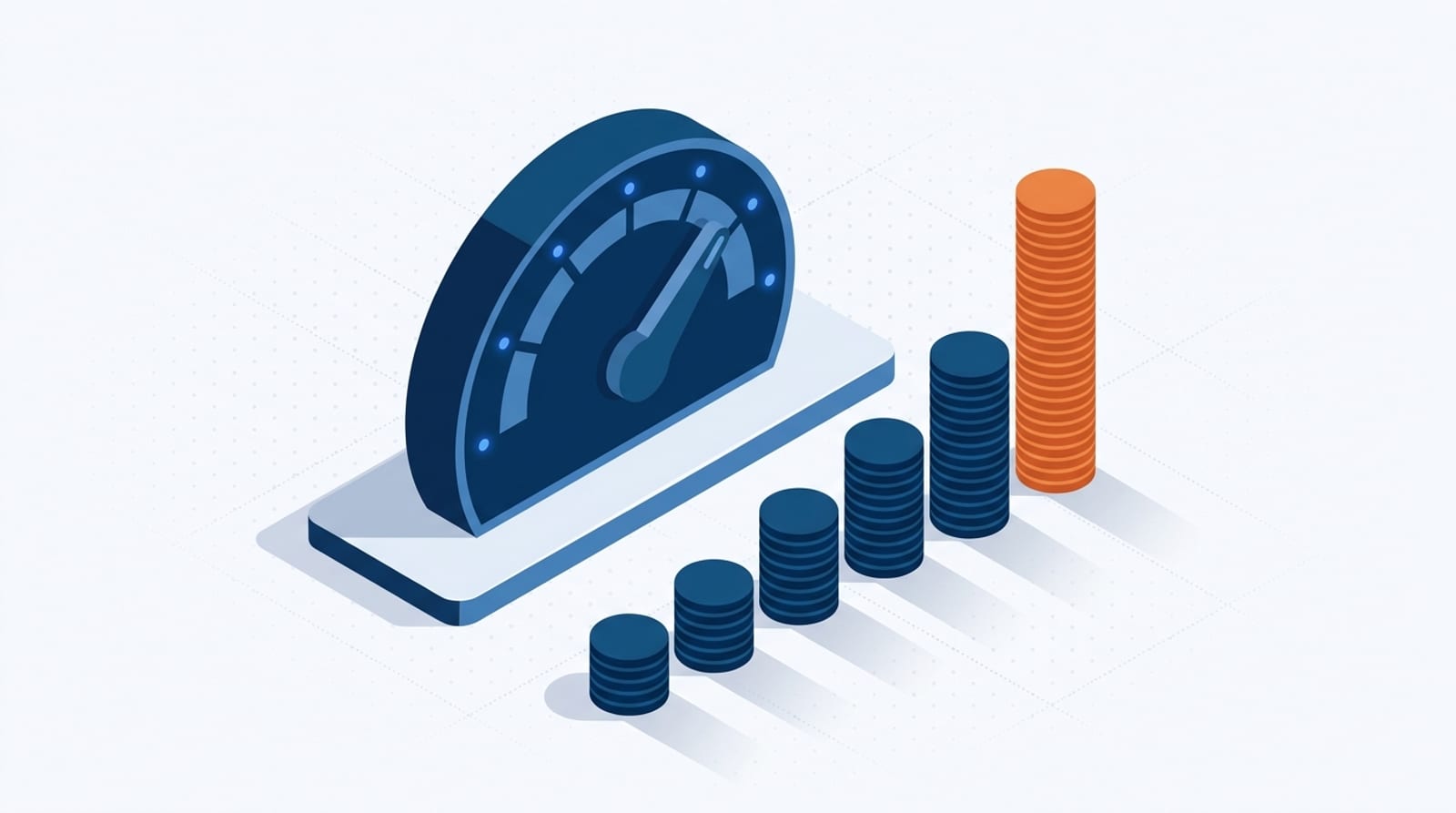
There is a dial in the GPT-5.6 Sol API that multiplies your bill by eleven without changing models. It is called reasoning.effort, has six positions, and most teams leave it at the default without ever measuring what the other five do to cost and quality.
We are not talking about choosing a better model, or turning on reasoning mode in ChatGPT. It is the same model, the same prompt, the same task, with a single word changed in the call. And the difference between the cheapest and the most expensive position is 181 versus 2,017 dollars on the same test battery.
Article summary
- GPT-5.6 Sol accepts six reasoning levels, and the cost of running the same benchmark varies 11.1 times between
noneandmax, while quality varies 1.45 times. - If a task costs US$ 1.00 on
high, it costs US$ 0.61 onmedium, US$ 0.37 onlowand US$ 2.88 onmax. - The step from
mediumtohighis the worst deal on the entire scale: 63% more expensive for 1 index point, a worse return per dollar than the next step. - The return on reasoning depends on the distance to the model's ceiling. On a task it already solves,
maxeven scores belowxhigh.
What exactly changes when you raise the effort
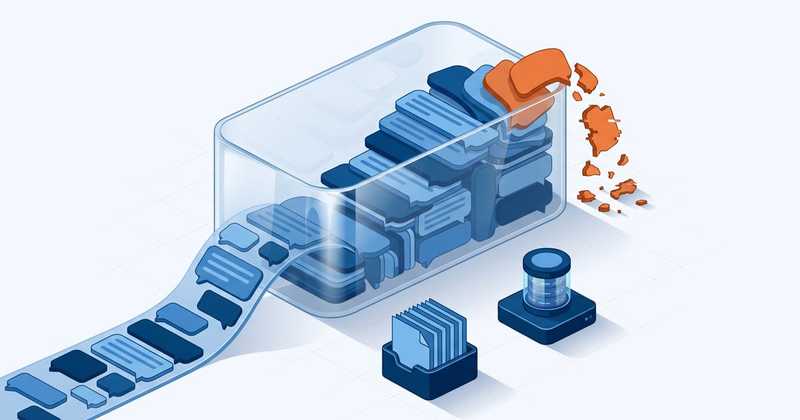
Reasoning effort is the thinking budget the model spends before writing the answer. It does not change the weights, does not switch models and does not change the length of the final text: it changes how many invisible tokens the model burns reasoning, and those tokens go on the bill.
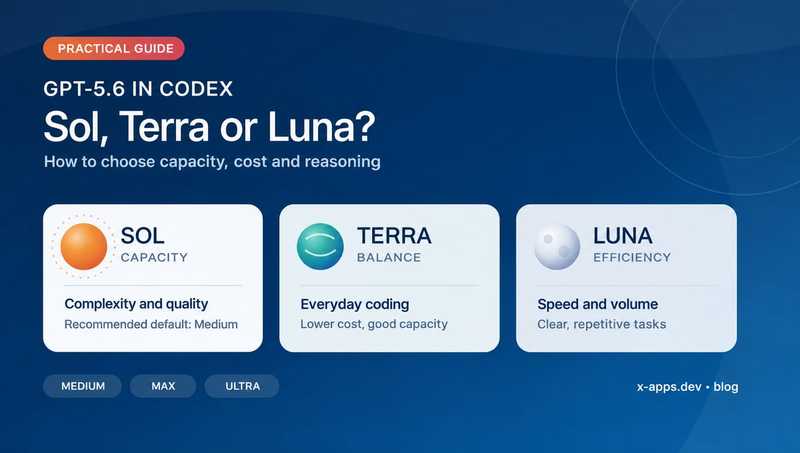
Sol accepts six values: none, low, medium, high, xhigh and max. The default is medium when the parameter is omitted. Two common confusions are worth noting. The first is minimal, which appears in OpenAI's general reasoning guide but not in the Sol list, so do not use it. The second is ultra, which is not an API effort: it is a product mode of Codex and ChatGPT Work that splits the task among parallel subagents. max is depth in a single agent; ultra is parallelism across agents.
OpenAI's official recommendation for anyone migrating is counterintuitive and works as a method: keep the current effort as a baseline and compare one level below, not one above. The documentation's default question is not how much you gain by going up, it is how much you lose by going down.
For billing purposes, what matters is that this thinking budget is charged at the most expensive rate on the price list.
How GPT-5.6 Sol bills reasoning
Reasoning tokens are billed as output. OpenAI's documentation is literal: they are not visible through the API, take up space in the context window and are billed as output tokens. That settles the question that causes the most spreadsheet errors: they are already inside output_tokens, and appear broken out in output_tokens_details.reasoning_tokens. Adding the two fields counts the same token twice.
In practice, reasoning is billed at US$ 20 per million while reading your document costs US$ 4 per million. That asymmetry explains almost everything that follows.
| Item | gpt-5.6-sol price per million tokens |
|---|---|
| Input | US$ 4.00 |
| Cached input (read) | US$ 0.40, one tenth of input |
| Cache write | US$ 5.00, or 1.25x uncached input |
| Output, including reasoning | US$ 20.00 |
| Batch and Flex | half of standard, US$ 2.00 and US$ 10.00 |
| Fast mode | double the standard, US$ 8.00 and US$ 40.00 |
Source: OpenAI API pricing table, read on August 31, 2026, checked again on November 11, 2026 with the same values. OpenAI declares this price as promotional: in August the promotion was valid at least until November 21, 2026, and on November 11, 2026 the model page began stating validity until November 30, 2026. The launch price, in July, was US$ 5.00 and US$ 30.00, and still appears in analyses from that month.
Two billing details change real bills. Caching is automatic for prefixes from 1,024 tokens, lasts at least 30 minutes and charges 1.25x to write against 0.1x to read, which means a prefix reused just once already pays for itself. And prompts above 272,000 input tokens cost double on input and 1.5x on output, for the whole request, not just the excess.
Six levels, one benchmark: the whole curve
The cleanest evidence available on August 31, 2026 comes from Artificial Analysis, which publishes GPT-5.6 Sol as six separate entries in the same Intelligence Index. Same model, same battery of nine evaluations, same methodology, only the effort changes. It is exactly the experimental design that matters.
| Effort | Index | Output tokens | Cost to run the index | Time to 1st token |
|---|---|---|---|---|
none | 42 | 2.6M | US$ 181.24 | 1.05s |
low | 51 | 6.6M | US$ 255.73 | 2.39s |
medium | 56 | 12M | US$ 429.35 | 3.94s |
high | 57 | 21M | US$ 699.68 | 11.42s |
xhigh | 59 | 35M | US$ 1,107.55 | 43.13s |
max | 61 | 70M | US$ 2,017.29 | 115.19s |
Source: Artificial Analysis Intelligence Index v4.1.1, per-variant pages for GPT-5.6 Sol, read on August 31, 2026. The index is made up of GDPval-AA v2, τ³-Banking, Terminal-Bench v2.1, SciCode, Humanity's Last Exam, GPQA Diamond, CritPt, AA-Omniscience and AA-LCR.
Read the table across two columns and the asymmetry jumps out: tokens grow 26.9 times end to end, cost grows 11.1 times, and the index grows 1.45 times. Reasoning scales much faster than the result it buys.
If high costs US$ 1.00, how much does each level cost
Normalizing high to 100, the direct answer for anyone who needs to budget:
| Effort | Relative cost | Relative quality | Savings vs high | If high = US$ 1.00 |
|---|---|---|---|---|
none | 25.9 | 73.7 | -74.1% | US$ 0.26 |
low | 36.5 | 89.5 | -63.5% | US$ 0.37 |
medium | 61.4 | 98.2 | -38.6% | US$ 0.61 |
high | 100.0 | 100.0 | 0% | US$ 1.00 |
xhigh | 158.3 | 103.5 | +58.3% | US$ 1.58 |
max | 288.3 | 107.0 | +188.3% | US$ 2.88 |
Our own calculation on Artificial Analysis Intelligence Index v4.1.1 data. Relative cost is the cost of running the index; relative quality is the index score.
The number that sums up the article is in the last row: max costs 2.88 times what high costs and delivers 7.0% more score. Switching high for medium gives back 38.6% of the budget and costs 1.8% of score.
The most expensive step on the ladder is medium to high
No configuration is strictly dominated: the frontier is monotonic, each level delivers more than the previous one and costs more than the previous one. But the price of each point gained collapses in the middle of the ladder and never recovers.
Moving from medium to high costs 63% more and delivers 1 point, from 56 to 57. That is US$ 270.33 per point, more expensive than the US$ 203.94 of the next step, which delivers two points. As a percentage of the budget, each percentage point of quality on that step consumes 22.0% of the cost of high, against 16.6% on the high to xhigh step.
To be fair, it gets worse: 56 versus 57 on an index made up of nine evaluations is a difference that probably fits within the benchmark's own confidence interval. In other words, the most expensive step per point on the scale is also the only one where you cannot claim there was a gain.
The return on effort depends on the distance to the ceiling
If effort yields little in the middle of the scale, why does OpenAI offer xhigh and max? Because the return is not a property of the model, it is a property of the task's difficulty. ARC Prize published Sol at five levels, and the same model, on the same day, shows both things at once.
| Effort | ARC-AGI-1 | ARC-AGI-2 | ARC-AGI-3 |
|---|---|---|---|
low | 74.5% | 42.5% | 0.33% |
medium | 92.5% | 67.1% | 1.07% |
high | 97.0% | 85.4% | 2.15% |
xhigh | 97.5% | 90.0% | 6.99% |
max | 96.5% | 92.5% | 7.78% |
Source: ARC Prize, GPT-5.6 Sol results on the semi-private set, read on August 31, 2026.
On ARC-AGI-1, which the model essentially already solves, the curve saturates at high and max ends below xhigh, 96.5% against 97.5%. You pay 1.8 times more to lose a point. On ARC-AGI-2, still far from the ceiling, the same jump from medium to max takes accuracy from 67.1% to 92.5%. On ARC-AGI-3, practically untouched, effort is the difference between not working and starting to work.
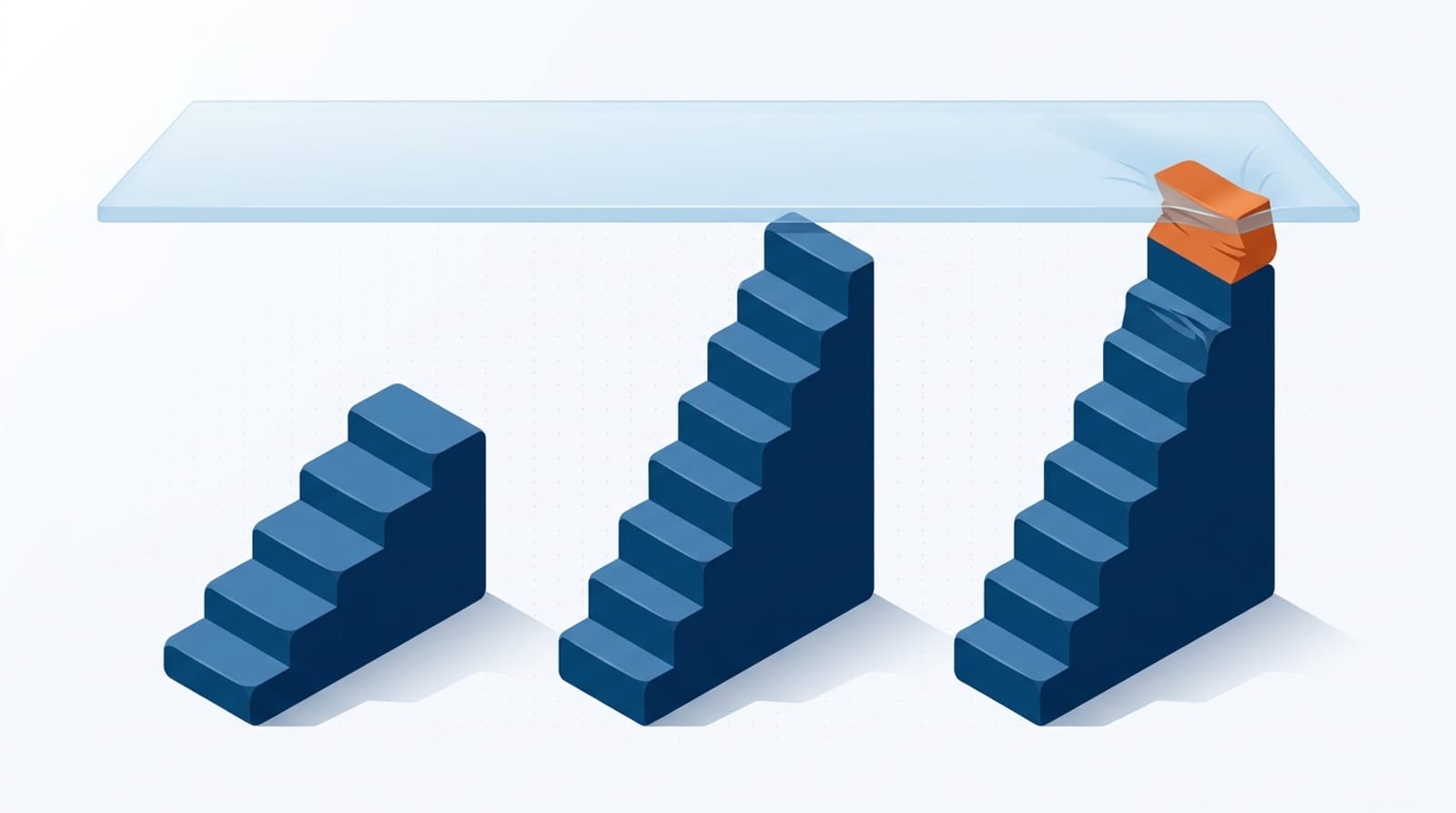
The practical consequence is that the question "which effort to use" has no global answer. It has one answer per task, and the deciding variable is how much your task still leaves on the table.
Latency: the cost that does not show up on the bill
Time to first token goes from 1.05 seconds on none to 115.19 seconds on max. That is 109 times. max takes about 29 times as long as medium, and high already takes almost 3 times as long.
This repositions the high levels: xhigh and max are not interactive product settings, they are batch settings. OpenAI itself classifies xhigh as deep research and asynchronous flows. Any interface where a person waits for the answer on screen drops out of the conversation above high, regardless of what the benchmark says about quality.
Note that generation speed barely changes: it stays between 72.6 and 80.8 tokens per second at every level. The model does not think more slowly on max, it thinks for much longer.
Where more reasoning makes the result worse
There is a class of task where raising effort is not expensive, it is counterproductive. These are faithful compression tasks: summarizing, extracting fields, transcribing into a schema. In them, the model's job is not to invent, and more deliberation opens room to elaborate.
A 2025 study compared eight reasoning strategies and three reasoning models across eight summarization datasets. The abstract's conclusion is direct: increasing a model's internal reasoning budget does not reliably improve summarization and can reduce factual consistency. The authors record a trade-off between quality and faithfulness, with factual faithfulness falling as reasoning capacity increases.

The likely explanation is simple. In a faithful compression task, getting it right means not adding anything. Each extra step of deliberation is one more opportunity for the model to connect dots the source did not connect, and that connection comes out plausible, well written and wrong.
An operational measurement points in the same direction. Observe.ai tested four effort levels on contact center tasks over call transcripts:
| Task | low | medium | high |
|---|---|---|---|
| Call summarization | 94.6% | 95.1% | 96.1% |
| Entity extraction | 87.5% | 87.6% | not reported |
| Abstractive generation | 90.5% | 91.4% | 89.0% |
Source: Observe.ai, evaluation of contact center tasks. Indirect evidence: the tests were done with GPT-5, not with GPT-5.6 Sol, and serve as a directional signal for the family, not as a measurement of this model.
In entity extraction, moving from low to medium changed the result by 0.1 percentage point. In abstractive generation, high came in below low. The latency of high in that study was 32.6 seconds against 2 to 3 seconds at the low levels. The authors' conclusion is that reasoning depth has minimal impact on performance and, in some cases, slightly reduces accuracy.
There is no public evidence breaking down GPT-5.6 Sol's hallucination rate by effort level. What exists is the consistent signal, in earlier models and in the academic literature, that tasks anchored in a document do not benefit from more deliberation in the same way that problem-solving tasks do.
How to decide on effort without guessing
The rule that comes out of the evidence is not "use medium". It is to measure your task's headroom before choosing.
- Start at the default and go down, not up, following OpenAI's own migration recommendation: fix the current effort as a baseline and compare one level below on a set of real cases.
- Measure the headroom. If your task already scores above 90% on
medium, you are in the saturation region and high effort will buy latency, not quality. - Separate the type of task. Problem-solving, debugging and long planning pay for effort. Faithful document compression does not, and may get worse.
- Treat
xhighandmaxas batch, never as an interactive path, because of the 43 and 115 seconds to first token. - Check your own
usageinstead of trusting the estimate, and compare it with the invoice.
That last point has a concrete reason. In July 2026, developers reported on the OpenAI forum that the usage.output_tokens field for GPT-5.6 was inflated, re-adding the reasoning total once per reasoning item. One recorded case reported 466,818 output tokens for 21,064 actual reasoning tokens. OpenAI support acknowledged receipt on July 13, 2026 and escalated it, and users reported it normalized at the end of that month. The episode does not describe today's billing, but it describes well why your measurement needs to be your own.
Sources and method
Research conducted on August 31, 2026, from primary sources. The model specifications, effort taxonomy, reasoning token accounting, caching rules and price table come from OpenAI's official documentation at developers.openai.com. The curve of cost, tokens, latency and quality per effort comes from the per-variant pages for GPT-5.6 Sol on Artificial Analysis, Intelligence Index v4.1.1. The per-effort ARC-AGI results come from the semi-private set published by ARC Prize.
Every normalized number in this article is our own calculation on this data, and the operation is stated next to each table. OpenAI does not publish an official score table broken down by reasoning effort: the GPT-5.6 system card presents performance as a function of effort in curves, without per-level values.
Two limitations are worth stating up front. The first is that the Intelligence Index is made up of hard reasoning problems, which makes it the most favorable scenario for high effort; on easier tasks, the return tends to be lower than shown here, not higher. The second is that the specific evidence on summarization and extraction comes from studies with GPT-5 and open models, not with GPT-5.6 Sol, and is labeled as indirect where it appears.
On November 11, 2026 we re-read the price table, the changelog and the model pages in OpenAI's documentation to record the arrival of GPT-6 Sol and GPT-6.1 Sol and the new validity of the GPT-5.6 Sol promotional price. The Artificial Analysis and ARC Prize measurements cited here are still those of August 31, 2026 and refer only to GPT-5.6 Sol.
Frequently asked questions
No. OpenAI launched GPT-6 Sol on September 22, 2026 and GPT-6.1 Sol on September 29, 2026, at US$ 2 input and US$ 10 output per million tokens. GPT-5.6 Sol remains in the API, with a promotional price of US$ 4 and US$ 20 until November 30, 2026, but it is now the previous generation. The numbers in this article apply to it; the method of measuring one level down applies to any model.
Six: none, low, medium, high, xhigh and max. The default is medium when the parameter is omitted. The value minimal appears in OpenAI's general reasoning guide, but not in the Sol list.
Yes. OpenAI's documentation states that they are not visible through the API, take up space in the context window and are billed as output tokens. They are already inside output_tokens, so adding the two counts them twice.
According to the Artificial Analysis Intelligence Index v4.1.1 measurement: about US$ 0.26 on none, US$ 0.37 on low, US$ 0.61 on medium, US$ 1.58 on xhigh and US$ 2.88 on max.
It is the step with the worst return on the entire scale. It costs 63% more and yields 1 point on the index, from 56 to 57, a difference that probably fits within the benchmark's own confidence interval.
When the task is still far from the model's ceiling. On ARC-AGI-2, moving from medium to max takes accuracy from 67.1% to 92.5%. On ARC-AGI-1, which the model already solves, max comes in below xhigh.
Yes, on summarization and extraction tasks. A 2025 study with eight datasets concluded that increasing the internal reasoning budget does not reliably improve summarization and can reduce factual consistency.
Time to first token goes from 1.05 seconds on none to 115.19 seconds on max in the Artificial Analysis measurement. Max takes about 29 times as long as medium.