Índice do artigofaltam 22 min de leitura
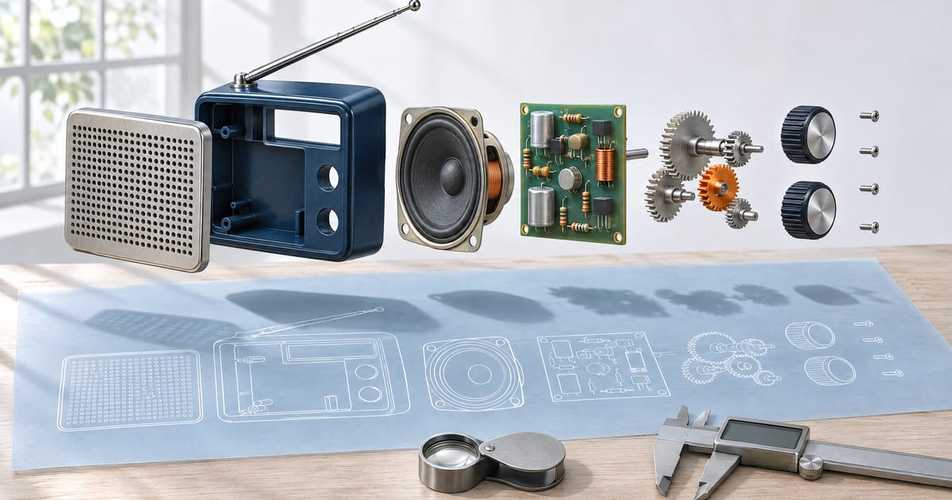
Reverse engineering is examining something finished, such as a part, a device or a program, to understand how it works without having the original design. What comes out of it is knowledge: a drawing, a specification, an explanation. Industry has done this for decades to remake out-of-catalog parts and maintain systems with no vendor. Copying and selling someone else's product is piracy, which is something else. In 2026, the most expensive part of the work in software, reading a closed program instruction by instruction, started being done by AI assistants. Checking is still manual, and that is where the risk lies. Below: what people are doing, where AI has already gotten it wrong and what Brazilian law says.
What is reverse engineering and what is it for?
Normal engineering starts from the design and arrives at the product. Reverse engineering goes the other way: it starts from the product and rebuilds the understanding. According to Wikipedia, the practice was born in the analysis of equipment to gain commercial or military advantage. The entry's example is the Tupolev Tu-4, a Soviet bomber built from American Boeing B-29 aircraft.
In software, the most cited definition comes from a 1990 article by Chikofsky and Cross in IEEE Software, which we read via citation: analyzing a system to identify its components and the relationships between them. The tables separate four terms that get confused and summarize what the practice is for.
| Term | What it is | What it delivers |
|---|---|---|
| Reverse engineering | Examining what is finished to understand how it works, without altering the original. | Drawing, specification or explanation. |
| Reengineering | Altering or rebuilding the system based on that understanding. | A new or modified version of the system. |
| Clean room | One team analyzes the original and writes the specification; another, which has never seen the original, implements it. | A compatible product, written without copying the original. Not a legal guarantee in Brazil. |
| Piracy | Copying or distributing the work without authorization. | A copy of someone else's product, conduct the law punishes. |
| What it is for | Example in this guide |
|---|---|
| Remaking a part with no drawing or out of catalog | Hospital equipment part scanned and 3D printed |
| Making equipment and systems talk to each other | Samba; card printer with no Linux driver |
| Freeing data locked in an old format | The .doc format; Quicken 2002 files |
| Understanding a system with no documentation or vendor | GPSi; X-Apps lab test |
| Auditing the security of what is yours | Customer portal examined from the outside |
| Preserving an old program or game | DX-Ball; Colin McRae Rally |
| Learning and training | Web edition of Chrome's dinosaur game; security competition challenge |
Types of reverse engineering: product, hardware and software
In industry, the term usually means measuring a part with a scanner to redo the drawing. Siemens warns that the scanner does not deliver a model ready to manufacture: it delivers a point cloud, which still needs to become a design model.

In software reverse engineering, the target can be the program, the firmware (the program stored inside a device), a file format or the conversation between two systems. X-Apps dealt with that last case in GPSi, the inspections app for Grupo GPS's field teams. There was an Android app with no source code and no documentation, and the iPhone version was born from recording each of its conversations with the server. The written specification stayed with the client.
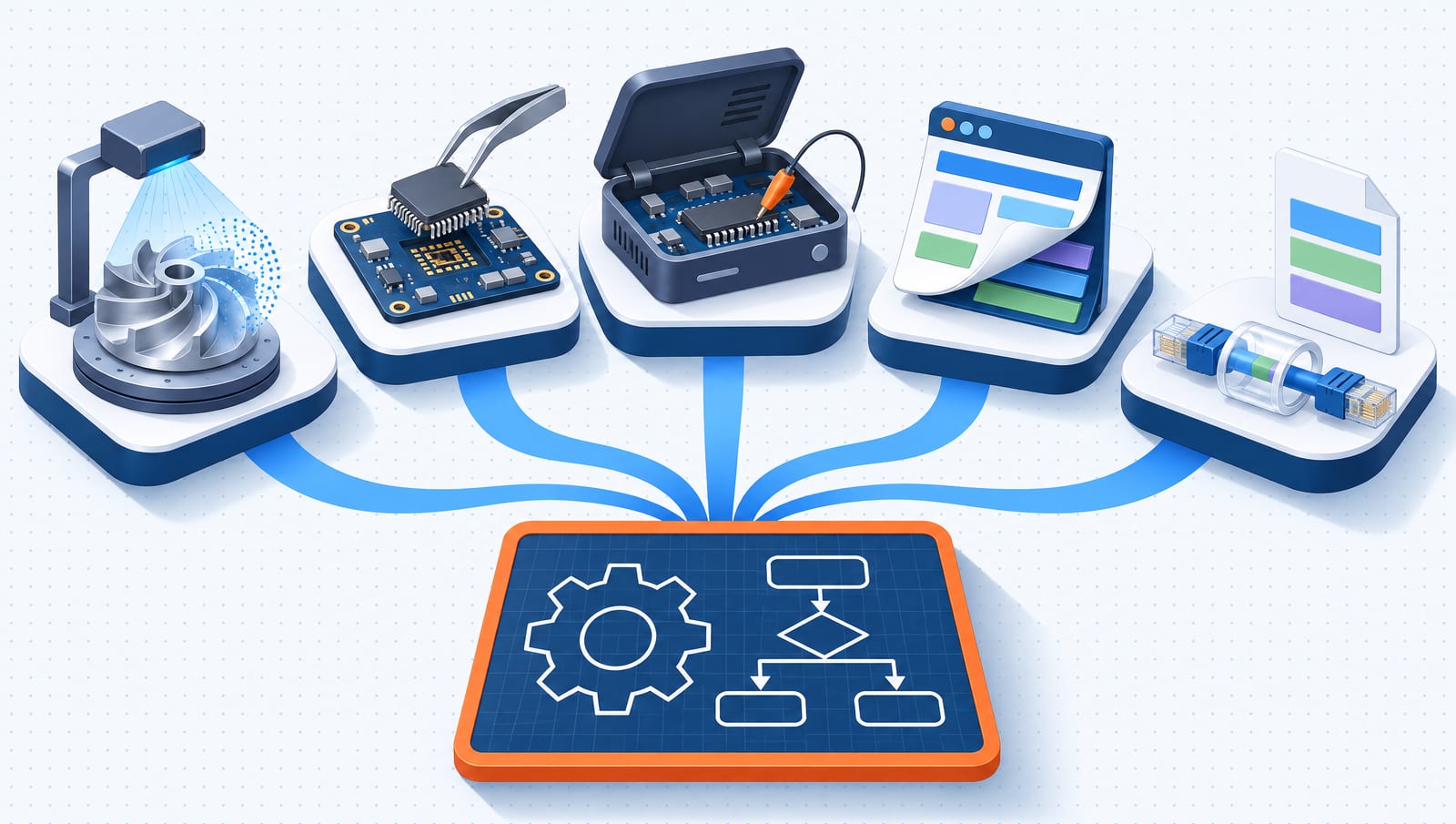
| Type | What is examined | How it is done | Known example |
|---|---|---|---|
| Physical product | Part or mechanical assembly | Laser scanner, point cloud, mesh and solid model. | Hospital equipment part scanned, 3D printed and used in place of the original, according to an article by IFBA authors (Federal Institute of Bahia, 2020). |
| Board and chip | Circuit board, chip, smart card | Each layer of the board is recreated in software until reaching the schematic. In chips, the analysis is invasive and destructive. | No example checked in this guide; the method description is from Wikipedia. |
| Firmware | The program stored in the device | Extract the contents and read them, without turning on the device. | Home camera that started accepting local control (in the use tables, further down). |
| Software | Executable program or app | Disassemble or decompile the program and check the reading against real behavior. | Phoenix's PC BIOS, released in May 1984 and written using the clean room method. |
| Web and mobile app | What the browser or device receives and what it exchanges with the server | Read the downloaded programs and observe the calls. What runs on the server is not reached. | X-Apps' GPSi, rebuilt from the Android app's traffic. |
| Old game | The game's executable | Rewrite function by function and compare with the original (the community calls it decomp, short for decompilation). | DX-Ball, from 1996 (in the use tables). |
| Protocol | The conversation between systems | Observe the traffic, without opening the program. | Samba, from 1992, was born from observing network traffic. |
| File format | The structure in which a program saves its data | Compare file samples. | The .doc format was deciphered by Sun and OpenOffice.org before Microsoft published the specification, in 2008. |
How is reverse engineering done and with which tools?
The method is similar across all types, and the step that separates knowledge from guesswork is the test against the original.
In programs, opening has two levels, disassembling and decompiling, explained in the glossary. Neither returns the original source code: names, comments and the reasons behind each decision do not come back.
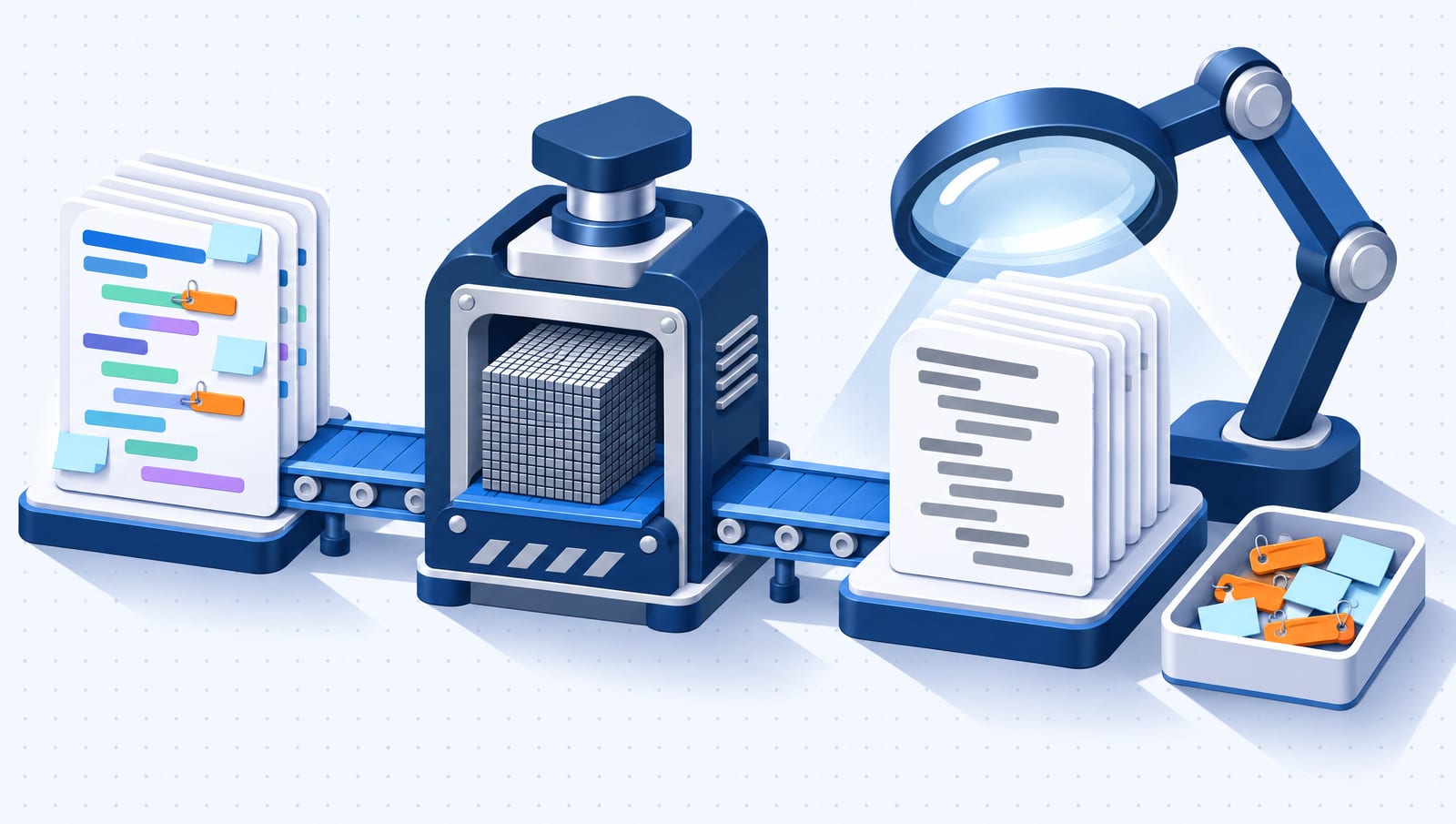
Many of the tools are open source. One of the best known, Ghidra, is maintained by the U.S. National Security Agency.
| Category | Tools | What for |
|---|---|---|
| Physical product | 3D laser scanner, contact measuring machine, modeling software (CAD) and 3D printer | Measure the part, turn the point cloud into a design model and manufacture it. According to an undergraduate thesis from UnB (University of Brasília), non-contact measurement collects many points, but is generally less precise than contact measurement. |
| Analysis platforms | Ghidra (free, open source); IDA Pro (commercial; on November 19, 2026, the IDA subscription ranged from US$ 365 per year, for the non-commercial Home edition, to US$ 8,599, with a limited free edition); Hopper (commercial, with a demo version); Binary Ninja (commercial); radare2 (free) | Disassemble and decompile programs built directly for the machine |
| By program type | JADX (Android), ILSpy and dnSpyEx (.NET), all three open source | Decompile apps on these platforms |
| Runtime observation | x64dbg (open source), Frida | Follow the program while it runs and record what it does |
| Network | Wireshark | Analyze network protocols |
Reverse engineering with AI: what changed?
Until recently, opening a closed program depended on a specialist who read thousands of machine instructions and pieced together, in their head, what the program does. In reverse engineering with AI, an assistant does that reading, raises hypotheses and runs the analysis tools based on a question in plain language. But an AI model produces plausible explanations, including wrong ones, and only the test against the original shows the difference.
| Aspect | Before | With an AI assistant |
|---|---|---|
| Who reads the instructions | A trained specialist | The assistant, based on a question in plain language |
| First answer | Depends on long, specialized reading | Comes out fast, and may be wrong |
| What the result is | The reading of whoever signs the report | A hypothesis, until tested against the original |
| What did not change | Testing against the original, rights over the target, the limit of what runs on a third party's server | The same |
The tool that made the subject popular is called REA, short for Reverse Engineer Anything. There are other bridges of this kind, among them an official one from the maker of IDA, from August 2026.
- REA is born
Repository created on GitHub on April 14.
- The first public version comes out
On July 12, with a single analysis tool.
- The subject leaves the niche
A thread on Hacker News, a tech forum, reaches 814 points on October 10.
- Third parties measure and assistants refuse
Third-party measurements from mid-October; reports of refusals in the press in November.
- Version 6.9.0 is live
About 470,000 stars, GitHub's mark of interest, on November 19.
What is REA (Reverse Engineer Anything) and how does it work?
REA is an open source project, with no license fee, hosted at github.com/morluto/rea. Besides the stars, the package had 357,000 downloads in the week of November 12 to 18, 2026. Downloads are not users: the count includes automation and reinstallations.
On its own, REA does not open any program. The technical reading is done by an analysis tool. REA is the bridge between that tool and the AI assistant, through an open standard explained in the guide to the protocol. The assistant decides what to examine and writes the answer; the bridge, according to the project, returns each finding with the passage that supports it and with its limitations.
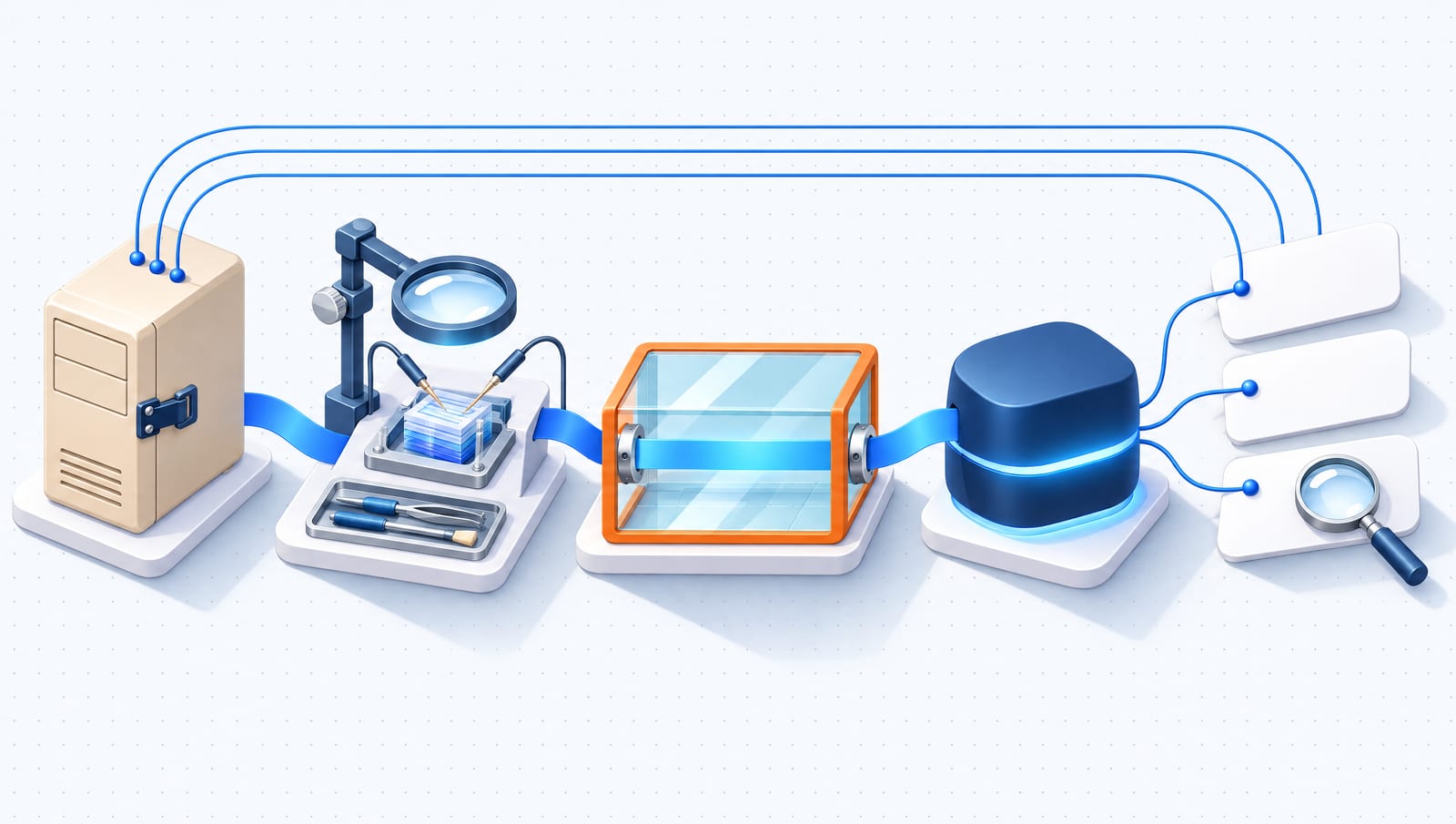
The table compares the two analysis modes.
| Mode | What it does | Risk |
|---|---|---|
| Read without running | Reads the file: instructions, embedded text, relationships between functions. This covers most analyses. | The program does not run. Reading alone does not prove runtime behavior. |
| Observe at runtime | Follows the program as it runs and records what it does, with a script written by the user. | The program runs with the user's permissions. An unknown file calls for an isolated environment. |
What REA reads depends on the type of program and the tool installed.
| Target | How REA reads it, according to the documentation |
|---|---|
| Program built directly for the machine | With a tool already installed: Hopper, Ghidra, IDA or Kuna, an open source decompiler. REA does not provide licenses for commercial tools. |
| JavaScript, .NET and desktop apps built with website technology (Electron) | By REA itself, with no native tool. |
| Android app | With JADX. |
| Firmware | With two extraction tools, Binwalk and Unblob, without the device and without running anything. Verified by the project only on 64-bit Linux. |
According to the project, the analysis runs on the user's computer, but the results go to the assistant, under the model provider's data policy. When to use the tool on a company system and what drives the cost are covered in Old system with no vendor: AI helps decipher it, with limits.
What are people doing with REA?
The wave's fame came largely from recreations of games and apps. In the cases we found with a public artifact, which are not a sample of all uses, our reading is different: many wanted to make something that was already theirs work.
Understanding your own device
| What it is for | Public example, with link | What came out and the caveat |
|---|---|---|
| Finding out what a cheap device does in secret | TV box, account on the project forum (October 31, 2026) | According to the author, the device ships with a preinstalled update service that silently installs apps and sends identifiers. It is his claim, with no independent verification or response from the manufacturer. |
| Controlling the device without the manufacturer's cloud | Home security camera (October 29, 2026) | The internal commands found allowed local control through a home automation system, without replacing the firmware. The author tested a single unit. |
| Changing a behavior of your own equipment | Firmware of a photo camera (repository from October 20, 2026) | The author reports a silent shutter on a real camera. A later version left the same camera unable to turn on, recovered only with bench equipment: it is an example of risk. |
| Finding out whether a phone's system can be replaced | Analysis of a Galaxy A10e (October 28, 2026) | The conclusion was that it cannot. A second, blind review corrected overly strong claims from the first. |
Making equipment and formats talk to each other
| What it is for | Public example, with link | What came out and the caveat |
|---|---|---|
| Using equipment on a system with no driver | Card printers on Linux (repository from November 8, 2026) | Experimental driver, with the network protocol recovered from the Windows driver. The author says he printed cards on one of the models, with many options untested on real equipment. |
| Connecting a device that only has a phone app | Bluetooth thermal printer on Windows (October 15, 2026) | The connection sequence recovered was identical to the one recorded in the real communication. REA was only the starting point: the author notes that it does not read that app's format. |
| Getting data out of an old file format | Quicken 2002 file reader (repository from October 29, 2026) | Exports the data to a common database. The author warns that the financial interpretation was not validated against an export from Quicken itself. |
| Finding out why a third-party program fails with yours | Debugging a macOS feature (November 11, 2026) | It explained why the accessibility keyboard did not suggest words in a terminal app. The fix was still in draft on November 19, 2026, and the author notes that reading without running did not prove the runtime path. |
Auditing what is yours
| What it is for | Public example, with link | What came out and the caveat |
|---|---|---|
| Seeing what your product leaves exposed | A company's customer portal (October 10, 2026) | No secret exposed in the page's files; the only real problem was an address that served the login without encryption, already fixed. It is an account by the service provider itself, which sells this service. |
| Generating a security report for an app | App X-Ray (repository from October 22, 2026) | Reports on open source desktop apps, with each finding linked to a file and line. It is the author's statement. |
Learning how a program works
| What it is for | Public example, with link | What came out and the caveat |
|---|---|---|
| Recovering the rule of a well-known program | Web edition of Chrome's dinosaur game (official case) | The speed rule recovered starts at 6, adds 0.001 per update and has a ceiling of 13. The target is open source: a teaching example. |
| Finding a calculation inside an app | Aegis authenticator (official case) | The six-digit code calculation was located and checked against the public standard's test cases. The target is open source. |
| Following a command inside an app | Notion desktop app (official case) | Follows the copy command from the page to the core of the app. The page has no date. |
| Training for a security competition | 2023 DownUnderCTF challenge (official case) | A password checker was understood, and the answer validated in the original program. The challenge has had a public solution since 2023: it shows method, not a live competition. |
Measuring whether the reading is right
| What it is for | Public example, with link | What came out and the caveat |
|---|---|---|
| Checking the reading against open source code | hexgrab (October 12, 2026) and test with bzip2 (October 12, 2026) | In the first, 8 of 9 findings were fully correct; in the second, what the tool pointed out matched the source code. One target and one author each: not a general accuracy rate. |
| Rewriting a function and proving it is identical | DX-Ball, a 1996 game (official case) and the project repository | On October 7, 2026, the rewritten sound function was checked in 3,205 cases against the original. Since October 22, 2026, the repository declares all 270 of the game's functions reproduced identically, without validating the 50 levels. |
| Checking reconstructions at scale | feature-heist (repository from October 21, 2026) | Batteries of 1,500 to 25,000 cases on four targets, all open source or the author's own. It is a demonstration of method. |
Keeping old programs running
| What it is for | Public example, with link | What came out and the caveat |
|---|---|---|
| Running an old game on a current machine | Colin McRae Rally (October 29, 2026) and Open Scrantic | Both require the user's original files. Open Scrantic, a Brazilian project, distributes only the engine. |
| Remaking an old game or program | Ski or Die and Desktop Games | This rests on the authors' word. Gameplay was not checked. |
The documentation lists more than 40 target types. For those in the table below, our targeted, limited search found no public case as of November 19, 2026: they are declared capabilities, not proven use.
| Documented capability | What the project declares |
|---|---|
| Understanding a malicious program | Analysis of malicious programs and incidents is a purpose foreseen in the responsible use notice. |
| iPhone app | Inventory without running. |
| WebAssembly module | Reading the module. |
| Integration documents (OpenAPI and GraphQL) | Read without contacting servers. |
| Training environment for AI assistants | Official guide to generating one from an app. |
| AI models in files, network captures, HarmonyOS packages and WeChat mini programs | Listed in the documentation. |
Was everything that went viral done with REA?
Some of it was not. An independent audit of 41 viral demonstrations attributed to the tool found, on November 17, 2026, 27 confirmed, 3 partial, 4 unverified and 7 that did not use it. The audit itself warns that it did not open the original posts.
The 404 Media report that described the wave does not claim that the cases it narrated used REA. And one of the examples on the official page shows the tool examining a single function of a game, while the verified reconstruction of that game is another project's work.
How far does AI get and which limits have already been measured?
There is little independent measurement, and what exists cools the enthusiasm. In rea-lab, a researcher compared the same assistant with and without REA on small challenges: accuracy was the same, and with the tool the work took about twice the time and cost. He warns that the test does not evaluate the product in general. On previously unseen programs, researchers linked to Columbia University saw a single model solve most of the tasks it was evaluated on, with frequent refusals, and the others fall far behind.
In the published cases, our reading is that four limits repeat: the reading gets a lot right and gets a part wrong; reading a file at rest does not prove what the program does when running; a third party's server is out of reach; and rebuilding everything costs more than understanding what is needed.
The Brazilian blog AkitaOnRails tried to fully rebuild a 1998 racing game: after eight days, it paused the reconstruction and built, in less than 30 hours, a program that keeps the original executable and adjusts it at runtime. The reconstruction was resumed later.
| Study | What it measured | Result | Caveat |
|---|---|---|---|
| rea-lab (October 2026) | 482 runs in five studies registered before testing, with and without REA 6.4.0 | Small challenges: 28 of 30 in both conditions. Larger programs: 11 of 24 without REA and 4 of 24 with it, a difference the author's statistical test does not consider significant, meaning it may be chance. | One version of REA, one author; both results cited are from a single assistant. It does not allow concluding that the tool worsens the result. |
| leanrea (October 2026) | Cost of loading all REA 6.5.0 tools at once and four tasks repeated three times | A trivial answer cost about 400,000 units of processed text (US$ 1.60). REA got 75 of 75 right and a lean alternative 74 of 75, with less time and cost. | Published by the author of the alternative. Ghidra, Hopper and JADX were not installed in the test. |
| SRE-Bench (version of October 1, 2026) | AI models on 19 private programs, 262 executables and 1,572 tasks; it does not measure REA | The best model solved 149 of 181 evaluated tasks (82.3%); the second, 80 of 254 (31.5%); the third, 60 of 223 (26.9%). | Refusals and out-of-memory failures are left out of the count, so 82.3% is not over the total. Malicious programs were the lowest-scoring domain for most models. |
| hexgrab (October 2026) | Each REA finding checked against the public source code of a utility | 8 of 9 findings fully correct | One target, one author. |
Are AI vendors blocking reverse engineering?
As of November 19, 2026, we found no vendor policy that prohibits reverse engineering in general. What is confirmed is specific. According to Tom's Hardware, an Anthropic employee confirmed that two sentences were added to the instructions of the company's coding assistant to prevent the recreation of a specific game. 404 Media reported that users of two assistants started running into blocks and that, according to an OpenAI engineer, the refusals were mostly accidental. Of the text, which is paywalled, we read only the open excerpt, which also cites a user whose account was banned on grounds of cyber abuse while analyzing televisions, with no confirmation from the company in the sources we read. Refusals happen; a general prohibition is not confirmed.
| Level of evidence | What is known | Source |
|---|---|---|
| Confirmed in an official document | Anthropic documents real-time safeguards against use in cyberattacks and a verification program for people who work in defense. The document does not mention reverse engineering. | Support page, updated on October 6, 2026 |
| Reported by the press | A rule against recreating a specific game; blocks on reverse engineering tasks, refusals described as accidental by an engineer from another vendor and one report of a banned account, without confirmation from the company. | Tom's Hardware (November 2, 2026), 404 Media (November 10, 2026) and IBTimes UK (November 11, 2026) |
| Not confirmed | A general prohibition on reverse engineering and blocking REA by name. | We found no source. A user post on the forum says the author has not seen Anthropic name REA. |
What precautions should you take before opening a program?
The first precaution concerns the program: the project warns that REA isolates nothing and runs with the permissions of whoever executes it. A program of doubtful origin calls for a separate machine and an assistant with limited access.
The second concerns the assistant: a file can contain text written to trick the AI, an attack known as prompt injection. REA marks the content as analysis material, not instructions, which reduces the risk without eliminating it.
The third concerns people's data, common in old system databases and files. Sending it to a cloud model is processing personal data under the General Data Protection Law (LGPD, Brazil's data protection law), which requires a legal basis and only the data that is necessary, as we detail in what the law already requires in the use of AI.
Is reverse engineering a crime? What Brazilian law says
There is no crime by that name. Law 9.609/1998, Brazil's software law, does not use the expressions "reverse engineering" or "decompilation", and neither does the copyright law. The texts punish related conduct: violating a program's copyright, breaking into someone else's device, using confidential information obtained through a contract or fraud.
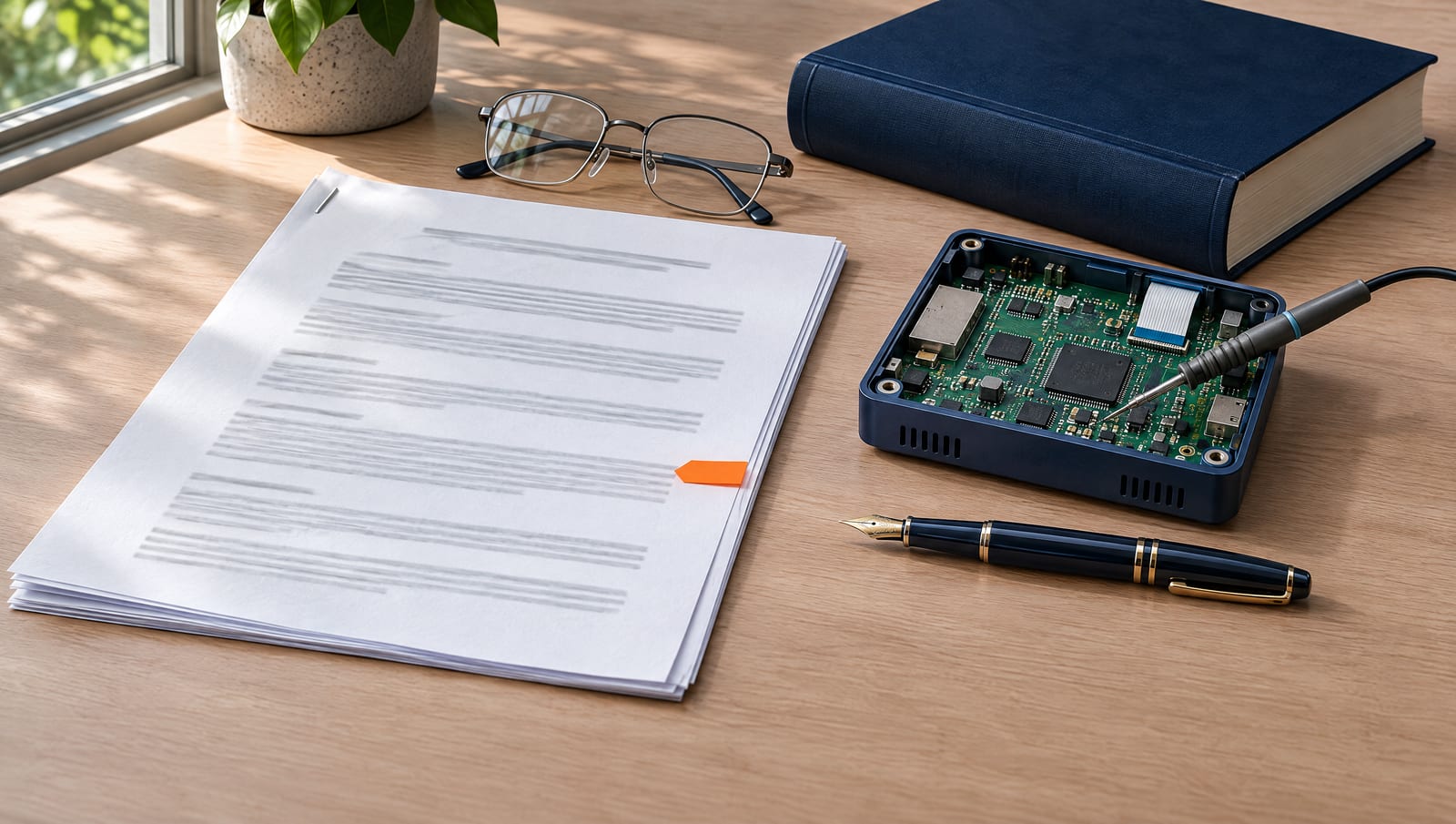
None of the texts we read expressly authorizes decompiling: there is no rule like the European one, which allows decompiling to make systems talk to each other, and we did not find any Brazilian court decision on the subject. There are lawyers who write that the risk lies in the related conduct, and a doctrinal text that calls the law silent on this point: these are opinions, not rules or decisions. The tables summarize what is written, not what a judge would decide in your case.
What the text defines or says is not an infringement
| Situation | What the text says | Where it is |
|---|---|---|
| Studying the ideas and methods of a work | Ideas, systems, methods and mathematical concepts as such are not subject to protection. | Law 9.610/1998, art. 8 |
| Making a single backup copy of a legitimately acquired copy; a program similar to another because of functional characteristics | They do not constitute an infringement of the owner's rights. | Law 9.609/1998, art. 6, I and III |
| Integrating a program into another system | Not an infringement, if the essential characteristics are maintained, if it is technically indispensable to the user and for the exclusive use of whoever carried it out. | Law 9.609/1998, art. 6, IV |
| Who owns a program made by an employee or contractor | As a rule, the rights belong to the employer or contracting party, unless agreed otherwise. | Law 9.609/1998, art. 4 |
What the text does not answer: talk to a lawyer
| Situation | What the text says | Where it is |
|---|---|---|
| Decompiling a third party's program to make it compatible with another | The text has no express authorization or prohibition by that name. | Law 9.609/1998, full reading |
| A license with a clause prohibiting reverse engineering | The use of a program in the country is subject to a license agreement. We found no rule that voids the clause. | Law 9.609/1998, art. 9 |
| Analyzing a purchased product to discover confidential information | The text punishes information obtained by unlawful means or fraud and does not say whether analyzing a lawfully purchased product is a lawful means. | Law 9.279/1996 (Brazil's Industrial Property Law), art. 195, XII |
| Studying a commercial program to write another one, as in an account from October 12, 2026, whose author says he obtained evidence and imperfect approximate code | There is no specific rule. The program's license and the punishment for copyright violation weigh in; this guide does not assess the lawfulness of the case, which is why it was left out of the use tables. | Law 9.609/1998, arts. 9 and 12 |
| Sending files with people's data to a cloud AI model | It is processing of personal data. The fine can reach 2% of revenue, capped at R$ 50 million (Brazilian reais) per violation. | Law 13.709/2018 (LGPD) |
What the text punishes
| Situation | What the text says | Where it is |
|---|---|---|
| Violating a program's copyright | Detention of six months to two years or a fine. Reproduction for commerce without authorization: imprisonment of one to four years and a fine. | Law 9.609/1998, art. 12 |
| Disabling a technical device put in place to prevent or restrict copying | Liable for losses and damages. The article has no exceptions for research or compatibility. | Law 9.610/1998, art. 107, I |
| Breaking into a computer device used by someone else, without the user's authorization, to obtain, alter or destroy data or install vulnerabilities | Imprisonment of one to four years and a fine. The same penalty applies to whoever produces or distributes a program intended to enable the break-in. | Penal Code, art. 154-A and § 1 |
| Using or disclosing confidential information obtained through a contract, employment, unlawful means or fraud | Unfair competition: detention of three months to one year, or a fine. | Law 9.279/1996, art. 195, XI and XII |
Outside Brazil, the text is more explicit, and it does not apply here.
| Place | What the text provides | Note |
|---|---|---|
| Brazil | The law does not use the term. It lists situations that do not infringe the owner's rights and punishes copyright violation. | In the laws read, there is no specific provision for compatibility, software preservation or repair. |
| European Union, directive | Directive 2009/24/EC allows whoever has the right of use to observe, study and test the program and to decompile for interoperability, under three conditions, and voids contrary clauses. | Does not apply in Brazil. |
| European Union, court | In 2021, the Court of Justice of the EU ruled that a lawful purchaser may decompile to correct errors, to the extent necessary. | Does not apply in Brazil. |
| United States, law | The law prohibits circumventing technical access control measures, with exceptions for interoperability and authorized security testing. | Does not apply in Brazil. |
| United States, exemptions | There are temporary exemptions reviewed every three years; the latest final rule is from October 28, 2024. | The status of the next review cycle was not checked. |
| United States, case law | Two rulings, from 1992 and from 2000, treated disassembly and intermediate copies as fair use. | Does not apply in Brazil. |
Where does your company's old system fit in?
For decision makers, the problem is usually narrower: nobody can say anymore what rule the old system applies. We tested this scenario in the lab. We wrote a small billing program and handed it, closed, to an AI assistant operating REA. It described the rule, and the rewrite made from that description was compared with the original in a first battery of 4,270 cases. All matched except 24, due to an error in the rewrite with absurdly large values, fixed in the next round.
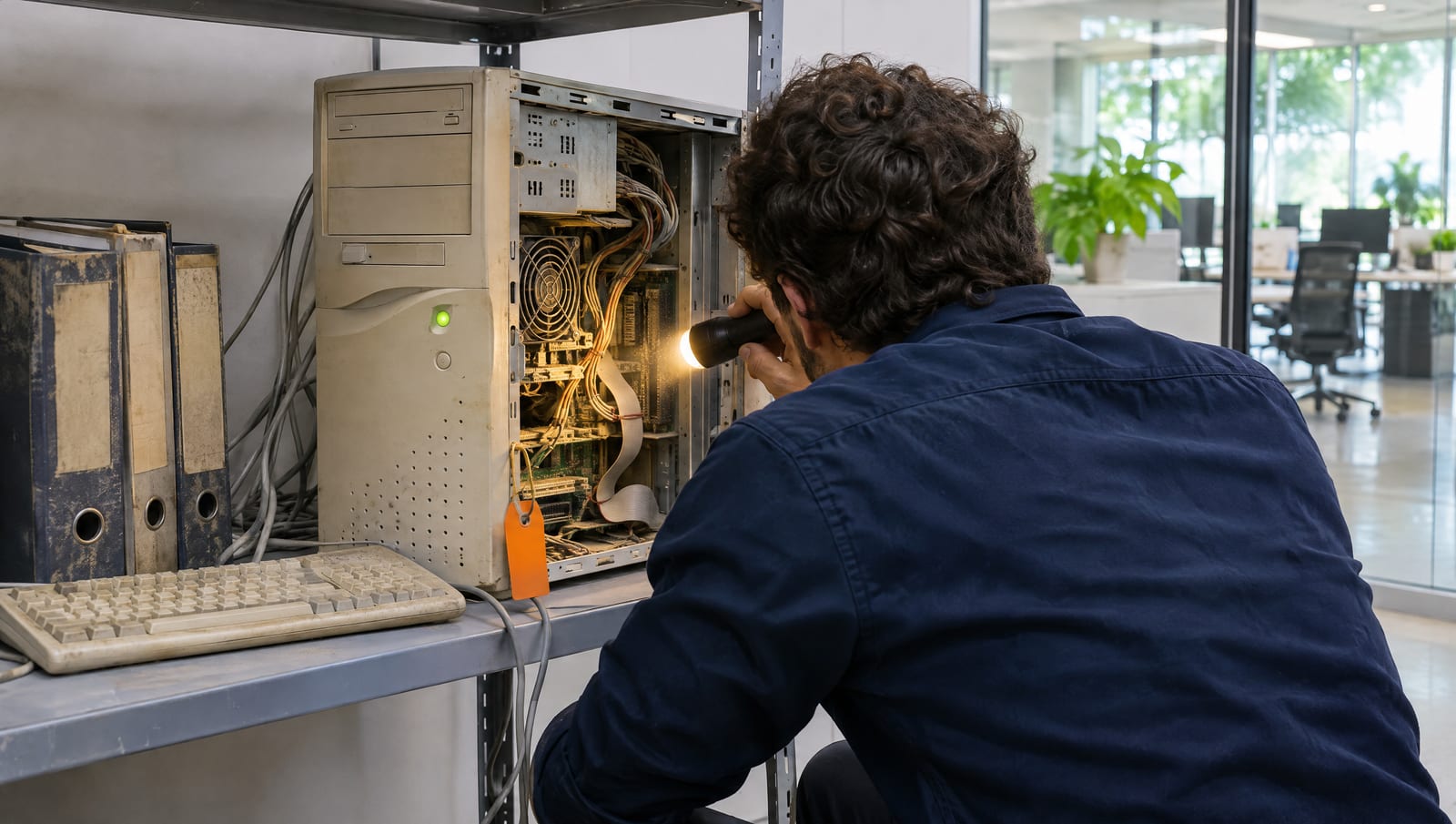
The limit is clear: a small program made by us, with no client deployment and no reproduction by third parties. The account is in Old system with no source code: AI read the rule, down to the cent.
The tool is not always the way: in GPSi, recording the app's conversations was enough. To integrate, see the options when the system has no official way in. And, before opening any executable, it is worth taking an inventory of what the company can still reach.
How to start safely?
To experiment on your own, start with these six precautions.
- Have rights over the target and read the license first.
- Download the tool only from official sources.
- Start with something of your own or open source.
- Work on a copy and on an isolated machine.
- Remove people's data before sending anything to the model.
- Check each finding against the original.
For those who will install it: according to the documentation, it is one command, and the installer asks for approval before changing the configuration.
npx rea-agents setup| Requirement | What the documentation asks for on November 19, 2026 |
|---|---|
| AI assistant | Any that accepts local MCP servers; the documentation lists, among others, Claude Code, Codex, Cursor, Gemini CLI and VS Code. |
| Node.js | Version 22.x from 22.23.4, 24.x from 24.22.1, or 26.12.1 onward, with npm. |
| Analysis tool | Only for programs built directly for the machine: Hopper, Ghidra, IDA or Kuna already installed. JavaScript and .NET do not need one. |
| Operating system | Varies by feature: firmware reading was verified by the project only on 64-bit Linux, and using Ghidra on Windows is experimental. |
What this means for decision makers
If your company depends on a system nobody can describe, three questions come before any tool. Do you have rights over the program? What is still within reach: the executable, the database, someone who remembers the rule? Which decision does the answer unlock: integrate, modernize or rebuild? On any path, what AI returns is a hypothesis until someone compares it with the original. When there is no team for that check, X-Apps takes over and improves existing systems through DevOps Operation.
Reverse engineering glossary
| Term | What it means |
|---|---|
| Source code | The text written by programmers, with names and comments. |
| Executable | The program ready to run, already translated for the machine. |
| Disassemble | Read the machine's instructions in its own terms. |
| Decompile | Try to recreate readable code from the executable. The result is approximate and is not the original source code. |
| Decomp | Nickname for decompilation in game projects: rewriting the code until it produces a program identical to the original. |
| Firmware | The program stored inside a device. |
| Protocol | The rules of the conversation between two systems or pieces of equipment. |
| File format | The structure in which a program saves its data. |
| Interoperability | The ability of systems from different manufacturers to work together. |
| Static analysis | Reading the file without running the program. |
| Runtime analysis | Observing the program while it runs. |
| AI assistant (agent) | A program that receives a text request, decides the steps and runs tools. |
| MCP | Model Context Protocol, the standard that connects AI assistants to external tools. |
Frequently asked questions
It is examining something finished, such as a part, a device or a program, to understand how it works without having the original design. The result is knowledge: a drawing, a specification, an explanation.
To remake parts without drawings, repair and integrate equipment, free data locked in old formats, understand systems with no documentation, study security and preserve old programs.
There is no crime by that name, and Law 9.609/1998 (Brazil's software law) does not use the expression. Reverse engineering is understanding how something works; piracy is copying or distributing the work without authorization. The law does not protect ideas and methods, but it punishes violation of the program's copyright, with a higher penalty for unauthorized reproduction for commercial purposes, as well as related conduct such as breaking into someone else's device. In a specific case, consult a lawyer.
You can get instructions and approximate code, but the original source code, with names and comments, does not come back. The tool depends on how the program was built: in .NET, decompilers such as ILSpy and dnSpyEx usually return easier-to-read code; for programs built directly for the machine, a platform like Ghidra or IDA is used, with a harder result. In any case, the reading needs to be checked against the program.
The method has six steps: obtain the object with the right to use it, observe its behavior, open and read it, form a hypothesis, test against the original and document. For programs, the most cited tools are Ghidra (free), IDA Pro, JADX for Android, ILSpy for .NET and Wireshark for networks; for parts, a 3D scanner and modeling software.
No. AI reads what is in the file you have: what runs on the vendor's server is out of reach, and the original source code does not come back. In the published account we cite, rebuilding a whole program cost much more than understanding one part. And reproducing a third party's program to sell it, without authorization, is conduct the law punishes.
It is an open source tool, under the MIT license, that connects AI assistants to program analysis tools. The code costs nothing; use of the AI model and of optional commercial tools is paid separately. Download only from the official sources: the morluto/rea repository on GitHub, the rea.tools website and the rea-agents package on npm. There has already been a report of a fake copy with a suspicious installer.
It can include that clause, and in Brazil the law says the use of a program is governed by the license agreement. In the European Union the directive voids clauses against certain uses; in Brazil we found no equivalent rule, so read the contract and consult a lawyer.
Sources: morluto/rea repository (README, use and security notices, guides, forum) and rea.tools; GitHub and npm figures; prices on the Hex-Rays page; studies rea-lab, leanrea and SRE-Bench; laws 9.609/1998, 9.610/1998, 9.279/1996 and 13.709/2018 and the Penal Code on the Planalto portal (the Brazilian presidency's legislation site); Directive 2009/24/EC on EUR-Lex; Wikipedia, Siemens, UnB and UEPG (State University of Ponta Grossa) for concepts and physical products. All consulted on November 19, 2026. X-Apps experiment published on November 14, 2026.