

Índice do artigofaltam 11 min de leitura
In 2026, legal was the non-technical role in which use of artificial intelligence grew most inside companies. In the same year, on the toughest legal benchmark, the best model tested by Harvey in May finished 7.1% of real tasks without failing any criterion. In November, on the Vals AI leaderboard over a revised version of the same benchmark, the leader reached 27%.
When someone talks about AI in legal, the image that comes up is a lawyer pasting a draft into ChatGPT. That already happens in every company, it needs no project and it is not the subject of this article.
The subject is a different one, and it is uncomfortable: the two facts in the opening are true at the same time. Adoption exploded and complete delivery is still rare. That gap is neither a contradiction nor hype, it is the predictable result of a discipline that has already tried to solve the same problem five times, in five different ways, since 1977. Each attempt solved one part and revealed the next.
This article goes through those five attempts to answer a practical question: what can be put into production today, in a company's legal department, and what cannot yet. The basis is Joel Niklaus's talk at the University of St. Gallen's AI and Legal Reasoning conference, on August 28, 2026. Niklaus is Data Lead at Hugging Face, was a researcher at Harvey and is the author of MultiLegalPile, one of the largest collections of legal text ever assembled. In other words, he has worked on the data, the benchmarks, the product and the models.
Article summary
- Legal grew 108x in corporate AI use between February and June 2026, the non-technical role that grew most. Engineering, in the same window, grew 5x.
- On the toughest benchmark there is, built on real cases and with more than 75,000 criteria written by experts, the best model tested by Harvey completed 7.1% of tasks without any errors in May 2026. In November, the leader of the Vals AI leaderboard, on a revised version of the benchmark, reached 27%. The measurements are not directly comparable, and even so three out of four deliverables still fail.
- What changed legal practice over fifty years was not artificial intelligence: it was searchable law and editable documents. The lesson applies again today.
- Training a model only on legal text yielded 0.2 points of aggregate gain. What moves the result is the system around the model, not the model.
Legal was the non-technical role where AI use grew most in 2026
Between February and June 2026, corporate AI use grew 108 times among legal professionals, the largest growth of any role outside software development. Developers are still about four fifths of users, but their curve is the flattest on the chart.
Source: a16z on OpenAI corporate usage data, August 2026, presented by Joel Niklaus in St. Gallen.
The money followed the same path. Harvey raised US$ 200 million in March 2026 at a US$ 11 billion valuation, and Sweden's Legora closed a Series D that put it near US$ 5.6 billion, with the two rounds announced two weeks apart.
What this unlocks for decision-makers: legal is no longer a hard area to convince. If your project was stuck because the department resisted, that obstacle has moved. The obstacle now is choosing the right task.
And the best model evaluated gets one task in four fully right
On May 6, 2026, Harvey launched its own legal agent benchmark, LAB, with 1,250 tasks drawn from real client cases, across 24 practice areas, and more than 75,000 criteria written by experts. The pass criterion is relentless: failing a single mandatory criterion zeroes out the whole task. Twenty days later, the company published the first leaderboard, measured on a held-out set of tasks that mirrors the public one.
Sources: Harvey, Legal Agent Benchmark launch (May 6, 2026) and initial results (May 26, 2026), a test run by the vendor itself; Vals AI, HLAB-Vals-1.1 leaderboard on Harvey's held-out set, updated on November 9, 2026.
In May, Claude Opus 4.7 led with 7.1%, and Gemini 3.5 Flash, last among the major families cited by Harvey, came in at 0.8%. Other measurements came later. In July, Artificial Analysis, running 120 held-out tasks from the same benchmark, measured 14.2% for Claude Fable 5. On November 9, the leaderboard maintained by Vals AI on Harvey's held-out set had Google's Gemini 4 Argon in first place, with 27.08%. The three measurements use different versions, sets and harnesses and are not directly comparable: Vals itself warns that its leaderboard cannot be compared with the v1 leaderboard it archived or with Artificial Analysis's. Even so, November's best result leaves three out of four tasks with at least one mandatory error. The same leader gets 96.3% of individual criteria right. It is their sum that brings the deliverable down, and that is what matters for a purchasing decision.
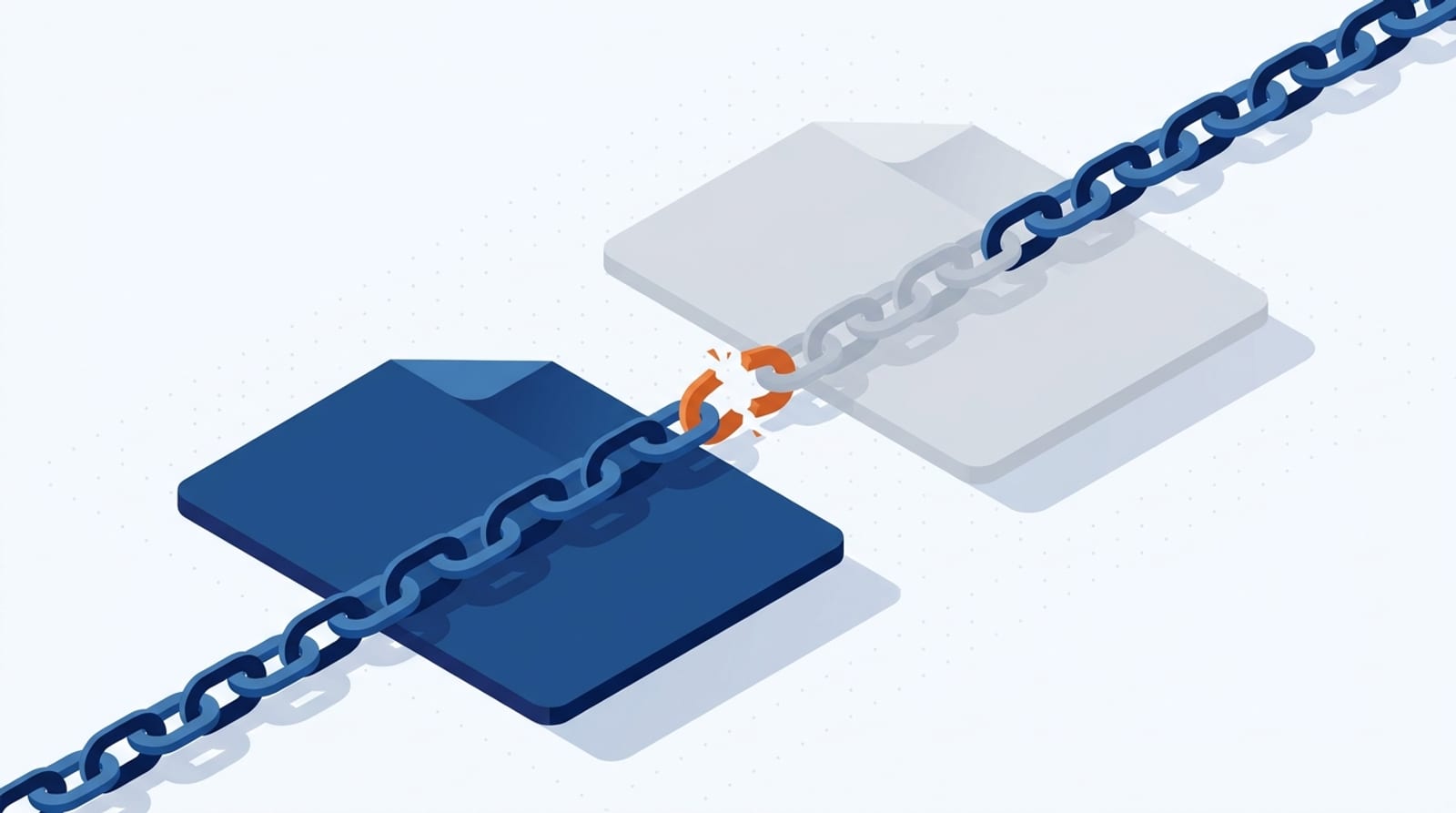
The correct reading of these leaderboards is not "AI is useless". It is that a complete legal task has many mandatory criteria, and the chance of getting all of them right falls quickly. A piece of work with thirty requirements is unforgiving. A piece of work with three is forgiving.
That is how you choose where to start: with the task whose list of requirements fits in one hand.
Fifty years, five waves, and none of them disappeared
Each wave of legal AI solved one problem and exposed the next. None replaced the previous one: they piled up, which is why today's market sells all five at the same time, under the same name.
| Wave | The bet, and what it exposed |
|---|---|
| Rules 1977-2009 | Write the law as code. It did not scale: each rule needed one lawyer to draft it and another to maintain it. |
| Features 2010-2019 | Predict the outcome from case data. It worked on paper and collapsed when the test started predicting the future. |
| Pre-training 2020-2023 | Teach the model legal language. It yielded almost nothing: the model learned to sound like a lawyer, not to do the work. |
| Instruction 2023-2024 | Ask in plain language. It became useful immediately, and brought the bill for invented citations. |
| Agents 2025-2026 | Give the model tools. It brought the two halves back together, and moved the question about quality. |
There is a detail in this timeline worth more than the dates: research and product barely touch until 2023. For forty-five years, what researchers published and what law firms bought were two separate worlds. That changed, and it is why the cycle is moving so fast now.
Wave 1: what changed practice was not artificial intelligence
The first serious AI and Law project was TAXMAN, by L. Thorne McCarty, published in the Harvard Law Review in 1977. It formalized corporate tax law as a computational model, written by hand, rule by rule. It is foundational work and nobody can point to a law firm it transformed.
What transformed legal work appeared in the same window, and none of these things was AI:
- 1973 · LEXISFull text of all New York and Ohio cases, searchable.
- 1975 · WestlawStarted with headnotes; full text only from 1978.
- 1979 · Word processorRevising a draft without retyping the whole page.
- 1986 · SwisslexSwiss case law by terminal, before the web existed.
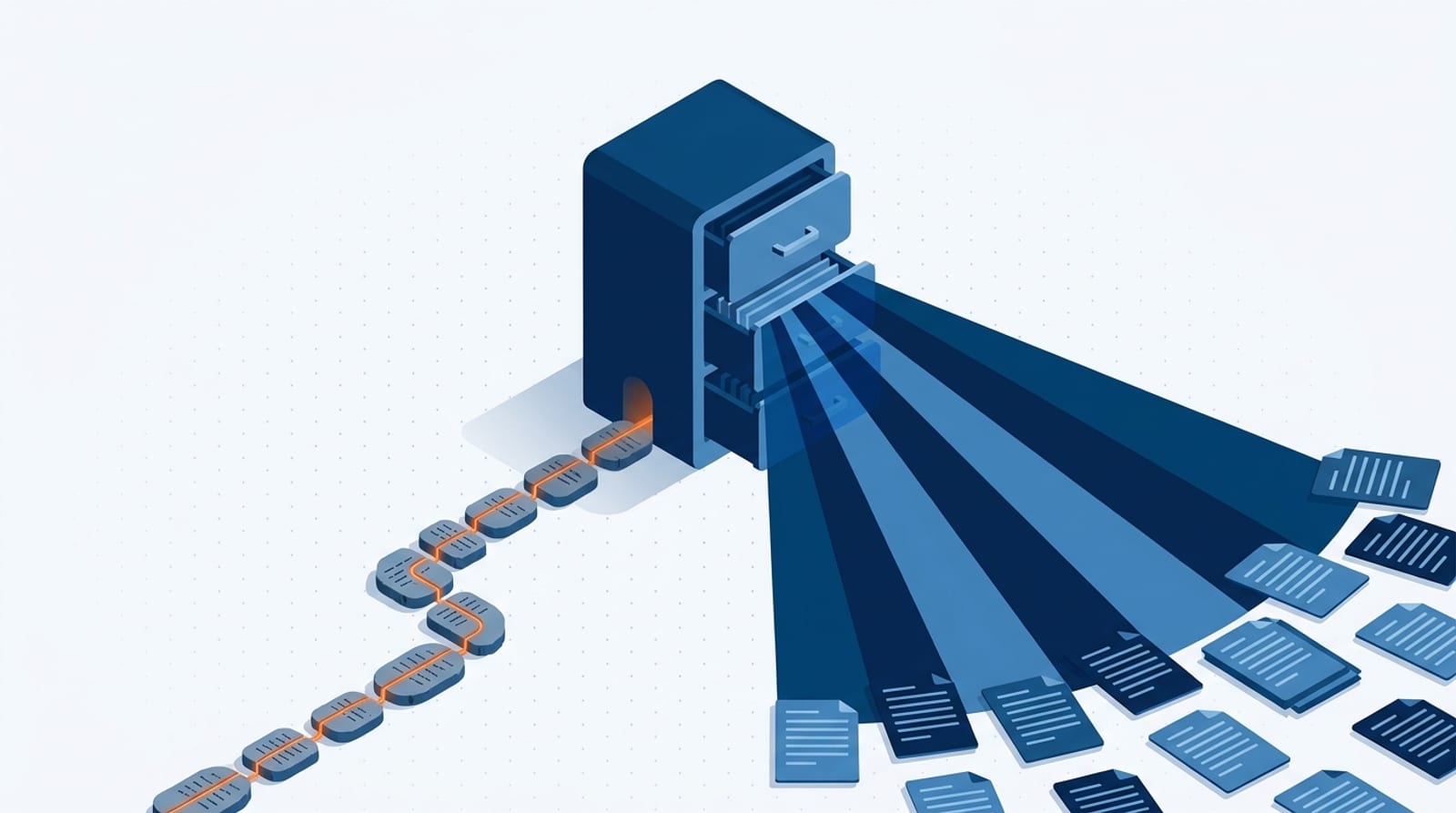
Searchable law and editable documents changed the working day of every living lawyer. Hand-written legal intelligence changed almost nobody's.
The difference between the two columns is not sophistication, it is scale: one grows with the number of lawyers available to write it, the other grows with the collection.
The translation of this to 2026 is direct and unglamorous: before buying reasoning, check whether your collection is searchable. Contracts as scanned PDFs inside a network folder do not become AI input, they become project expense. This is the same argument we make in You rent the AI model. Your company's collection is what nobody can copy.
Wave 2: predicting lawsuit outcomes worked until the test became honest
In 2016, a study published in PeerJ Computer Science classified 584 judgments of the European Court of Human Rights and reached a result that made headlines: the facts of the case predicted the decision with 73% average accuracy, against 62% for the legal argument. The easy reading, that law matters less than facts, circulated widely.
Three years later, another group redid the test with one change in method. Instead of randomly drawing cases for training and testing, it trained on the past and tested on the future, which is how the tool would actually be used. Average accuracy fell from 0.77 to 0.58.
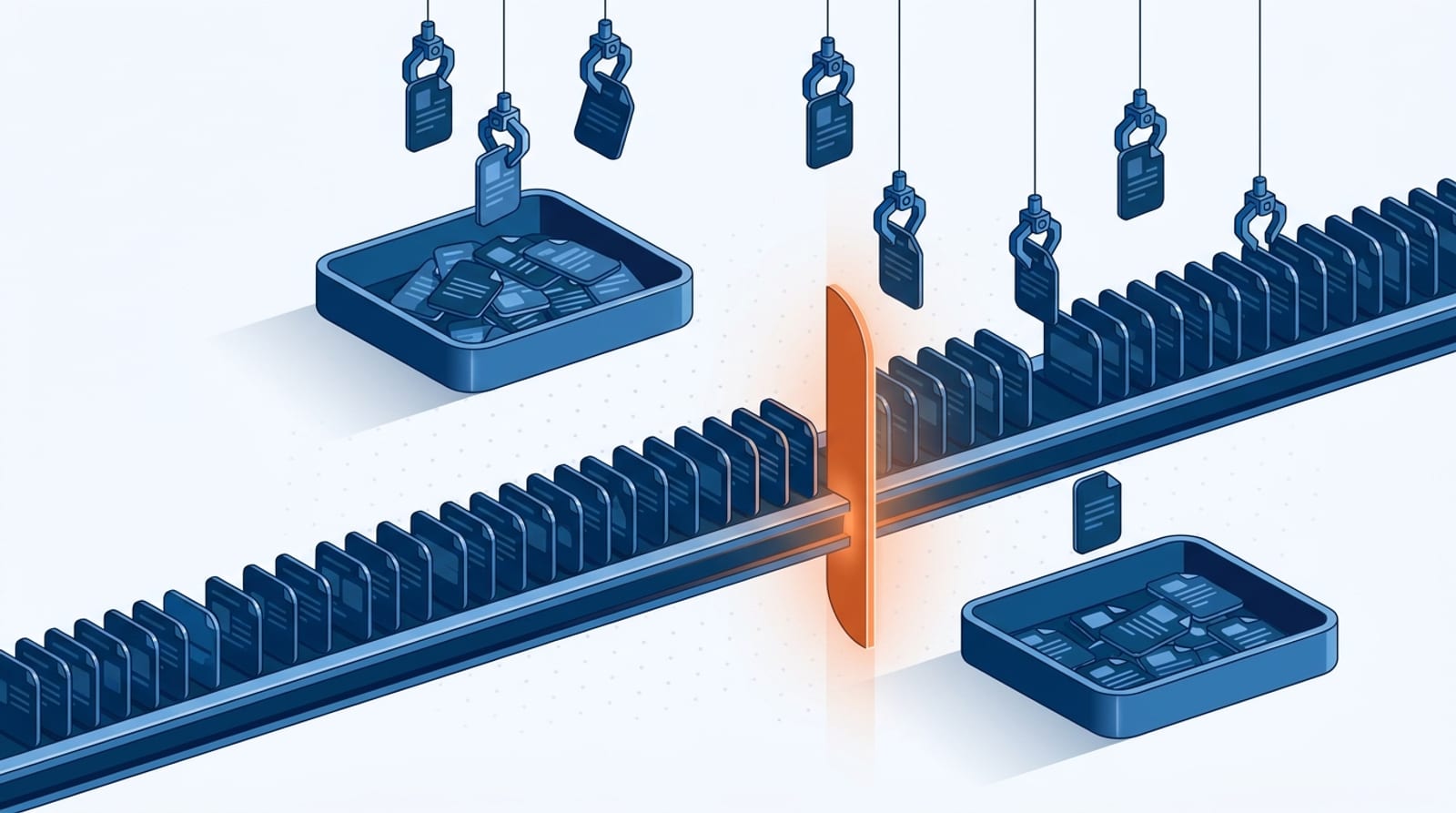
Almost twenty points of accuracy evaporated without a single line of the model changing. What changed was the honesty of the test: drawing cases from all periods lets the model see the future during training, and no tool in production has that privilege.
That is how the field discovered that those systems were learning to recognize patterns of time period and distribution, not to reason about the case.
What this unlocks, and what it blocks, for anyone evaluating jurimetrics today: an accuracy number only means something once you know how the test was split. Ask whether the test respected the timeline. Ask which fields went in. If the answer is vague, the number is decorative. The mechanics of putting that question together are in How to evaluate an AI vendor without believing the number they show you.
Wave 3: a model trained only on law yielded 0.2 points
Between 2020 and 2024, the academic community took legal pre-training from 12 GB of English text to 689 GB in 24 languages and 17 jurisdictions. It was an enormous effort of collection, cleaning and licensing. The aggregate gain was 2.0 points in a 2022 measurement and 0.2 points in the 2024 measurement, according to the datasets' own authors.
This has an immediate and useful commercial consequence: when a vendor charges a premium for a "model trained on law", ask for the measured gain on your task, not on vocabulary. The public evidence available today does not support a large premium for language specialization. What supports gains is your own data and a system designed for your task.
Wave 4: it became useful before it became reliable
In 2023, the legal market, which had been testing language models since late 2022, took generative AI into production in months, not years. In March, OpenAI estimated that GPT-4 was close to the 90th percentile on the American bar exam:
-
Allen & Overy rolls out Harvey to more than 3,500 lawyers
One of the largest law firms in the world puts generative AI into internal production, after a closed test started in November 2022.
-
Casetext launches CoCounsel
A commercial legal assistant built on the new generation of models and open to the market. Two weeks later, the company confirms it runs on GPT-4.
-
Mata v. Avianca: six fictitious cases and a US$ 5,000 fine
The first widely reported case of AI-invented citations taken to court.
-
Lexis+ AI and Westlaw AI-Assisted Research
The world's two largest legal collections enter the race, with the promise of citations checked against their own database.
Nine months passed between the first major law firm with generative AI in production and the two largest legal collections selling the same feature, with a fine for an invented citation along the way. No previous wave came close to that speed.
And the bill keeps running. A public database maintained by researcher Damien Charlotin had recorded, as of August 26, 2026, 1,962 court decisions involving AI-fabricated citations, in more than 50 jurisdictions. That is the subject of The AI cited a case that does not exist, which also covers the rates measured in commercial legal products.
What this unlocks: the usefulness is real and it arrived before reliability. That is not a reason not to use it, it is a reason to design who checks. A useful but unreliable tool is exactly the description of a brilliant intern in their first month, and nobody files the intern's pleading without reading it.
Wave 5: the discovery that changes the project budget
The current wave gives the model tools: it searches the collection, opens the document, runs a check, writes the file. And this is where the most consequential result of the whole talk appeared, in a controlled experiment.
They took a model, froze the weights, fixed the same 100 tasks, the same documents, the same requested file names and the same evaluator. They changed only the code around the model. The rate of criteria passed went from 3.5% to 80.1%.
A twenty-three-fold difference, with the same model. For those who approve budgets, this reorders priorities: switching to the most expensive model is the smallest lever, and it is the only one the market sells ready-made. The whole experiment, with the numbers by framework and what it means for procurement, is in Why the same AI model gets 80% right in one place and 3% in another.
What can go into production today
The rule that comes out of the five waves is simple to apply: AI delivers well on tasks with an answer verifiable in a document, and delivers poorly on tasks whose correctness depends on judgment. Between the two ends there is a wide band where it works with a human reviewer along the way.
Fits now
Verifiable answer, high volume- Finding a clause across a batch of contracts
- Comparing versions and pointing out what changed
- Extracting deadline, amount, venue and owner
- Building a timeline of obligations
- Triage and classification of incoming documents
Not on its own yet
Judgment and accountability- An opinion that settles a position
- A pleading that will be filed
- Settlement strategy and provision amounts
- Case law research without citation checking
- Any deliverable with dozens of mandatory criteria
The left column has something in common that is worth more than the subject: there is an answer key. Someone can tell whether the answer is right by opening the document. That is what makes measurement possible, and what is not measured cannot be improved or defended in an audit.
None of this was measured in Portuguese or on Brazilian law
It is worth saying plainly, because the temptation to carry foreign numbers over to Brazil is strong: the talk does not include a single Brazilian data point. The studies cited cover the European Court of Human Rights, Chinese courts, the American bar exam and contracts in English. None of the measurements was done in Portuguese or on Brazilian law.

This does not invalidate the lessons, which are about method and not about jurisdiction. But it means that any performance number for your case needs to be measured on your case, with your documents and your vocabulary.
Brazilian mass litigation, pleadings in Portuguese with courtroom jargon and citations following the CNJ (Brazil's National Council of Justice) standard are a regime none of these studies touched.
The speaker, incidentally, ended by asking for exactly this: that local experts build benchmarks for their own jurisdictions, because the people who define defensible tasks are those who know the local law. The infrastructure to do this has become cheap. Two of the largest open legal databases cited in the talk, with 1,055,271 Swiss decisions and 36 million indexed cases, were each built by a single lawyer.
Where to start without burning the budget
- Choose a task with an answer verifiable in a document, not one that depends on judgment
- Confirm that your collection is searchable before discussing models
- Build an answer key with your own real cases and freeze that set
- Measure the whole system, not the model, and measure again after each change
- Make explicit, in writing, who checks what before it leaves the company
The fourth item is the one most people skip, and it is what separates a project that evolves from a project that becomes a belief. The fifth is the one that cost those who ignored it dearly in wave 4.
Sources and method
The basis of this article is the talk "Fifty Years of Legal AI: five waves from hand-coded rules to legal agents", by Dr. Joel Niklaus, given at the University of St. Gallen's AI & Legal Reasoning Conference on August 28, 2026. The studies and products cited belong to third parties, with the sources the speaker himself credited:
- Aletras et al.PeerJ Computer Science 2:e93, 2016
- Medvedeva, Vols & WielingArtificial Intelligence and Law 28, 2020
- Chalkidis et al.LEGAL-BERT, EMNLP 2020; LexGLUE, ACL 2022
- Niklaus et al.MultiLegalPile, ACL 2024
- HarveyLegal Agent Benchmark, May 2026
- Damien CharlotinAI Hallucination Cases, August 2026
Third-party measurements added on November 11, 2026: Artificial Analysis, Harvey LAB-AA (July 7, 2026); Vals AI, HLAB-Vals-1.1 (leaderboard of November 9, 2026).
The Harvey and Legora valuations, the hallucination database, the bar exam recomputation and the agent benchmark results were checked against independent sources in the research of September 1, 2026. On November 11, 2026, the benchmark leaderboard was updated with the November measurement (Vals AI), the July one was attributed to Artificial Analysis, and the 2023 timeline was reordered by announcement dates. Harvey, Legora, LexisNexis, Thomson Reuters, Hugging Face, Vals AI and Artificial Analysis are companies external to X-Apps, cited here as subjects of analysis and with no commercial relationship with us.
Frequently asked questions
Not for complete tasks. On the toughest benchmark available today, built on real client cases, the best model tested by Harvey in May 2026 delivered 7.1% of tasks without failing any mandatory criterion. In November 2026, on the Vals AI leaderboard over a revised version of the same benchmark, the leader reached 27%. The two measurements are not directly comparable, but even November's best result leaves three out of four tasks with at least one error. It replaces steps, not deliverables.
Tasks with an answer that can be verified in a document: finding a clause, comparing versions, extracting deadlines and amounts, building a timeline of obligations. The gain comes from reading very fast, not from deciding.
Published evidence does not support the premium. Training on legal text yielded a 2-point aggregate gain in 2022 and 0.2 points in 2024, according to the datasets' own authors. What moves results is the system around the model.
The high numbers published came from tests with random splits of cases. When the same group tested by predicting the future from the past, average accuracy fell from 0.77 to 0.58. And 65% accuracy came from the judges' surnames alone.
With a task that has a verifiable answer, real volume and a controlled cost of error, measured against your own answer key. Batch clause review and document triage fit that description; legal opinions and filed pleadings do not.
No. The source is a talk given in Switzerland in August 2026, with data from the United States, Europe and China. None of the measurements cited was done in Portuguese or on Brazilian law.


