Índice do artigofaltam 14 min de leitura
A privacy policy is not a document to leave for the end of the project.
It must match what the app actually does, what was implemented in the backend and what you declare on Google Play and the App Store.
When an app has login, payments, location, chat, a marketplace, KYC, analytics, crash logs or remarketing, publishing in the stores is no longer just a technical step. The company needs to explain which data it collects, why it collects it, who it shares it with, how it protects it, how long it keeps it and how users can exercise their rights.
This guide shows how to organize that information before sending the app for review. The goal is not to replace your legal team or DPO, but to help the business, product and development teams speak the same language.
This guide is part of the journey to publish an app on Google Play and the App Store. Before filling in privacy and data, also see the steps to create a Google Play Console account, create an Apple Developer account and grant access to the developer with governance, including one-off approvals by the account holder when the store requires them.
Last technical review: May 12, 2026.
Quick summary
Before publishing an app on Google Play or the App Store, prepare four deliverables: a data and SDK map, a public Privacy Policy, Terms of Use when there are operational rules and consistent declarations in Google's Data Safety and Apple's App Privacy.
The most common mistake is declaring one thing in the store, implementing another in the app and publishing a generic policy that does not reflect login, payment, KYC, location, chat, analytics, crash logs, marketing or account deletion.
What you will find here
- The difference between Privacy Policy, Terms of Use, LGPD (Brazil's data protection law), Data Safety and App Privacy.
- How to build a data map of the app before filling in the stores.
- What changes when there is login, chat, a marketplace, payment, KYC, location or remarketing.
- How to think about SDKs, third parties, cloud, analytics, crash logs and anti-fraud.
- How to align app, backend, policy, Google Play and the App Store in a consistency matrix.
- A quick glossary for terms such as SDK, tracking, retention, controller and processor.
- A checklist of what to send to the developer and to the legal team.
- FAQ with common questions before submission.
- Common mistakes that cause rejection, rework or unnecessary support.
How to prepare privacy before publishing the app
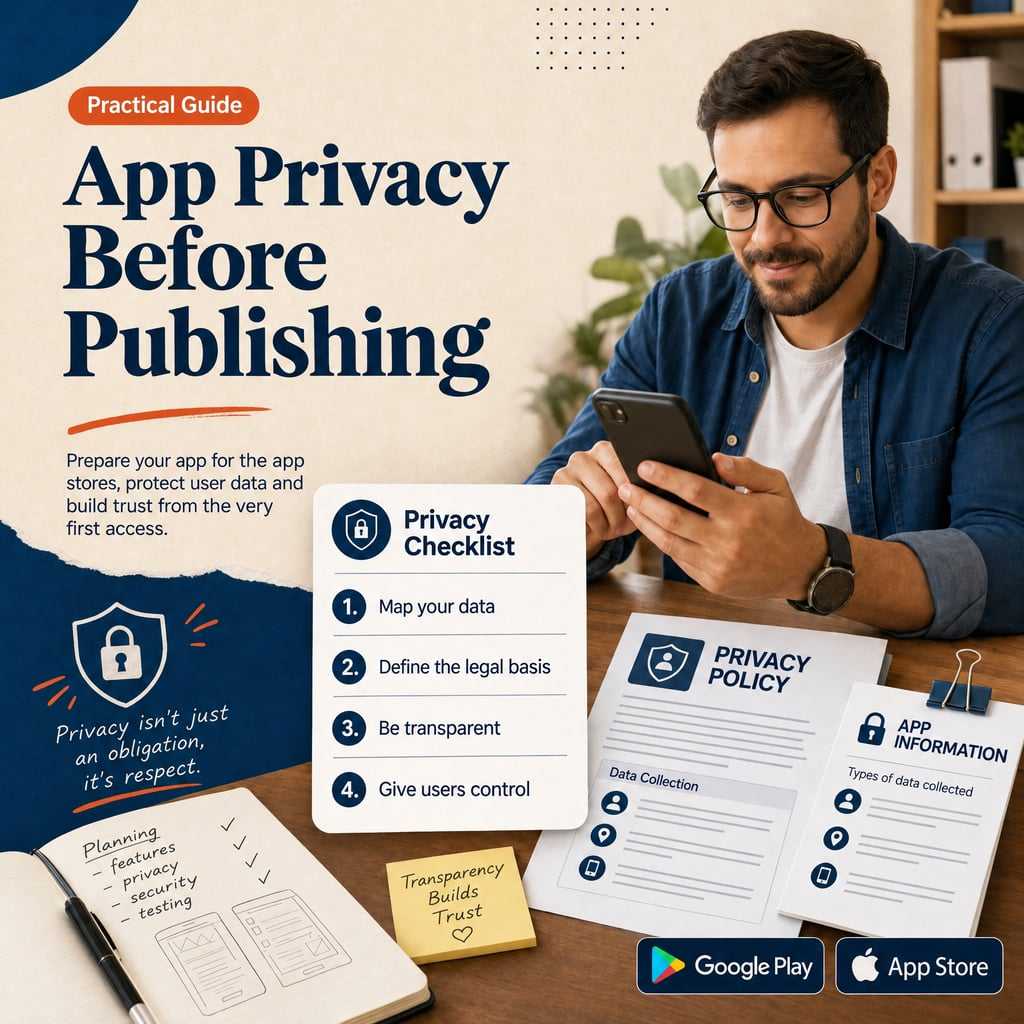
Use this sequence before opening Play Console or App Store Connect:
- List every feature of the app. Login, payment, KYC, chat, location, notifications, public content, marketplace, support, analytics and marketing.
- Map data from the app, backend and SDKs. Don't look only at sign-up fields; events, logs, identifiers and permissions also count.
- Identify who accesses each piece of data. Company, technical team, cloud, gateway, analytics, anti-fraud, app store, support and partners.
- Define purpose, retention, deletion and legal basis. This step should involve legal or the DPO when there is risk, sensitive data, payment, KYC or minors.
- Publish the Privacy Policy at a public URL. The page must be accessible, stable, unblocked and consistent with the real app.
- Implement the links and flows inside the app. Include policy, terms, contact and account deletion when the app lets users create an account.
- Fill in Data Safety and App Privacy based on the real app. Use project evidence, the SDK list and a technical review, not assumptions.
First: each document has a function
It is common to mix everything into a single text. That produces a long, imprecise document that is hard to use when it is time to fill in Play Console and App Store Connect.
In practice, separate them like this:
| Item | What it is for | Where it fits in publishing |
|---|---|---|
| Privacy Policy | Explains how the company handles personal data: collection, use, sharing, retention, security and data subject rights. | Public URL required by the stores and inside the app. |
| Terms of Use | Defines the rules for using the platform: account, conduct, responsibilities, payments, content, marketplace, moderation and termination. | Usually shown at sign-up, in the footer, on the website or on an acceptance screen. |
| LGPD | Brazil's General Data Protection Law. Defines principles, legal bases, data subject rights, security and responsibilities for personal data. | Legal and operational guide for handling the data. |
| Google Play Data Safety | Form in which the developer declares the app's collection, sharing, security, deletion and data types. | Play Console, in the app content section. |
| Apple App Privacy | Declaration of the data types collected, uses, link to the user and tracking for the App Store privacy label. | App Store Connect, in the app privacy area. |
Rule of thumb: the public policy, the app, the backend and the store forms must tell the same story.
Quick glossary
| Term | What it means in practice |
|---|---|
| SDK | Third-party library integrated into the app, such as analytics, crash logs, push, social login, payments, anti-fraud or advertising. |
| Tracking | Use of user or device data to follow behavior across third-party apps, websites or services, especially for advertising and measurement. |
| Controller | Company that decides why and how personal data will be processed. |
| Processor | Vendor that processes personal data following the controller's instructions. |
| Independent controller | Third party that uses data for its own purposes, such as some stores, gateways, anti-fraud providers or media platforms. |
| Retention | How long the company keeps data before deleting it, anonymizing it or preserving it due to legal obligation, security, fraud or dispute. |
| Anonymization | Process that prevents the data from being reasonably associated with a specific person. |
| ATT | App Tracking Transparency, Apple's mechanism related to authorization for tracking on iOS. |
Useful official sources:
- Apple - App privacy details
- Apple - Manage app privacy
- Apple - App Review Guidelines: Privacy
- Google Play - Data safety
- Google Play - User data policy
Before writing: build the app's data map
The mistake that delays this stage the most is starting with the wording of the policy. The safest path is to start with a simple data map.
You need to answer:
- Which data does the app collect?
- Who provides that data: the user, the device, the system, third parties or the store?
- What is each piece of data used for?
- Does the data leave the device?
- Is the data linked to an account or identity?
- Is the data shared with third parties?
- Is the data used for analytics, advertising, remarketing or anti-fraud?
- How long is it stored?
- How can the user access, correct or delete it?
A simple template:
| Category | Examples | Decision question |
|---|---|---|
| Sign-up and contact | name, email, phone, profile photo | Is it needed to create an account, for support or for communication? |
| Login and security | password, token, social login, MFA, access events | How is the account recovered and abuse prevented? |
| Device and usage | IP, operating system, model, app version, screen events | Is it used for operation, security, analytics or performance? |
| Location | address, approximate or precise geolocation | Does the feature depend on it? Does use happen in the foreground or background? |
| User content | photos, videos, texts, ratings, comments, attachments | Is it public, private or shared with other users? |
| Chat and messages | messages, attachments, date/time, participants | Is there moderation, reporting, dispute handling or investigation? |
| Payments | payment status, transaction, chargeback, reconciliation | Does the gateway or store act as a third party/independent controller? |
| KYC and documents | ID document, selfie, face validation, proofs | Is it essential for risk, anti-fraud, withdrawals or compliance? |
| Analytics and crash | clicks, screens, failures, performance, technical logs | Is it aggregated/anonymous or linked to a user/device? |
| Marketing and remarketing | advertising identifiers, events, campaigns | Does it depend on consent, ATT, opt-out or device preference? |
This map is the material that reduces errors in the legal text, in Play Console, in App Store Connect and in development.
Consistency matrix between app, policy and stores
Use this table to prevent each team from declaring different information.
| App feature | Must it appear in the policy? | Must it be reviewed in Data Safety? | Must it be reviewed in App Privacy? | Who validates |
|---|---|---|---|---|
| Login with email, phone or social | Yes | Yes | Yes | Product, dev and legal |
| Payment, subscription or gateway | Yes | Yes, depending on data accessed | Yes, depending on data collected | Product, gateway, dev and legal |
| Analytics or crash log SDK | Yes | Yes | Yes | Dev, product and marketing |
| Approximate or precise location | Yes | Yes | Yes | Product, dev and legal |
| Chat, comments or user content | Yes | Yes | Yes | Product, support and legal |
| KYC, documents or selfie | Yes | Yes | Yes | Product, compliance and legal |
| Account and data deletion | Yes | Yes | Yes | Dev, product and legal |
If the answer changes in one column, review the others. The public policy, the app, the backend, Google's Data Safety section and Apple's privacy label must be consistent.
Apple App Privacy: what the App Store wants to understand
At Apple, privacy answers appear on the App Store privacy label. The company that owns the app must declare the data types collected by the app and by third-party partners integrated into the code, such as analytics, advertising, login, crash, anti-fraud or messaging SDKs.
Points that need to be analyzed before answering:
- which data is collected;
- what it is used for;
- whether it is linked to the user's identity;
- whether it is used for tracking;
- whether it is collected by the app or by third-party SDKs;
- whether the practice changed since the last published version.
Apple also distinguishes data processed only on the device from data transmitted to servers. If a piece of information never leaves the device and is not accessible to the company or third parties for longer than needed to serve the request in real time, the declaration may be different. This needs to be validated case by case.
If the app uses remarketing, advertising, identifiers, marketing SDKs or combines app data with third-party data, treat this with special attention. In many scenarios, this overlaps with tracking, App Tracking Transparency and consent.
Watch out for the Privacy Manifest and SDKs on iOS
Besides the privacy label in App Store Connect, iOS apps need to review the SDKs used in the project. Depending on the SDK and the APIs used, you may need to deal with the Privacy Manifest, third-party SDK signatures and justifications for Required Reason APIs.
This does not replace the Privacy Policy. The goal is to complement the technical analysis: the app needs to know which SDKs exist, which data they access, which APIs they use and how this relates to App Privacy, ATT, the public policy and the in-app experience.
Official references:
- Apple - App privacy details on the App Store
- Apple - Manage app privacy
- Apple - Privacy manifest files
- Apple - Required Reason API entries
Google Play Data Safety: what has to match
On Google Play, the Data Safety form must reflect how the app collects, shares, protects and deletes data. Google makes it clear that the developer is responsible for keeping this section accurate and consistent with the Privacy Policy.
Before filling it in, confirm:
- whether the app collects personal or sensitive data;
- whether there is sharing with third parties;
- whether data is encrypted in transit;
- whether the user can request deletion of account and data;
- whether there is a public Privacy Policy URL;
- whether the policy also appears inside the app;
- whether third-party SDKs collect data automatically.
An important point: on Google Play, the Privacy Policy must be at an active, public URL, not geofenced and not editable by the user. Avoid using a PDF as the main policy. Ideally, use a simple HTML page that is indexable, stable and accessible without login.
If the app lets users create an account, treat account deletion as a publishing requirement, not a legal detail. Prepare two paths: an in-app flow and a web page to request deletion of the account and associated data. The web page must work, be easy to find and mention the app or the developer.
Official references:
- Provide information for the "Data safety" section
- User data policy
- App account deletion requirements
Privacy Policy: a minimum structure that usually works
A good policy must be clear to the user and useful to whoever fills in the stores. It should not be too generic.
A practical structure:
-
Who the responsible company is
Company name, role as controller, privacy channel and contact. -
Scope of the policy
App, website, dashboard, registered users, visitors, customers, service providers, merchants or other profiles. -
Categories of data processed
Data provided by the user, collected automatically, generated by use and received from third parties. -
Purposes and legal bases
Sign-up, authentication, operation, security, payments, support, marketing, analytics, anti-fraud, legal compliance and exercise of rights. -
Sharing with third parties
Cloud, gateway, app store, analytics, crash, messaging, support, anti-fraud, KYC, authorities and operational partners. -
SDKs, cookies and identifiers
Separate operation, security, analytics, advertising, remarketing and performance. -
Retention and disposal
What stays while the account is active, and what may stay due to legal obligation, dispute, security, anti-fraud or transaction history. -
Data subject rights
Confirmation, access, correction, deletion when applicable, portability when applicable, withdrawal of consent and objection when applicable. -
Information security
HTTPS, access control, authentication, logs, monitoring, backup, incident response and good practices. -
Policy updates
How the company communicates relevant changes.
For data subject rights in Brazil, use as an institutional reference the page of the ANPD (Brazil's data protection authority) on data subject rights.
Terms of Use: what should not be missing in apps with real operations
Terms of Use do not replace the Privacy Policy. They explain the rules for using the platform and reduce operational conflict.
In apps with accounts, content, payment, a marketplace or service delivery, consider including:
- electronic acceptance and updates to the terms;
- eligibility, minimum age and accuracy of sign-up information;
- account security and responsibility for the use of credentials;
- rules of conduct and acceptable use;
- user content, license of use and responsibility for posts;
- moderation, reports, appeals and enforcement measures;
- payments, fees, refunds, chargebacks, payouts and disputes;
- rules for marketplace, service providers, partners or merchants, when applicable;
- prohibition of fraud, disintermediation, scraping, spam and abuse;
- availability, maintenance, support and operational changes;
- intellectual property, integrations and third-party services;
- suspension, account termination and its effects;
- jurisdiction, applicable law and contact channel.
The goal is to prevent every dispute from becoming an informal interpretation. The terms must reflect the real operation of the app, not a copied generic template.
Examples by type of app
| Type of app | Privacy points that usually need attention |
|---|---|
| Marketplace | Buyer and seller data, address, payment, payouts, disputes, ratings and moderation. |
| App with KYC | ID document, selfie, face validation, liveness, anti-fraud, retention for compliance and verification partner. |
| App with chat | Messages, attachments, reports, moderation, logs and preservation of evidence in disputes. |
| App with location | Approximate or precise location, foreground or background, purpose and a manual alternative when possible. |
| App with remarketing | Advertising identifier, events, media platforms, consent, ATT and opt-out. |
| App with subscription or in-app purchase | App store, gateway, receipts, chargeback, cancellation, support and transaction retention. |
Scenarios that require extra attention
App with login
If there is an account, there is usually an email, phone, user identifier, access events, credential recovery and some kind of security log. This affects the policy, the store declarations and the account deletion flow.
Related guide: App login: which model to choose.
App with a marketplace, service providers or merchants
A marketplace usually involves multiple roles: customer, seller, service provider, partner store, administrator and support. Each profile may have different data and responsibilities.
Critical points:
- who is responsible for delivering or performing the service;
- which data is shared between users;
- how payments, fees, payouts and disputes work;
- when the platform acts as an intermediary;
- which documents may be required from service providers or merchants.
If there is also a payment split, review the payments and KYC journey before publishing.
Related guides:
- Payments in the app: how to choose a gateway and avoid rejection
- KYC and document validation: questions that define cost and complexity
App with chat, social network or user content
When users post photos, texts, comments, ratings, listings or messages, the policy must explain how that content is handled. The terms must also provide for community rules, reports, moderation and measures against abuse.
Important questions:
- is the content public, private or visible only to certain users?
- can private messages be analyzed in case of a report, fraud, risk or dispute?
- is there human, automated or hybrid moderation?
- can the user delete content?
- what evidence can be preserved in case of an investigation?
App with location, camera, photos, microphone or contacts
Sensitive permissions must have a clear purpose consistent with the experience. If the app collects background location, contacts, media, camera or microphone, it is not enough to write this in the policy: in some cases, you need to explain it inside the app before the permission prompt.
Google Play requires a prominent disclosure when the collection or use of personal and sensitive data does not match the user's obvious expectation for that feature. Apple also evaluates consistency between purpose, permission, description and experience.
App with marketing, remarketing or advertising
Remarketing and measurement may involve advertising identifiers, usage events and integration with external platforms. This topic must be aligned between product, marketing, legal and engineering.
Quick checklist:
- which events are sent to campaigns?
- is there an advertising identifier?
- is there an ad, attribution or remarketing SDK?
- does the user have an opt-out or preference controls?
- on iOS, is there an App Tracking Transparency impact?
- does the policy explain marketing and measurement clearly?
What to send to the developer before publishing
To avoid rework, send an objective briefing:
- Public URL of the Privacy Policy.
- URL of the Terms of Use, if any.
- Support channel and privacy channel.
- List of data collected in the app.
- List of SDKs and third parties used.
- Which data is shared with third parties.
- Which data is used for analytics, crash, anti-fraud or marketing.
- Which permissions the app requests and why.
- How account and data deletion works.
- Whether there is payment, subscription, split, refund or chargeback.
- Whether there is KYC, documents, selfie, biometrics, liveness or company validation.
- Whether there is public content, chat, reporting, moderation or a marketplace.
This material feeds the policy, Play Console, App Store Connect, the app screens and the technical review.
Checklist before submitting for review
- Privacy Policy is published at a public, working URL.
- The policy mentions the app, company, contact and privacy channel.
- Terms of Use exist when there is an account, marketplace, content, payment or community rules.
- Google's Data Safety was filled in based on the real app, not on assumptions.
- Apple's App Privacy takes SDKs and third-party partners into account.
- iOS apps reviewed Privacy Manifest, SDK signatures and Required Reason APIs when applicable.
- Login, device, analytics and crash log data were mapped.
- Payments, KYC, documents and anti-fraud were carefully reviewed.
- An account deletion flow exists when the app lets users create an account.
- A deletion web page exists for Google Play when applicable.
- Policy, Data Safety, App Privacy, app permissions and store texts tell the same story.
- Sensitive permissions have a clear justification.
- Marketing and remarketing SDKs were evaluated.
- The policy, the app and the store forms are consistent.
If the app has accounts, also see: Account deletion and LGPD: the right flow to get approved by Apple and Google Play.
If you are close to submission, do a cross-review before sending: installed app, backend, SDKs, public policy, Data Safety, App Privacy, account deletion and sensitive permissions. It is cheaper to fix things at this stage than to respond to a rejection later.
Common mistakes that cause rejection or rework
-
Using a policy that is too generic
Fix: mention the app's real data and purposes. -
Declaring less data in the stores than the app collects
Fix: review backend, SDKs and events before filling in. -
Forgetting that SDKs also collect data
Fix: ask the technical team for the list of SDKs and their purposes. -
Publishing the policy as a PDF or on a blocked page
Fix: use a public, accessible and stable URL. -
Having login without account deletion
Fix: implement an in-app flow and a web resource when applicable. -
Not explaining retention
Fix: say what is deleted, anonymized or retained due to legal obligation, security, anti-fraud or dispute. -
Using remarketing without aligning consent and tracking
Fix: involve legal, marketing and engineering before submission. -
Terms of Use don't cover the real operation
Fix: if there is a marketplace, payment, content, moderation or disputes, that must appear in the terms.
FAQ
Does an app need a Privacy Policy to be published on Google Play?
Yes. Google Play requires a Privacy Policy provided in Play Console and accessible inside the app. The policy must explain data access, collection, use, sharing, security, retention and deletion.
Does an app need a Privacy Policy to be published on the App Store?
Yes. Apple requires a Privacy Policy link in the App Store Connect metadata and expects it to be easily accessible to the user in the app.
What is the difference between Privacy Policy, Data Safety and App Privacy?
The Privacy Policy is the public document about data handling. Data Safety is Google Play's data declaration. App Privacy is the declaration Apple uses for the privacy label shown on the App Store.
Do third-party SDKs need to be included in privacy declarations?
Yes. Analytics, advertising, login, push, crash log, anti-fraud, payment or messaging SDKs may collect data automatically. They must be included in the technical map and, when applicable, in the store declarations and the policy.
Does an app with login need account deletion?
In practice, yes. If the app lets users create an account, prepare an in-app deletion flow and, for Google Play, also a web page for requesting deletion of the account and associated data.
Can I use a PDF as my Privacy Policy?
For store publishing, it is not good practice and can cause problems. Use a public HTML URL, accessible without login, stable and not editable by the user.
Do Data Safety and App Privacy need to be identical?
They are not identical forms, but they must be consistent with each other, with the app, the backend, the SDKs, the public policy and the permission screens.
Do Terms of Use replace the Privacy Policy?
No. Terms of Use cover account rules, conduct, payment, content, moderation and responsibilities. The Privacy Policy covers collection, use, sharing, retention, security and rights over personal data.
How this connects with publishing the app
Privacy is not an isolated step. It relates to the developer account, backend, login, payments, KYC, environments, testing and post-launch.
Related guides to continue the journey:
- What do I need to publish my app on Google Play and the App Store?
- How to create a Google Play Console account and grant access to the developer
- How to create an Apple Developer account and grant access to the developer
- Staging and production environments: why separate them before publishing
- Recurring costs of an app: servers, stores, APIs and maintenance
Official sources consulted
- Apple - App privacy details
- Apple - Manage app privacy
- Apple - App Review Guidelines: Privacy
- Apple - Privacy manifest files
- Google Play - Data safety
- Google Play - User data policy
- Google Play - App account deletion
- ANPD - Data subject rights
How X-Apps helps
X-Apps can help the company turn this topic into execution: mapping data, reviewing app flows, guiding how to fill in the stores, and aligning the Privacy Policy, Terms of Use, account deletion, SDKs, backend and publishing.
The practical gain is fewer rejections, less rework between legal and technology, and arriving at store review with consistent information.
| X-Apps can help with | Legal/DPO must validate |
|---|---|
| Technical map of data, SDKs, permissions and third parties. | Legal bases, final wording of the policy and risk assessment. |
| Consistency between app, backend, Data Safety and App Privacy. | Data subject rights, retention, international transfer and incidents. |
| Technical account deletion flows, links and screens required by the stores. | Terms of Use clauses, contracts with third parties and responsibilities. |
This content is for guidance and does not replace legal analysis, a DPO or a compliance review. The final decision on legal bases, retention, sharing and legal texts must be made by the company responsible for the app.