Índice do artigofaltam 7 min de leitura
The API exists, the vendor confirmed it exists, and still the data does not show up on the screen. That is the exact point where most integration projects discover the problem was never technological.
The scene repeats itself in mid-sized companies. The ERP has the customer record. The CRM has the deal. The e-commerce site has the order. The app has the end consumer. All four work well, each in its own corner, and nobody can see the whole operation anywhere.
This article is about what needs to be decided before anyone writes the first line of integration code. It is not a technical manual: it is the set of questions that separates an integration project that goes into production from one that turns into a scope argument in the third month.
Article summary
- An API existing does not mean it delivers the field you need. In the projects we have run, a missing field stalls more integrations than a connection failure.
- What defines the timeline is not technical difficulty: it is who has permission to change each side of the connection. When only the ERP vendor can publish a field, the schedule is theirs.
- There are five ways to connect two systems, and the wrong choice shows up months later, in the maintenance bill.
- The document that prevents most scope disputes is the data contract, and it needs to exist before the quote, not after.
The API exists and the data still does not arrive
The most expensive misreading on this subject is thinking that integration means plugging in a cable. The conversation usually ends with "the system has an API, so we can integrate", and that sentence hides three different questions that need three different answers.
Having an API means there is a door. It says nothing about what goes through it. In an app project for a tire retail chain, the ERP had a published API, the team had the credentials, the connection responded, and the app could not find customers by CPF (Brazil's individual taxpayer ID). The CPF was registered in the ERP. It simply did not come back in the response, because the field was not part of the published resource. Months later, the same project needed the area code and date of birth, and it was the ERP vendor, not the app team, that had to change the API.
That is the real shape of the problem. It is not a connection failure, it is a missing field. And the fix was not on the side of whoever was building the app.
What stalls things is not technology, it is who can change what
Every integration has two sides, and almost never does the same person control both. That asymmetry is the variable that most influences the schedule and the one that least appears in commercial proposals.
In practice there are three control boundaries, and it is worth mapping each one before promising a date. The first is the side you control, usually the app, the website or the new platform, where any adjustment goes into the next delivery. The second is the side a vendor controls, the off-the-shelf ERP or CRM, where publishing a new field depends on opening a ticket, waiting in a queue and sometimes buying support hours. The third is the side nobody controls anymore, the legacy system whose author has left the company, where the only reliable source is the database.
The business consequence is direct: when the three boundaries are mapped, the schedule stops being a technical estimate and becomes a sum of dependencies with names and owners. It is the difference between "four weeks" and "four weeks after TOTVS (a Brazilian ERP vendor) publishes the field, which depends on the ticket opened on such-and-such date".
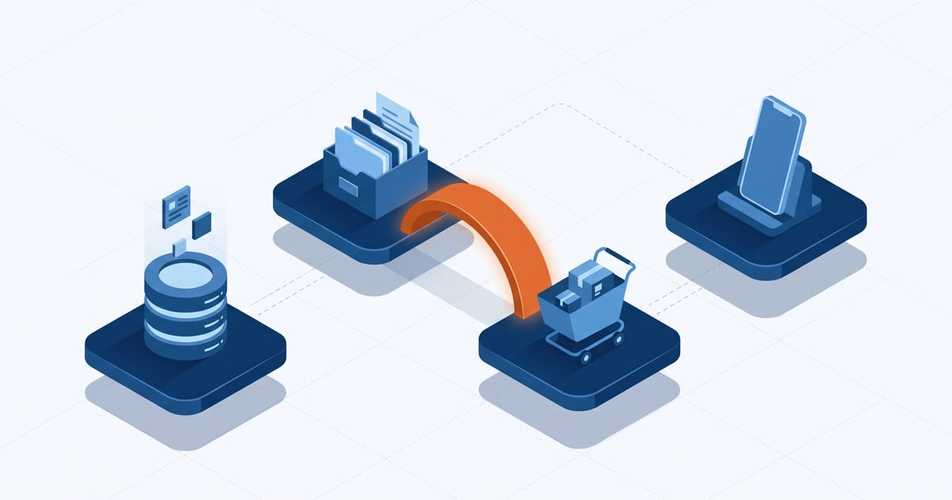
The diagram above is the shape we find most often: a core the company can evolve at its own pace, surrounded by systems that evolve at third parties' pace. Recognizing this is not pessimism, it is what makes planning possible.
The five ways to connect two systems
There are five paths, and the difference between them does not show up at delivery. It shows up in maintenance, six months later, when someone needs to change something.
| Mode | When it fits | The price you pay later |
|---|---|---|
| Batch file | Large, periodic loads: catalog, payroll, accounting close | Structural delay. The data is always from yesterday, and nobody notices until a customer complains |
| Vendor API | Point lookups and writes, when the needed field is already published | Dependence on the vendor's calendar for any new field |
| Direct database reads | Legacy system with no API and nobody maintaining it | Silent breakage with every version upgrade, and usually loss of support |
| Event and webhook | Immediate reaction: order created, payment approved, status changed | Requires handling resends, ordering and duplicates. Without that, the data slowly diverges |
| Integration platform | Many simple connections between off-the-shelf systems | Cost per volume and limited control when the rules get complex |
The middle column is the one the sales team reads. The right-hand column is the one that decides whether the project will be a source of pride or embarrassment the following year. In most real cases the right answer is a combination: batch for volume, API for lookups, events for what needs to be immediate.
Real time is expensive and almost never needed across the board
The decision that most inflates budgets without improving operations is treating the whole integration as real time. It rarely needs to be.
It is worth separating what the user is looking at on screen from what the company reconciles later. Balance, order status and appointment availability need to be immediate, because the customer is waiting for the answer. Product catalog, price list and accounting close work perfectly with an overnight load, and nobody on the other side notices a difference.
There is also an intermediate case that is often forgotten: the same vendor may offer both. In an integration for looking up outstanding vehicle fines and taxes, the same company exposed a synchronous route and an asynchronous route, with different semantics. Choosing the wrong one does not produce an error, it produces a poor experience that only shows up with the app already in production and real volume.
The data contract prevents most disputes
Before the quote, before the schedule and before choosing technology, there is a short document that defines whether the project will go well: the data contract.
It answers, in writing, which fields travel, in what format, how often, which system is the source of truth for each field and what the system should do when the data does not exist on the other side. It looks like bureaucracy, and it is the piece that prevents the most unpleasant conversation of all, the one where one party says the integration was in scope and the other says it was not.
It is worth noting that this risk is real and commercial, not hypothetical. In a retail project with in-store installment credit, the line "integration with the ERP" was in the formal plan and in the kickoff, and it still became a disagreement, because what was written was the system's name, not which exact queries the app would make against it.
- Each field listed with name, type and which system is its source of truth
- Frequency defined field by field, not a single frequency for everything
- Expected behavior when the data does not exist, is empty or comes in an old format
- The name of the person responsible, on each side, for publishing changes to the connection
- The staging environment named, with who grants access to it
The last item looks like a detail and is not. A test environment made available late is one of the most common causes of delay, and sometimes the block is not even technical: in a payment provider integration, the test environment rejected calls with a permission error until the merchant was commercially enabled on the other side.
Integrate, replace or coexist
Not every annoying system needs to be integrated, and almost none needs to be replaced urgently. It is worth placing each case on the matrix below before deciding.
The top-left quadrant is the most delicate: a system the operation depends on and that nobody evolves anymore. There the answer is neither to integrate nor to replace immediately, but to place a layer on the outside that isolates the rest of the company from it, and buy time to decide on replacement without rushing. That layer is what protects the investment on the other fronts, and it is the subject of API-first architecture.
Who answers when the integration breaks
An integration is a production system that depends on another production system. It will break, and the time to define who responds is before, not during.
Three agreements solve almost everything. The first is to log every call, with what was sent and what came back, because without that the conversation between the two vendors comes down to one side's word against the other's. The second is to define the product's behavior when the other side is down: showing old data with a warning is usually better than an error screen. The third is to agree, in writing, on the channel and response time for escalating to the vendor on the other side.
To be honest about the limits: a well-designed integration layer reduces the number of failures, makes each failure diagnosable and makes fixes cheaper. It does not guarantee that the system on the other side stays up.
Where to start without stopping the operation
The path that works is to start with a narrow vertical slice, with real value, and not with a complete integration project.

Pick a question the operation asks every day that today requires opening two systems. Checking the customer's balance. Seeing whether the order was invoiced. Knowing whether the part is in stock. Integrate just enough to answer that question end to end, put it into production and measure.
What you learn on the first complete path is worth more than any six-week assessment, because it reveals the missing fields before the whole budget is committed.
From there, each new slice is cheaper than the previous one, because the authentication layer, call logging and error handling already exist.
Frequently asked questions
Almost never. In most cases the ERP remains the source of truth and gets an integration layer on the outside. Replacing the ERP is a much bigger project, with much greater risk, and it solves a different problem.
It solves the easy half. Having an API means there is a door. It does not mean the door exposes the fields you need, at the frequency you need, with permission for whoever will consume it. Those three things are what define timeline and cost.
It is the written agreement on which fields travel between the two systems, in what format, how often, which system is the source of truth for each one and what happens when the data does not exist. It is the document that prevents most scope disputes.
Technically it is usually possible, and it is the fastest path in the short term. The cost shows up later: you start depending on the internal table format, which changes in version upgrades without notice, and you usually lose the vendor's support guarantee.
The right question is not who builds it, but who can change each side. If only the ERP vendor can publish a new field, the project schedule depends on their calendar, and that needs to be in the contract before the date is promised.
Rarely all of it. Balance and status lookups usually need real time; catalog loads and accounting close work well as an overnight batch. Treating everything as real time multiplies infrastructure cost with no operational gain.
Sources and method
This article is based on integrations carried out by the X-Apps team between 2023 and 2026, involving TOTVS Protheus, TOTVS Fluig, VTEX, Salesforce, HubSpot, retail ERPs and payment and lookup providers. The cases cited were de-identified when the relationship between client and system is not public.
The statements about platform behavior were checked against each vendor's official documentation on August 31, 2026. Prices, call limits and service levels were not researched and therefore do not appear in the text.