

Índice do artigofaltam 22 min de leitura
In short: ChatGPT ads arrived in Brazil in August 2026 and, in the same month, the self-serve Ads Manager opened to companies headquartered in the country. Today any Brazilian company can create an account at ads.openai.com, go through verification and launch a campaign with a minimum of R$ 40 (Brazilian reais) per day. The early-mover advantage has shrunk: OpenAI already counts more than 100,000 advertisers worldwide. What still separates those who learn fast from those who burn budget is having the offer, website, creatives and measurement ready before a single real of budget is spent.
ChatGPT ads started running in Brazil in August 2026, and OpenAI recorded the launch in the country in an official note on August 11. Ads appear to users on the Free and Go plans, and OpenAI does not show ads to accounts identified as belonging to people under 18. Subscribers to Plus, Pro, Business, Enterprise or Education still see no ads.
What makes this launch interesting for companies selling high-consideration products and services is not the size of the audience. It is the type of signal. On Google, the starting point is usually a short query. On Meta, a profile and a reaction to a creative. On ChatGPT, the starting point can be an entire conversation, with the problem, context, constraints and decision criteria.
This guide was published on August 5, 2026 and revised on November 10, 2026 against OpenAI's official documentation in force on that date. It separates what is already fact from what is still hypothesis and shows what your company needs to do to advertise with qualified lead measurement from the very first campaign.
What is already in effect in Brazil
When this guide came out, on August 5, OpenAI's official Ads Manager availability page listed Brazil as Coming Soon. That changed later in August: the self-serve Ads Manager is open to Brazilian companies. When checked on November 10, 2026, the same page lists Brazil as Available, in a list of 89 available countries, and notes that to use self-serve, the legal entity that advertises and is billed must be headquartered in a country marked as available.
| Item | Status on Nov 10, 2026 |
|---|---|
| Ads running on ChatGPT in Brazil | Yes, since August 2026 |
| Plans that see ads | Free and Go; accounts identified as belonging to people under 18 are excluded |
| Self-serve Ads Manager for companies headquartered in Brazil | Yes, sign-up at ads.openai.com |
| Minimum daily spend for accounts billed in reais | R$ 40 per campaign |
| Agencies that took part in the pilot | BETC Havas, Monks, Omnicom, Publicis and WPP |
The exact date self-serve opened varies among trade press sources: one report said August 6 and another said August 17. What matters to the advertiser is the current status, and it is documented on the official availability page.
The R$ 40 minimum is in the official table of minimum spend by billing currency, alongside US$ 25 for dollar accounts and £15 for pound accounts.
In practice, a Brazilian company that wants to advertise has two tasks:
- Create the account at ads.openai.com, set up billing and complete account verification and review.
- Have the offer, landing pages, tracking and CRM ready before publishing the first campaign.
The second task is what separates those who will learn fast from those who will burn budget learning the basics later.
From the interest form to direct sign-up
In August, the public entry point was OpenAI's interest form for advertisers, which asked for name, work email, job title, company, website, headquarters country, countries of interest and type of business, with no campaign, budget or billing to configure.
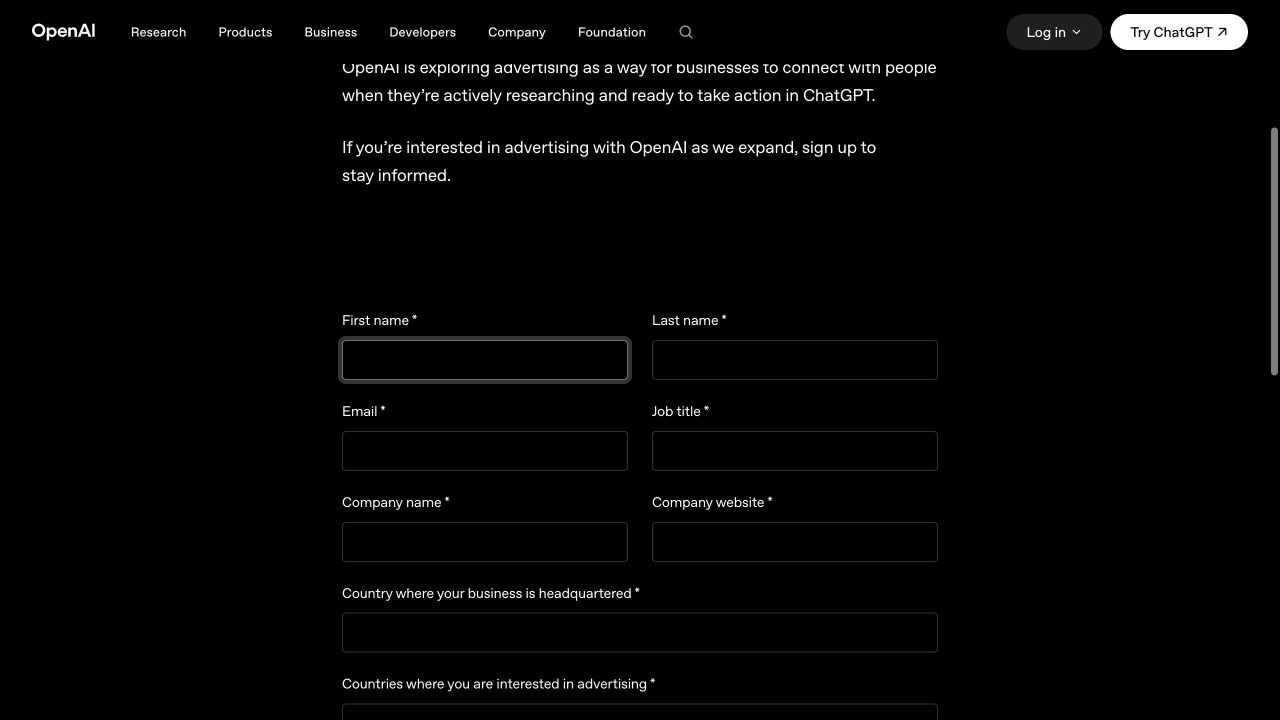
Screenshot of OpenAI's public page on August 5, 2026, before self-serve opened in Brazil.
Today the address openai.com/advertisers redirects to ads.openai.com, where sign-up leads straight to the Ads Manager. OpenAI says the fastest path is to create the account there; larger advertisers with more complex needs can request help from the sales team on the same site.
Why the early-mover window was real (and is closing)
The "get in early" argument is usually vague. In this case, there is a concrete number to back it up, and a more recent one showing how fast the window is closing.
OpenAI turned on ads in the United States on February 9, 2026. On March 26, less than two months later, the company confirmed to CNBC that the pilot had already passed US$ 100 million in annualized revenue and was working with more than 600 advertisers. In the same update, about 85% of Free and Go users in the United States were eligible to see ads, but fewer than 20% saw one on any given day.
Translation: the channel went from zero advertisers to more than 600 in less than two months, in a single country, with deliberately restricted inventory.
The expansion followed a fast calendar:
| Date | Move |
|---|---|
| Feb 9, 2026 | Test begins in the United States |
| Mar 26, 2026 | Expansion announced to Canada, Australia and New Zealand |
| May 7, 2026 | United Kingdom, Mexico, Brazil, Japan and South Korea announced |
| Aug 11, 2026 | Official note confirms the launch in the United Kingdom, Mexico, Brazil, Japan and South Korea |
| Aug 2026 (date varies between August 6 and 17 depending on the source) | First ads in Brazil and self-serve Ads Manager opened to companies headquartered in the country |
After that, the pace picked up. In the announcement of the expansion to 26 more countries, published by OpenAI a little over eight months after ads began, the company said more than 100,000 advertisers had already run campaigns on ChatGPT and that the channel was now available in 89 countries, including Argentina, Chile, Colombia and Peru. The Brazilian auction, therefore, is no longer empty ground. The advantage for those arriving now does not come from being first in line, but from arriving with their house in order.
The early-mover advantage, however, needs to be described honestly. There is no promise of cheap media. OpenAI itself says the platform does not yet have performance benchmarks by advertiser, industry or campaign type, and that results will depend on objective, creative, landing page and relevance.
The real advantage for those who get in before their direct competitor is different and more durable:
- discovering earlier which types of conversation generate sales opportunities in your industry;
- building up creative data while the competitor is still reading the documentation;
- having the Pixel, Conversions API and CRM integrated before you need to compete on efficiency;
- getting through the account verification queue before it gets congested.
In the beginning, the biggest advantage is not buying cheap clicks. It is building up learning while competitors are still figuring out how to turn a conversation into a campaign.
What ChatGPT Ads is, technically
The current format is a sponsored unit displayed below a ChatGPT answer. Each ad contains:
- advertiser name;
- favicon or logo;
- headline;
- supporting text;
- image;
- landing page.
The system picks the ad based on relevance and expected outcome, considering the context and intent of the current conversation, the landing page, the headline, the text, the context hints provided by the advertiser and, when personalization is turned on, selected signals from the user's broader ChatGPT experience.
When this guide came out, OpenAI described the auction as a second-price auction weighted by relevance. The documentation revised in November 2026 is more generic: it says the auction determines which eligible ads appear, that the final winning bid sets the price paid and that the system aims to maximize value for advertiser and user. The practical point is the same: the highest bid alone does not guarantee the impression, because selection takes relevance and expected outcome into account.
For CPC campaigns, OpenAI's general guidance is to start with a maximum bid between US$ 3 and US$ 5 per click. Note: this is platform guidance, not a Brazilian benchmark, and it is not the price actually charged.
What advertising on ChatGPT does not buy
This is the point that generates the most misinformation in the market, so it is worth being explicit.
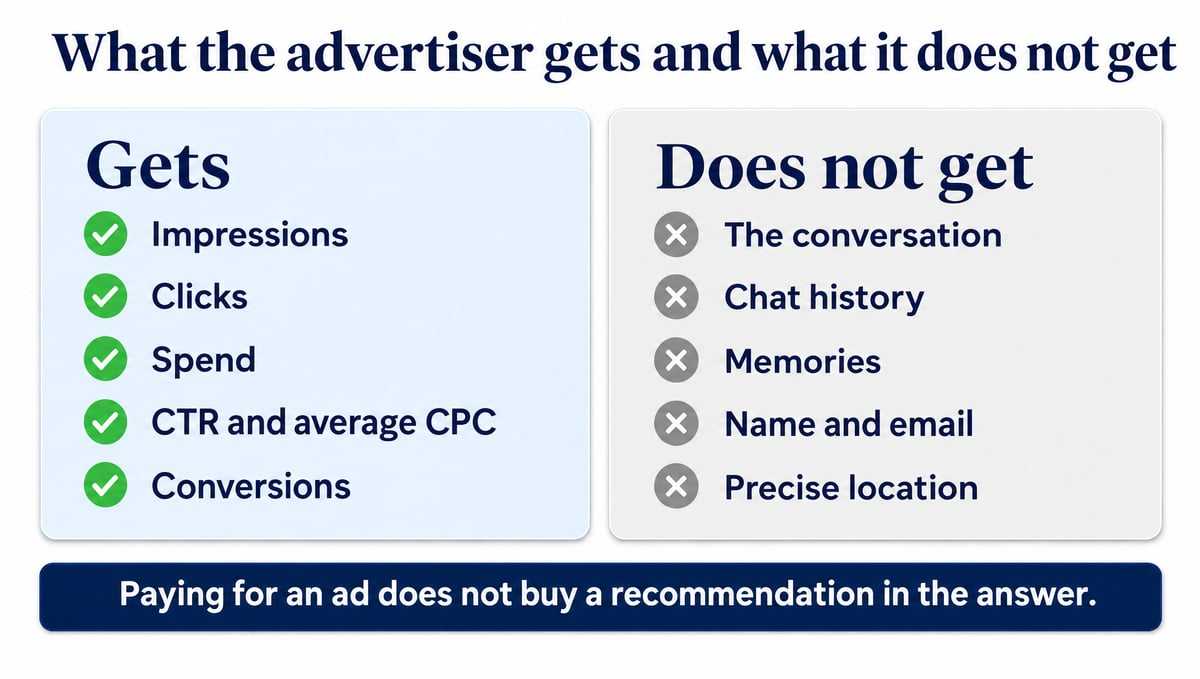
- Paying does not make ChatGPT recommend your company in the answer. Ads run on systems separate from the chat model, and advertisers have no way to influence, rank or change the answers.
- Seeing an ad does not mean an OpenAI endorsement. The documentation says so in no uncertain terms.
- The advertiser does not receive the conversation. No chats, history, memories, name, email, precise location, IP address or sensitive information. Reporting is aggregated.
- Ads do not appear in temporary chats, nor near sensitive topics such as personal health, mental health and politics.
In addition, the policies prohibit ads that imitate ChatGPT's look, functionality or voice in a way that confuses the user. In other words, no creative pretending to be a model answer, and no "recommended by ChatGPT" in the headline.
OpenAI Ads' public page illustrates this separation: the unit appears labeled Sponsored below the answer, not as a recommendation inside it.
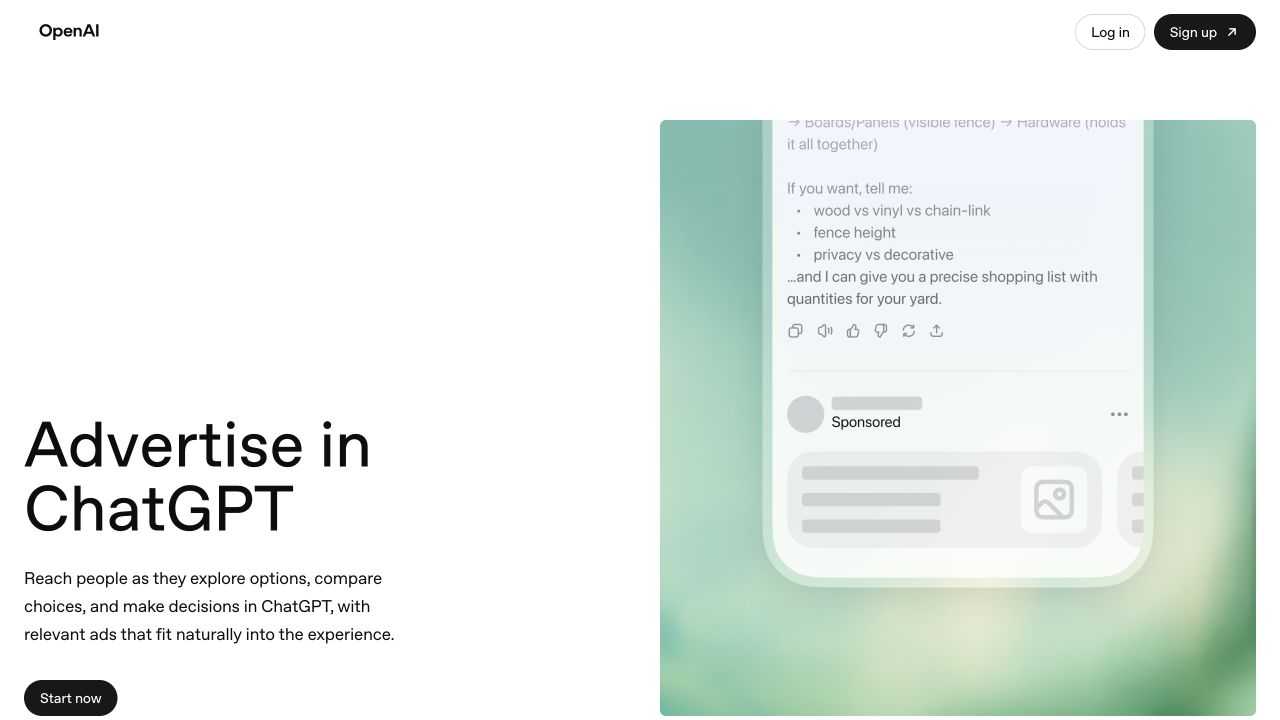
Screenshot of OpenAI Ads' public page on August 5, 2026. The image illustrates the sponsored format, not an OpenAI endorsement of the advertiser.
Why a conversation is a different intent signal
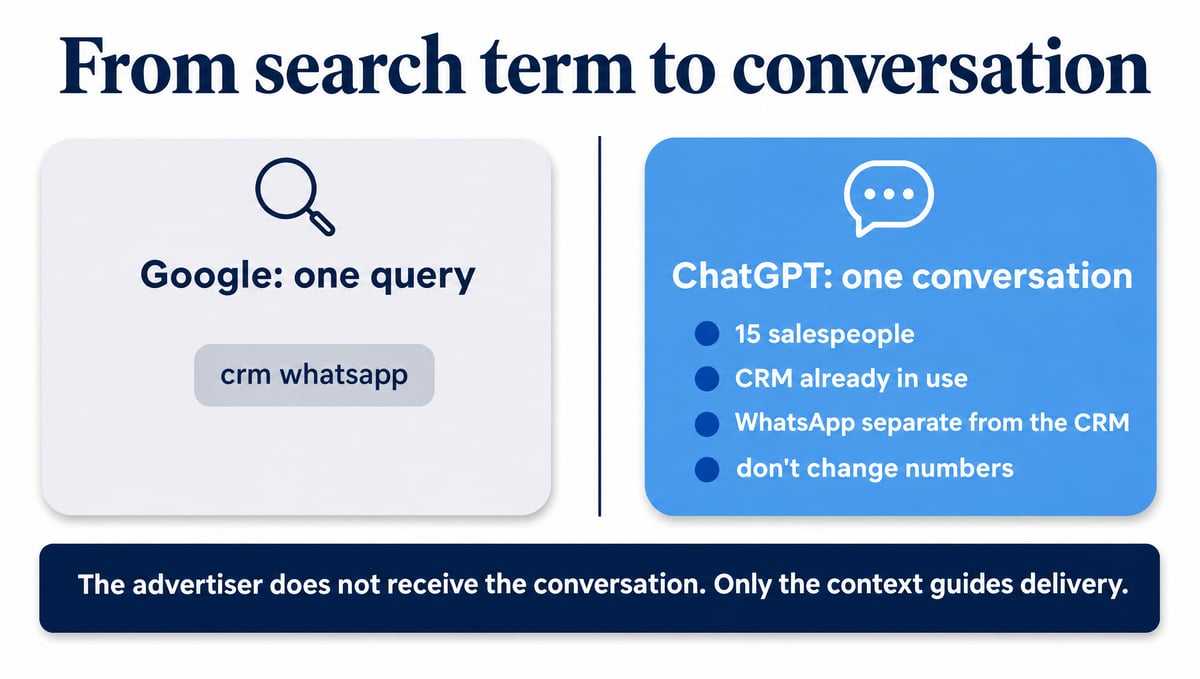
Consider the same customer on two channels.
On Google, they type:
crm whatsappOn ChatGPT, they write:
I have 15 salespeople, I already use a CRM, but WhatsApp is separate
and we lose the history when someone leaves the company. I need
to integrate customer service, lead distribution and reporting without
forcing the team to change phone numbers.
The second message carries team size, current stack, a governance problem, a requirement to keep phone numbers, a concern about adoption and the decision stage. The advertiser does not receive this text, but the ad system can use this context to understand that an ad for a CRM integrated with WhatsApp makes more sense there than a generic software development ad.
That is why a direct translation of Google Ads keywords does not work well here. The job shifts from "buying terms" to "describing situations".
| How you used to think on Google | How you need to think on ChatGPT |
|---|---|
| custom software | company wanting to replace spreadsheets and manual processes with its own system |
| app development | entrepreneur assessing how to validate an app before investing in full development |
| ERP CRM integration | operation with duplicated data in different systems that needs to sync |
| CRM WhatsApp | sales team that needs to centralize conversations, owners and history |
Where the channel tends to perform best
The potential is greatest in purchases that require research, comparison and diagnosis: software and SaaS, high-ticket local services, education, travel, technical products with many variants and B2B services with a long consideration cycle.
Two limitations that almost nobody mentions are worth noting:
- Paid plan users are not part of the inventory. Many senior professionals and many companies use Plus, Pro or Business. In B2B, that cuts out a relevant slice of the audience.
- You do not see the prompt in the report. Intent will have to be inferred from the ad group, the context hints and the landing page that generated the lead.
Who can advertise today, and who cannot
This is where the toughest filter lies at the moment. In the early phases, OpenAI concentrates advertising in a limited set of categories:
- consumer goods and home products;
- local services;
- travel and entertainment;
- digital products and education.
The documentation states that categories should expand over time as safeguards, review systems and compliance infrastructure mature. Software, SaaS and digital product companies fit best in the "digital products" block, but approval is case by case and evaluates the advertiser, creative, image and landing page together.
Restrictions that directly affect the Brazilian market:
| Category | Status outside the United States |
|---|---|
| Financial services | Generally prohibited |
| Health services | Generally prohibited |
| Legal services | Not allowed |
| Political content | Prohibited |
| Gambling, alcohol, tobacco | Prohibited |
There is a useful distinction: software tools that do not promote financial products or transactions are usually allowed. The documentation cites budgeting apps, financial software in general and educational material about finance as acceptable examples, while offers of credit, investment or insurance fall into the restricted category.
There is also an end-to-end consistency requirement: an approved creative cannot lead to a destination with prohibited content. Review looks at the advertiser, ad and landing page as a single package, with automated systems, LLMs and classifiers, plus human review in higher-risk cases.
Preparation: the part you can do today
Self-serve is already open, but opening the account is not the first useful step. Before publishing the first campaign, this is the work that pays off.
1. Choose a specific offer
Conversational campaigns punish generic offers. "We build any system" gives little signal to the delivery system and little reason for the user to click.
Offers that work better have a clear focus:
- assessment to replace manual processes;
- MVP with a testable prototype before full development;
- integration between CRM, ERP and WhatsApp;
- back-office automation;
- legacy system modernization;
- rescue of a delayed project.
Each offer needs five elements: core problem, type of company, expected result, evidence and a clear next step.
2. Build the intent map
Gather material you already have: Google Ads search terms, sales meeting recordings, recurring questions in proposals, support tickets, objections, reasons for lost deals. Then group them by stage.
| Stage | What the user wants to find out |
|---|---|
| Awareness | "How do I fix this inefficiency?" |
| Exploration | "What kinds of solutions exist?" |
| Comparison | "Which alternative fits best?" |
| Validation | "How do I reduce risk before hiring?" |
| Decision | "How much does it cost and how do I hire?" |
OpenAI's rule is clear: keep each ad group focused on one product, theme or area of intent, and create separate groups for different audiences or use cases.
3. Write the context hints
context hints live at the ad group level and describe conversations, themes or words where your product may be relevant. OpenAI advises treating them as broad thematic signals, not exact keyword matching, and using descriptive phrases instead of loose terms.
Examples for a software company:
Group: product validation
- entrepreneur assessing how to validate an app idea;
- company looking for a working prototype before development;
- business wanting to estimate the scope and investment of an MVP.
Group: process automation
- company with operational processes running on spreadsheets;
- team looking to reduce manual work and rework;
- operation with duplicated data across different tools.
Group: integrations
- company wanting to integrate CRM, ERP and WhatsApp;
- operation needing to sync legacy systems;
- business looking to automate data exchange between platforms.
An operational detail that saves headaches: in bulk upload, the context hints you send replace the group's entire list. They are not added to the existing ones.
Creatives: specifications and strategy
OpenAI says plainly that creating ads for ChatGPT requires a different approach from keyword-based platforms, and that clear, specific, benefit-oriented copy is more likely to be relevant.
Current limits
| Element | Recommended | Maximum |
|---|---|---|
| Headline | 16 to 24 characters | 50 characters |
| Text | 32 to 48 characters | 100 characters |
| Image | Square | 1200 x 1200 px |
Yes, the recommended limits are short. That pushes the creative toward concrete information, not slogans.
Since this guide was published, the Ads Manager has started offering two formats: single image and multiple images. The multiple-image format, in open beta, uses 4 to 6 square images (1:1 aspect ratio) that all lead to the same destination URL, with "Learn more" as the only call to action. Both formats follow the same headline and text rules.
Three more rules matter:
- the image must be at a public URL that opens directly in the browser, with no login, no redirect to a preview page and no crawler blocking;
- bulk upload accepts up to 5,000 campaigns, 5,000 groups and 5,000 ads per file;
- the official guidance is to produce volume and variety, with several headlines and texts per offer, because that widens the opportunities in which the ad can be considered relevant.
Angle matrix
For each intent group, produce variations that attack different angles, not the same sentence rewritten.
| Angle | Question it answers |
|---|---|
| Result | What does the customer improve? |
| Use case | In which situation does it help? |
| Risk reduction | How does it avoid errors and waste? |
| Process | How is the work carried out? |
| Qualification | Which type of customer is it for? |
Examples within the limits
| Headline | Text |
|---|---|
| Custom software | Web, app and AI aligned with your operation. |
| Validate before investing | Scope and prototype before development. |
| Integrate your systems | Connect CRM, ERP, WhatsApp and automations. |
| CRM with WhatsApp | Centralize service, team and history. |
| Automate your operation | Less manual work, more integrated flow. |
| Clear scope from day one | Assessment, architecture and a real estimate. |
Visual direction
The official guidance asks for simple, relevant images aligned with the message, avoiding abstract or cluttered visuals. In practice:
- works: real interface screenshots, product dashboards, a simple flow of connected systems, a service in use;
- does not work: generic stock photos, too much text in the artwork, abstract AI illustrations, decorative humanoid robots, made-up badges, any element that imitates the ChatGPT interface.
A healthy initial production is 4 to 6 intent groups with 3 to 5 genuinely different variations in each.
Landing pages: they are part of targeting
This point is often missed. In ChatGPT Ads, the landing page is not just there to convert. OpenAI explicitly says it may use the page content to determine when it is most relevant to show the ad.
In other words: a generic page hurts twice. It lowers conversion and it worsens the system's understanding of when your ad makes sense.
The official recommendation is to point to the most relevant page, a specific product or piece of content, instead of always landing on the home page.
A structure that works for each main intent:
- Headline aligned with the problem, not the name of the service.
- Explicit definition of the audience.
- Expected practical result.
- Concrete use situations.
- Work process, from assessment to delivery.
- Verifiable evidence, with case studies and numbers.
- Technologies and integrations you actually deliver.
- Scope range, when it helps filter out incompatible demand.
- Frequently asked questions: timeline, code ownership, support, hosting.
- A CTA consistent with the stage.
A form that qualifies
For B2B, collect enough to separate curiosity from opportunity: name, work email, company, job title, main problem, size of operation, current solution, intended timeline, investment range and desired next step.
The investment range adds friction, but it keeps the sales team from treating an incompatible contact as an opportunity. For an entry-level offer, you can collect this information in the second step.
Technical preparation of the website
This step is a hard requirement. If the crawler cannot access your page, the ad does not run.
Crawlers
| Crawler | What it is for | Recommendation |
|---|---|---|
OAI-AdsBot | Validates the page used in the ad and helps determine relevance | Mandatory |
OAI-SearchBot | Allows you to appear in ChatGPT search results | Recommended |
GPTBot | Collects content that may be used for training | Separate decision |
The separation is useful: you can allow AdsBot and SearchBot and keep blocking GPTBot if the company does not want to authorize use for training. OpenAI states that data collected by OAI-AdsBot is not used to train foundation models.
Minimum robots.txt configuration:
User-agent: OAI-AdsBot
Allow: /

User-agent: OAI-SearchBot
Allow: /
What else usually blocks it
robots.txt is just the first layer. OpenAI's documentation lists the points of failure in order:
robots.txtwith a restrictive rule.- Edge protection and bot mitigation, such as Cloudflare or Akamai, returning
403 Forbidden. - Human verification at the application level: CAPTCHA, JavaScript challenge, behavioral analysis.
- Rate limiting, with
429 Too Many Requestsduring validation spikes.
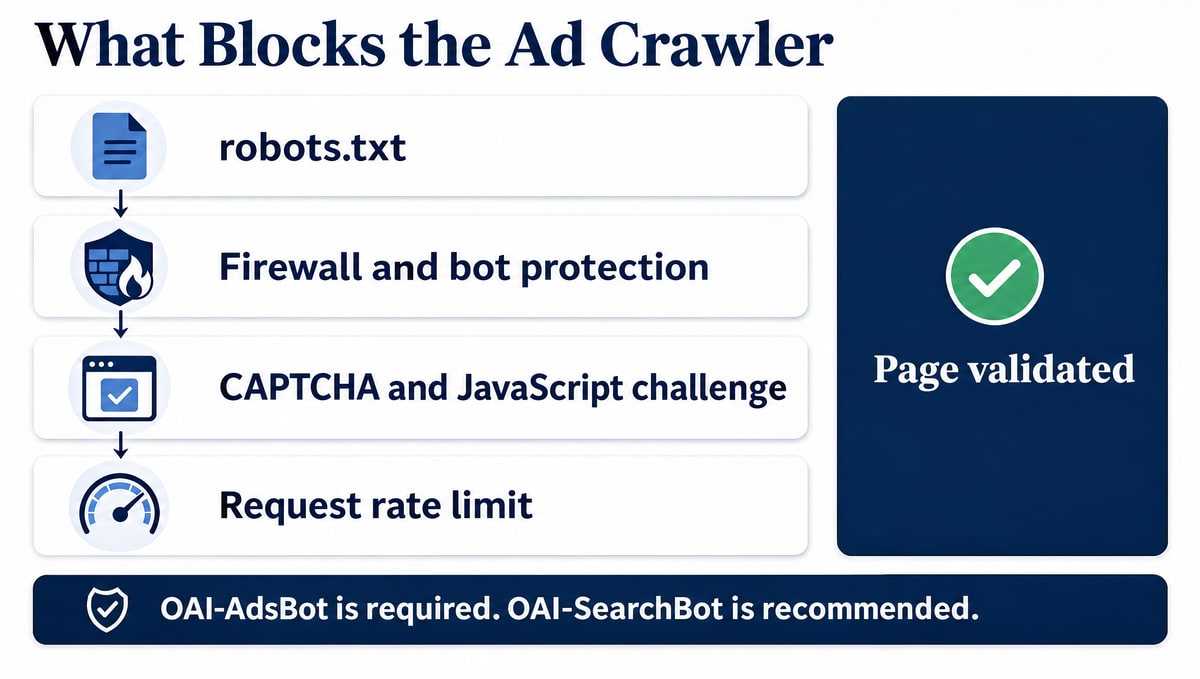
Two practical details: OAI-AdsBot is already officially verified and allowed by Cloudflare, and there is no support shortcut to skip validation. The page needs to be genuinely accessible. App store links, deep links, documents and pages that require login or regional access may not provide enough content for review.
If you need to allow by IP, the ranges are at openai.com/adsbot.json and openai.com/searchbot.json, but the guidance is to validate by user agent and verified bot programs, not by log observation.
Measurement: where a lead campaign parts ways with a click campaign
This is the part that decides whether the channel becomes revenue or a pretty report.
Available infrastructure
- OpenAI Pixel for browser events.
- Conversions API for server events.
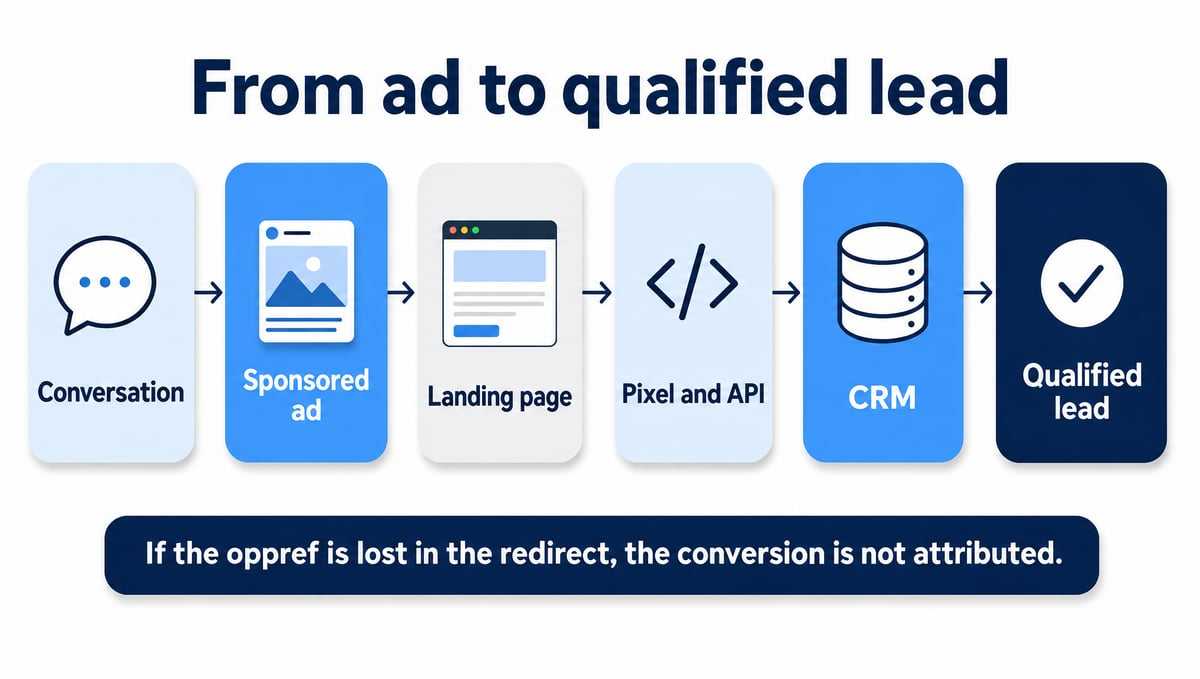
oppref, the click identifier OpenAI appends to the end of the destination URL. The Pixel captures it and stores it in a first-party cookie, andopprefcan also be sent through the Conversions API.- Deduplication: when using the Pixel and the API together for the same conversion, send the same event ID.
- Automatic advanced matching: the Pixel detects form data, normalizes it and applies SHA-256 hashing in the browser itself before sending. Raw contact data is not sent.
- Dynamic parameters:
{campaign_id},{ad_group_id},{ad_id}and{ad_account_id}, filled in at delivery.
Recommended flow
Ad on ChatGPT
  -> landing page with UTM, macros and oppref preserved
  -> Pixel fires page_viewed
  -> form submitted
  -> lead created in the CRM
  -> lead_created via Pixel and/or Conversions API
  -> appointment_scheduled when the meeting is booked
  -> custom events for qualification, opportunity and sale
Useful standard events for B2B: page_viewed, contents_viewed, lead_created, appointment_scheduled, registration_completed, trial_started and order_created.
Note an important limitation: conversion-optimized campaigns accept only one standard event per campaign. Custom events are not supported for optimization, although they work for reporting.
Precautions that prevent rework
- Preserve
opprefthrough redirects and internal navigation. Lose the parameter, lose the attribution. - Conversions can take 24 to 48 hours to show up in reporting. Do not conclude anything on day one.
- An event can be firing correctly and still show as zero if it does not exactly match the event configured in the campaign. Historical events from a wrong setup are not backfilled.
- Ads Manager, Google Analytics and other platforms will disagree. Attribution windows, time zones, consent and deduplication differ. A discrepancy is not necessarily an error.
Metrics that matter
The dashboard provides impressions, clicks, spend, CTR, average CPC, average CPM and conversions. For lead generation, the analysis cannot stop there.
| Metric | Calculation |
|---|---|
| Landing page conversion | Leads ÷ clicks |
| CPL | Spend ÷ leads |
| Qualification rate | Qualified leads ÷ leads |
| CPQL | Spend ÷ qualified leads |
| Cost per meeting | Spend ÷ meetings |
| Pipeline ROAS | Pipeline value ÷ spend |
CPQL, cost per qualified lead, should be the central metric for high-ticket services. A channel can have a high CPL and still be your best one if its share of real opportunities is higher than the others'.
For this to work, the CRM needs to store source, campaign, group, ad, oppref, UTMs, landing page, intent theme, creative angle and the sales outcome. If your operation still lives in spreadsheets, it is worth fixing that first: we wrote about that path in how to turn a spreadsheet into a system.
Objectives, auction and budget
The three objectives
| Objective in Ads Manager | How you pay | Best for |
|---|---|---|
| Views (CPM) | Per thousand impressions | Reach and awareness |
| Clicks (CPC) | Per valid click | Traffic and engagement |
| Conversions (oCPC or oCPM) | Per valid click or per thousand impressions, depending on the billing chosen | Action after the ad |
With the conversion objective you never pay per conversion. With per-click billing (oCPC), you pay per valid click and delivery optimizes for conversions that happen after the click. With per-impression billing (oCPM), an option added after this guide was published, you pay per thousand impressions and delivery also considers conversions influenced by seeing the ad. In neither case is the Bid Cap a conversion price or a guaranteed CPA.
Three locks that require planning before creating the campaign:
- The objective and billing method cannot be changed in the campaign itself after it is created.
- The conversion event cannot be changed after creation.
- To change objectives you need a new campaign. The clone campaign feature helps with the switch, but the result is always another campaign, with its own history.
Budget and spend pacing
The daily minimum for accounts billed in reais is R$ 40 per campaign. A campaign can use a lifetime budget or a daily budget, and the daily budget works as a seven-day average, which changes cash planning:
- maximum spend on a single day is twice the daily budget;
- maximum spend over seven days is seven times the daily budget;
- the budget week runs Sunday to Saturday in the account's time zone, and a campaign that uses up the week's allotment early may stop delivering until the following week, even while marked active.
With R$ 100 per day, a single day may consume R$ 200, but the week will not exceed R$ 700.
To size the test without inventing a CPC:
Clicks needed =
  qualified lead target
  ÷ landing page conversion rate
  ÷ qualification rate

Estimated budget = clicks needed × observed CPC
With a target of 10 qualified leads, an 8% page conversion and a 40% qualification rate, you would need about 313 clicks. The final amount depends on the CPC you measure, not on a number someone promised.
A structure tip: since the R$ 40 minimum is per campaign, start with one campaign and several intent groups, instead of slicing the budget into many campaigns. When a theme proves results, it earns its own campaign and budget.
Step-by-step account setup
Opening an account has irreversible traps. Read this before you click.
- Sign up at ads.openai.com. Access uses the same OpenAI account as ChatGPT. You can start by entering your website, and the Ads Manager builds a first ad and a first campaign from it, or skip that step and go straight to the dashboard. Careful with the first path: ads created during sign-up can go live as soon as they pass review, if billing and the account are ready. If it is not yet time to spend, pause the campaign.
- Team by invitation. Whoever creates the account invites the team under
Settings > Users, with three roles: Admin (full access), Member (creates and manages campaigns) and Viewer (view only). - Country, currency and time zone cannot be changed later. If you get them wrong, you need to create another account.
- Three different names. The name entered at sign-up fills in Account Name (internal use), Brand Name (the public name shown next to the ad) and Legal Name (the registered company name, used for billing and verification). Review all three and the logo under
Settings > General. Changing the Brand Name or Legal Name triggers a new review. - Account verification and review. If verification is required, the Ads Manager shows a notice to complete it. Without verification, ads may not run. Creating extra accounts does not skip verification or review.
- Billing. A billing profile, address, invoice email and credit card are mandatory before any delivery. Your bank may show a temporary pre-authorization to validate the card. The amount varies by country, is requested in the account's currency and appears on the setup screen. It is not a completed charge and may stay visible for 8 days or more, depending on the bank.
- Charging by payment threshold. On card accounts, the charge happens when accumulated spend reaches the threshold assigned to the account. This threshold is not a campaign budget, rises automatically with payment history and cannot be changed by support.
- Card and address must match the account's country. A Brazilian account requires Brazilian billing.
- Multiple brands require multiple accounts. Each advertiser has its own account, accessed with the same OpenAI login. Anyone who already belongs to 10 or more accounts cannot create another one on their own.
- A new account may start restricted to its home country. OpenAI warns that some new self-serve accounts can only advertise in the country associated with the account, and that unlocking other countries depends on history. For those selling in Brazil, this rarely gets in the way; for those wanting to test all of Latin America, it does.
Only after this: install measurement, create the campaign, create groups by intent, write the context hints, upload ads and landing pages, and submit for review.
Custom audiences and LGPD
ChatGPT Ads accepts custom audiences from email or phone (plain text or SHA-256 hashed) or Google Advertising ID, with three uses: include, exclude and adjust bids with a multiplier from 0.1x to 10x at the group level.
The problem is the minimum size. Inclusion and bid adjustment require at least 25,000 matched users, and the official recommendation is 100,000. For most mid-sized Brazilian B2B companies, that rules out inclusion at the start. The useful exception is exclusion: audiences smaller than 25,000 can be used to remove current customers from the campaign. Context hints will carry much more weight.
Relevant operational details, according to the documentation revised in November 2026:
- CSV or TXT file in UTF-8, up to 500 MB; audiences larger than 5 million members go in several uploads;
- accepted identifiers: email, phone, email or phone already SHA-256 hashed and Google Advertising ID, which can be mixed in the same CSV;
- phone in E.164 format, with
+and the country code; - once created, the audience accepts adding, removing or replacing members without recreating the audience or touching the campaigns that use it;
- the uploaded file is deleted after processing, usually within 24 hours.
On the LGPD side (LGPD is Brazil's data protection law), the yardstick is the usual one, but with specific points:
- review the privacy policy and consent banner before installing the Pixel;
- define the legal basis for measurement and for using data in audiences;
- stop sending data when the applicable consent is revoked;
- do not upload purchased lists, only first-party data with the applicable permissions;
- validate the implementation with the company's privacy officer, especially if it involves a large database, offline conversion or enriched data.
Paid media and organic discovery are different things
There are two independent paths to show up in the ChatGPT ecosystem, and confusing them creates false promises.
| ChatGPT Ads | Discovery in ChatGPT Search | |
|---|---|---|
| How you earn it | Buying media | Crawlable, useful content |
| Where it appears | Below the answer, labeled as sponsored | Citation or link within the search experience |
| Technical requirement | OAI-AdsBot allowed | OAI-SearchBot allowed |
| Control | Campaign, bid, creative | No guaranteed position |
There is no public "SEO for ChatGPT" formula that guarantees a recommendation. What exists is hygiene: clear, verifiable and technically accessible content, with a site architecture the crawler can read. The same logic we apply in API-first architecture as a digital asset holds: what is not accessible in a structured way does not get used.
90-day plan
| Period | Focus | Deliverable |
|---|---|---|
| Days 1 to 15 | Eligibility and strategy | Account created in Ads Manager, billing and verification completed, policy audit, offer defined, intent map |
| Days 16 to 30 | Infrastructure | Landing pages, creatives, Pixel, Conversions API, CRM, UTMs, crawlers allowed |
| Days 31 to 45 | Controlled launch | One CPC campaign, 4 to 6 groups, 3 to 5 ads per group |
| Days 46 to 60 | Diagnosis | CTR, conversion, qualification, meetings and CPQL per group |
| Days 61 to 75 | Optimization | Pause weak themes, new variations, improve page and form |
| Days 76 to 90 | Evolution | oCPC campaign, offline events, expansion of the best intents |
Since the Ads Manager is already open for Brazil, the only real wait is the account and ad review. You can compress days 1 to 30 if the offer, pages and tracking already exist, but it is not worth publishing the campaign before the Pixel and CRM are measuring: the first days of spend without attribution become cost without learning. And days 1 to 30 pay off either way, because they also improve Google Ads, the website and the sales process.
Risks nobody should leave out
An honest article about a new channel needs to list what can go wrong.
- No benchmark. There is no reference CPC, CPL or CPA for Brazil. Plan by scenario, not by promise.
- Restricted inventory. Only Free and Go, only users 18 and over, and only when there is an eligible conversation.
- Limited categories. Finance, health and legal are out or heavily restricted outside the United States.
- Platform in beta. OpenAI warns that inventory, formats, delivery, buying, management and measurement may change during the beta.
- Manual approval. Account, creative and landing page go through review, and not every company will be accepted.
- No prompt in the report. You will never know exactly what was asked.
- Fragile attribution. Redirects, crawler blocking, lack of consent or loss of
opprefbreak measurement. - Vanity metrics. A high CTR is not a sales opportunity. Only CPQL and pipeline tell the truth.
Checklist to get started
- Account created at ads.openai.com, with country, currency and time zone checked before saving.
- Billing configured and account verification completed.
- The company's category checked against the advertising policies.
- One specific offer defined, with problem, audience and result.
- Intent map built from real sales data.
- 4 to 6 intent groups with context hints in natural language.
- 3 to 5 distinct creatives per group, within 50 and 100 characters.
- Square images at a public URL that opens directly, up to 1200 x 1200.
- A specific landing page per intent, not the home page.
-
OAI-AdsBotandOAI-SearchBotallowed inrobots.txt, the WAF and the anti-bot layer. - OpenAI Pixel installed and validated in debug mode.
- Conversions API configured with the same event ID for deduplication.
-
opprefpreserved through redirects and stored in the CRM. - UTMs and campaign, group and ad macros configured.
-
lead_createdandappointment_scheduledevents firing correctly. - CRM ready to tag source, qualification, meeting, opportunity and revenue.
- Privacy policy and consent reviewed for the new data collection.
- Budget planned considering the R$ 40 minimum, 2x per day and 7x per week.
What to do this week
Self-serve is open in Brazil, the minimum is R$ 40 per day per campaign and there are already more than 100,000 advertisers on the channel worldwide. The barrier to entry is no longer access. It is preparation.
Those who arrive with a focused offer, a specific landing page, the crawler allowed and conversions measured will start learning in the first week of the campaign. Those who publish before putting their house in order will spend the first weeks discovering that the Pixel was not installed and that OAI-AdsBot was hitting a 403.
The channel does not guarantee cheap leads. At most, it guarantees one thing: whoever figures out first how to turn a conversation into a campaign will have an advantage while everyone else is still reading the documentation.
References
- Advertise in ChatGPT, OpenAI Ads
- Testing ads in ChatGPT, OpenAI
- ChatGPT Ads expands to 26 new countries, OpenAI
- Ads Manager Account Setup, OpenAI Help Center
- Billing & Payment, OpenAI Help Center
- Custom Audiences, OpenAI Help Center
- Ads in ChatGPT: The Basics, OpenAI Help Center
- Create Campaigns for ChatGPT, OpenAI Help Center
- Create Ad Groups for ChatGPT, OpenAI Help Center
- Create Ads for ChatGPT, OpenAI Help Center
- Conversion Measurement, OpenAI Help Center
- Conversion-optimized Campaigns, OpenAI Help Center
- Daily Budgets, OpenAI Help Center
- Ads Manager Availability, OpenAI Help Center
- Advertiser Guidance for Allowing OpenAI Web Crawlers, OpenAI Help Center
- Advertising policies, OpenAI
- Supported Standard Conversion Events, OpenAI Developers
- OpenAI Crawlers, OpenAI Developers
- OpenAI ads pilot tops $100 million in annualized revenue in under 2 months, CNBC


