
Índice do artigofaltam 7 min de leitura
A wrong order in the ERP can be reversed. A wrong post on the company profile has already been seen, captured and commented on before anyone deletes it.
The technical answer to the question in the title is yes, and it has been yes for a while. There are hosted MCP servers that expose posting, scheduling, ads, comments and direct messages as tools an assistant calls in natural language. Connecting takes minutes.
That is why the technical question is the least interesting one. The one that decides the project is different: what happens when it gets it wrong, and who answers for it? This article is about designing that answer before turning the agent on, not after.
The subject here is public posting on behalf of a brand, which is a different risk from data leakage, covered in Prompt injection: how to protect chatbots and AI agents without slowing the product, and different from the design of several cooperating agents, covered in AI agent orchestration: from a single agent to a governed software factory. The numbers come from the public documentation of Zernio, an external Spanish company founded in 2025, with no corporate relationship with X-Apps, used as a concrete, documented case.
Article summary
- The surface we found is 496 tools, with about 50 visible and the rest discovered on demand. Dynamic discovery saves context and does not reduce the risk of a wrong choice.
- The risk that sets this case apart is irreversibility: a public post cannot be refunded, and the damage is to the brand.
- The approval gate does not cancel the gain, because the expensive work is preparing the post, not pressing the button.
- The autonomy ladder starts with reads, which deliver immediate value and cannot publish anything.
What a surface of 496 tools means, in business terms
A tool, in agent vocabulary, is an action the assistant can choose to execute. The surface is the list of those actions. In the offering we examined, there are 496 tools covering every endpoint, built as about 20 hand-written core tools plus one generated automatically per endpoint.
Not all of them are visible at the same time. About 50 stay loaded and the rest are discovered on demand, through a search the agent itself runs when it needs to. This solves a real and expensive problem, which is filling the model's context window with descriptions of actions it won't use.

Translated into business risk: the assistant has at its disposal, among other things, posting, deleting a post, sending a direct message, creating an ad campaign, changing a budget and disconnecting an account. All of these actions exist because the API exists, and automatic generation does not distinguish reads from destructive writes.
On-demand discovery makes the surface usable. It does not make it smaller.
Four things dynamic discovery doesn't solve
Four things remain open when the surface is large, and none of them can be solved with an instruction in the prompt.
| Risk | How it shows up in practice |
|---|---|
| Wrong choice | The agent finds a plausible tool, not the correct one. Posting on a partner's personal profile instead of the company page is the cheap version; deleting instead of unpublishing is the expensive one |
| Name collision | Two tools with similar names in different contexts, and the search returns the one from another scope |
| Instruction from outside | The agent reads a comment or message and treats the text as an order. The inbox is third-party content by definition |
| Destructive action within reach | Deleting a post and disconnecting an account are on the same list as posting, with no natural separation between them |
None of these four is a vendor defect: they are properties of exposing an entire API to a model. What changes between a safe project and a risky one is where the decision to execute is made.
Public posting is irreversible, and that changes the design
This is the point that sets posting apart from almost every other corporate automation, and it is why the design cannot be copied from an ordinary integration project.
A wrong accounting entry can be reversed. A wrong order can be canceled. A wrong email reaches a known list and can be followed by a correction to the same list. A wrong post on the company profile is seen by whoever was online, captured by whoever wanted to, commented on by whoever disagreed and distributed by the algorithm before anyone notices. Deleting removes the post, not the record of it.
The design consequence is direct and worth stating plainly: the decision to make something public does not belong to the agent. Everything before it can.
The approval gate is the product, not the obstacle
The predictable objection is that human approval cancels the gain from automating. It doesn't, and the reason is that the expensive work was never pressing the publish button.
The expensive work is gathering context, writing the text variation for each network, choosing the format each platform accepts, deciding the time, preparing the record and checking whether the product is still in stock. That is what eats up the afternoon, and it is exactly what the agent does well.
The detail that makes this flow work is already available in the API we examined: posting, scheduling and drafts are the same endpoint, distinguished by a parameter. Creating without a date and without a publish order produces a draft, and that is where the gate rests.
Where the agent adds value without being able to post: reads
If the goal is to prove value in the first month, the answer is reads, and they are usually underestimated because they don't look impressive.
An assistant connected only to read capabilities answers "how did last week's campaign perform compared with the previous one", "which accounts have connection problems right now", "how much did we spend on ads on each network this month" and "which comments from the last 24 hours look like purchase intent". None of these questions can publish anything.
It is the same move that made the reporting dashboard pay off first in operations without agents: the lowest-risk item has the fastest return, and it builds the political support for the next step.

There is a way to make this step safe by construction rather than by discipline: a credential that simply cannot write. If the vendor offers a read-only key, the first step stops depending on correct configuration.
Until that is confirmed, the separation remains your side's responsibility, in which operations your layer agrees to execute.
The autonomy ladder: what to release, in what order
The choice is not between an autonomous agent and nothing. There are steps, and each one is climbed only after the previous one has run without incident long enough for nobody to be nervous anymore.
The fourth step exists and has legitimate cases, all narrow: reposting an item that has already been approved, answering a message with a closed-catalog response, unpublishing an ad for a product that went out of stock. What they have in common is not that they are simple; it is that the set of possible outputs is known in advance.
Where the fourth step doesn't fit: new content, crisis responses, anything with a price, and anything on a client account that has not authorized that level of automation in writing.
Your own layer is where the decision lives
Plugging the assistant directly into the vendor's MCP server is the fastest path and the one that creates the problem that only shows up months later. The design that supports real operations puts a layer of yours in the middle, and it is not big.
What this layer does is short to describe and is what separates a serious project from a demo: it receives the agent's intent, checks whether that account and that operation are allowed for that requester, records the request before executing, executes and records the result.
The side benefit is the same as with any integration layer of your own: switching vendors becomes adapter work. The equivalent design for the messaging channel is detailed in The governance layer that reduces dependence on the WhatsApp vendor.
What to ask the vendor before turning the agent on
The documentation we examined describes MCP server authentication via OAuth 2.1 with PKCE or via an access token with the API key, and describes dynamic tool discovery. It does not describe a read-only mode or per-tool scopes.
This is a due diligence item, not a conclusion: a feature missing from the documentation is not a feature missing from the product. What the gap determines is that these questions go to support, in writing, before signing.
- Is there a read-only key that cannot post, delete or send messages?
- Can you limit which tools the MCP server exposes for a specific key?
- Can the key be restricted to one client or a set of accounts, and what happens outside that scope?
- Does revoking the key interrupt execution in progress or only prevent new calls?
- Is there a record on the vendor's side of which key executed which action, and how long is it retained?
The first question is the one that changes the project the most. If a read-only key exists, the first step of the autonomy ladder is safe by construction, not by configuration discipline.
What to log so you can explain it later
Every automation that acts in public needs to answer a question that only comes up months later, when someone asks why that post went out: who asked, what exactly was asked, who approved and what actually went out.
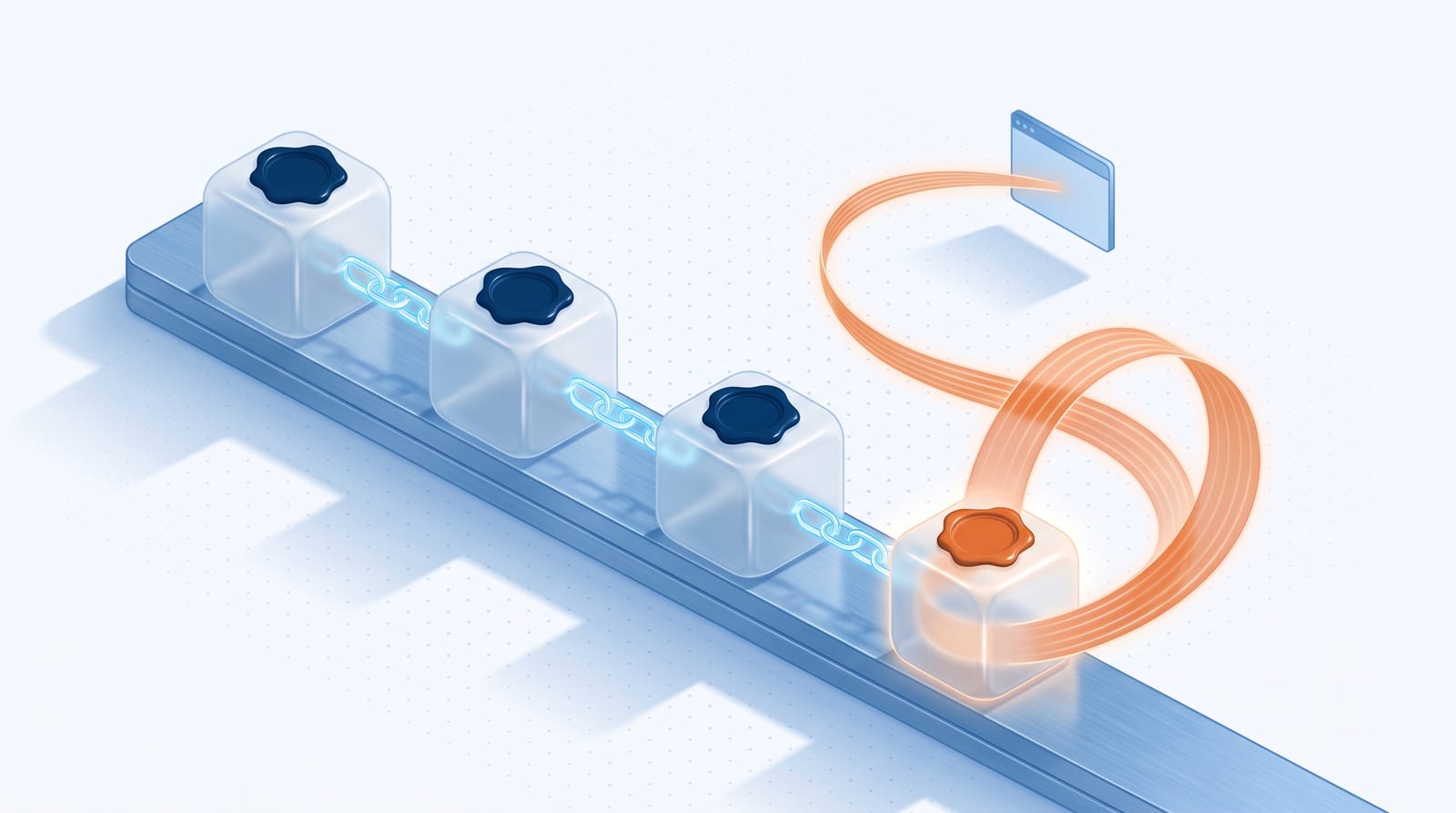
Four records are enough, and all of them stay on your side. The original request, with the requester's text and the time. The resolved intent, with account, network and final content before executing. The approval, with the named person and the moment. And the signed event feedback, with the identifier of what actually went out.
Storing the feedback is what closes the loop, because what the agent asked for and what the platform published are not always the same thing: networks that cut captions, formats the platform converts and posts that fail on one of the accounts in a multi-account send are routine. Without the feedback stored, the record describes the intent, not the fact.
Sources and method
The numbers on tool surface, authentication, dynamic discovery and publishing modes come from reading Zernio's public documentation on September 1, 2026, on the MCP, quick start and glossary pages. It appears as a concrete case because it publishes the exact size of the surface it exposes to the agent.
The documentation read on that date does not describe a read-only mode or per-tool scopes, and that is an observation about the documentation, not about the product. An undocumented feature may exist, which is why it appears here as a question for the vendor and not as a limitation.
The autonomy steps, the approval gate and the list of records are a design recommended by X-Apps based on what the documentation allows, not a report of a system in production. No risk, incident or savings figures are presented, because there was no measured pilot.
Primary sources consulted on September 1, 2026: docs.zernio.com (MCP, quick start, glossary and platforms).
Frequently asked questions
Yes. There are hosted MCP servers that expose posting, scheduling, ads and direct messages as tools an assistant calls. The capability exists; the decision to enable it is a different conversation.
Irreversibility. A wrong order in the ERP can be reversed; a wrong post on the company profile has already been seen, captured and commented on before anyone deletes it. The damage is to the brand and cannot be undone with a compensating transaction.
No, because the expensive work is not pressing the publish button. It is gathering context, writing the variation for each network, choosing the time and preparing the record. The agent does that; the release stays with a person.
It is the set of actions the assistant can choose to call. In the offering we examined there are 496, with about 50 visible and the rest discovered on demand. The bigger the surface, the greater the chance the agent picks the wrong tool.
Whether there is a read-only key, whether the exposed tools can be limited, whether the key can be restricted to a specific client and what happens when it is revoked. If the documentation doesn't answer this, that doesn't mean the feature is missing; it means it is a question for support.
With reads. An agent that answers 'how did the campaign perform' and builds the report delivers real value and cannot publish anything.