Índice do artigofaltam 20 min de leitura
None of the WhatsApp vendors evaluated offers exactly-once semantics, so event loss is a structural possibility. What the layer between the vendor and the operation does is reduce the loss, make it measurable and lower the cost of switching vendors; the exit path itself is a contract clause and a pilot item, not an architecture item.
There are two different conversations about WhatsApp platforms. The first is the buyer's, comparing price, free plan, inbox and partner badge. The second belongs to whoever will wake up at two in the morning because an endpoint went down, events stopped arriving and nobody can say how many messages were lost. This article is about the second.
The vendor comparison is in the previous article, Zernio, YCloud and 360dialog compared by ownership and exit. Here the subject is what remains after the choice: the design of your own layer that receives events, stores what arrived, confirms what went out and feeds the agents. Two caveats apply to the whole article. First: what is described is a recommended design, not a report of a system in production. Second: the vendors mentioned are external companies in a transport role; Zernio, which appears more often because its documentation is the most detailed on the points that matter here, is a Spanish company founded in 2025, with no corporate relationship with X-Apps. If you don't yet know what coexistence is, start with the complete WhatsApp CoEx guide; this text assumes that knowledge.
Article summary
- None of the vendors evaluated documents exactly-once delivery. What exists is at-least-once with retries, which turns deduplication, queueing and reconciliation into your requirement, not a plan feature.
- A vendor's hosted MCP can give the agent access to every API endpoint. The defensible design is the opposite: your own thin MCP, with a few approved tools, mostly read-only and with supervised writes.
- A 200 API response is not delivery. Strong confirmation requires two pieces of evidence: the send webhook and a re-read of the conversation with the same identifier and the same content digest.
- The six months of history synced at onboarding are a bootstrap, not a backup. The importer and the canonical database must exist before connecting the main number, because the initial history event happens only once.
What belongs to the vendor and what remains yours
The division of responsibilities needs to be designed before the contract, not after the first incident, and most fights with vendors come from never having written it down.
The vendor keeps: Embedded Signup, tokens and subscriptions with Meta, webhook delivery according to its policy, the send API, product logs, billing and connection support. The onboarding flow itself is detailed in how to set up Meta's Embedded Signup. You keep: the Business Portfolio and the list of administrators, the gateway and signature validation, the queue, idempotency and your own dead letter queue, the canonical database and export, immutable media storage, transcription, RAG, Slack, the thin MCP, approval, auditing and periodic reconciliation.
The highlighted quadrant is the one that needs to exist first, because it is the only one nobody gives back later.
The vendor's plan, free or paid, covers the transport quadrant. It does not cover an event store, deduplication, downloading media before it expires, transcription, approval with a receipt, reconciliation, Slack and RAG, and that is the exact line separating a price comparison from a total cost calculation. The entry prices of the three vendors are in the series comparison.
The thesis behind the whole article fits in one sentence: every vendor evaluated works with at-least-once delivery, meaning the same event can arrive twice and an event may not arrive on the first attempt. That is not a defect of any of them; it is how distributed systems work. The practical consequence is that reducing conversation loss and measuring whatever loss remains is a product of your layer, not of the contracted plan.
The design in eight stages, from the app to the agent
Recommended architecture. Transport is the piece the design keeps swappable in code; the contractual exit is negotiated separately.
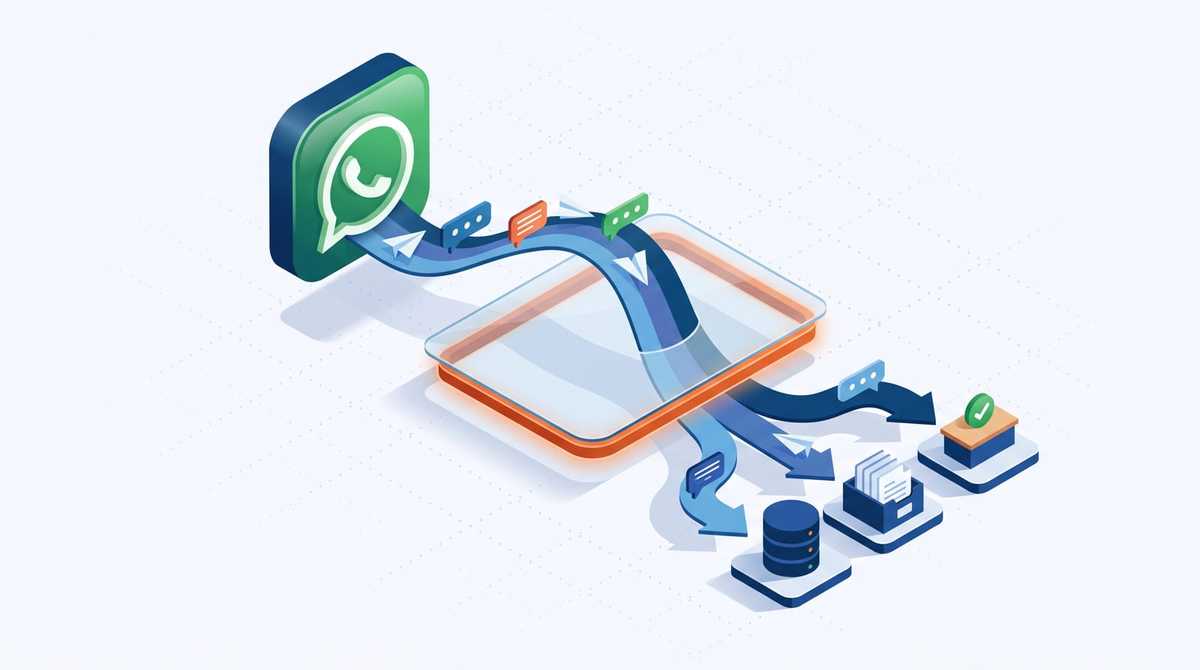
An event goes through eight stages, in this order: the gateway validates signature and replay; the raw payload is written before any processing; the 2xx response goes out within the short deadline the vendor requires (Zernio asks for a 2xx within 5 seconds and makes up to 7 attempts over about 51 hours before sending the event to its dead letter queue; YCloud asks for less than 6 seconds); processing moves to a durable queue; an idempotent consumer deduplicates by event and by message; ordering happens by conversation, timestamp and sequence; canonicalization writes to the normalized tables, with your own dead letter queue; and only then are media and derivatives processed, with hashing, antivirus, transcription and indexing.
Notice what is not on the path: no language model, no CRM update and no file download before the queue. All of that is slow, fails often and cannot hold up the response to the vendor.
The webhook endpoint: six obligations and two signature families
The webhook endpoint does six things and nothing else:
- Preserve the raw body exactly as it arrived, byte for byte, because the signature is calculated over it and any reserialization breaks verification.
- Verify the HMAC before looking at the content, with constant-time comparison.
- Deduplicate by the stable event identifier the vendor sends.
- Persist the raw event before any processing, in an append-only table.
- Respond 2xx fast, within the short deadline required by the vendor.
- Process asynchronously, in the queue, outside the request cycle.
Two implementation details almost never appear in tutorials. When inserting the event collides with the unique key, that is a legitimate duplicate and should return success, not an error: an endpoint that returns 500 for a duplicate makes the vendor resend the same event until retries are exhausted, turning a protection into an incident. And any authorization header must be replaced with a redaction marker before persisting, because the raw record will last for years and the secret shouldn't. Deduplication by a composite unique key in the database, with tenant, provider and external identifier, is more reliable than application logic, because the database resolves concurrency races that code doesn't.
On signatures, there are two families among the vendors evaluated, and they require different code on your side. Zernio signs the raw body with HMAC SHA-256, without a timestamp. 360dialog does the same for message events sent to partners: HMAC SHA-256 of the body with the platform secret, optional validation, and its own documentation warns that the signature carries neither a timestamp nor a nonce, so a captured event can be resent later. YCloud is the other family: it signs the timestamp, a dot and the raw body.
$ hmac_sha256(secret, raw_body) == received_signaturevalid signature, authenticity confirmed$ event captured yesterday, resent nowsignature still valid: old event accepted, no replay protection$ hmac_sha256(secret, timestamp + "." + raw_body)replay tolerance enforceable in the consumer
The difference is not academic: in the first family, replay protection is built by you, with a tolerance window and an already-seen event check; in the second, it comes for free, because the timestamp is inside what was signed. Three operating rules close the section: constant-time comparison, the webhook secret as a separate credential with its own rotation, and never responding 2xx before validating the signature, because that turns the endpoint into an open door for anyone who discovers the URL. And internal routing should use the account identifier the vendor sends, not the phone number as free text, which changes formatting between surfaces and is the classic source of duplicate conversations.
A 200 response is not delivery, and the ledger is yours
The anti-pattern deserves to be named, because it shows up in real code written by competent people: marking the message as sent right after the API's 200. It is quick to write, works in manual testing and produces wrong reports for months.
A successful HTTP response only produces the accepted-by-provider state. To declare a confirmed send, you need two independent pieces of evidence: the send webhook and a re-read of the conversation returning the same message identifier and the same content digest. It seems excessive until the first time an asynchronous send is accepted and fails later, a behavior YCloud documents explicitly. From that comes a rule that rewrites the vendor selection criterion: after an attempt with a possible effect, a timeout never authorizes an automatic provider switch or a blind retry; the state becomes reconciliation, resolved by querying the API, the webhooks and the event store. The good vendor, at incident time, is not the one with the most uptime: it is the one that returns enough evidence to reconcile.
The vendor's own idempotency protection is useful and insufficient, in that order. Zernio's, for example, keeps the key for 24 hours, tied to the credential and the exact call path, and repeats the original response when the same key comes back with the same body; with a different body or on another path, it returns 422, and while the first call is still processing, 409. Two details from its documentation reinforce the thesis of this section: only a 2xx response is stored, because a failure releases the key and the new attempt really runs; and after a 5xx or a timeout the guidance is to list messages before trying again, warning that an empty list proves nothing. Great for the peak of the incident, irrelevant for the December audit.
There is a concrete gap that changes the rollout order of an entire project: the documented idempotency covers sending in an existing conversation and may not cover creating a new conversation with a template, which is precisely the path of the first sales contact. At Zernio, the list of writes that accept the idempotency key includes sending a message in the inbox, but not the endpoint that opens a conversation with a template. Hence the recommendation to start with customer service, where the conversation already exists and the protection applies, and to handle first contact with a single attempt protected by a local lock. A detail almost every project discovers late: the unit of idempotency is the segment, not the message. A reply may have several paragraphs and attachments, and each part needs its own attempt, key and receipt.
The canonical database is not optional: six months is a bootstrap, not a backup
The sync of up to six months of history and contacts during onboarding is a great starting point and a terrible archive. According to Meta's documentation, it must start within 24 hours after onboarding and can only be done once; repeating it requires disconnecting the number and redoing Embedded Signup. Group conversations are left out, and the media file identifier only comes for messages from the 14 days before the connection. The vendor API's retention was not designed to serve as an archive either. The app's history, in turn, stays on the device of whoever replies.
Today
History lives on the phone- Nothing is auditable outside the device
- Media depends on the vendor's window
- Whoever leaves the company takes the conversation
- No executable export
After
History is your asset- Append-only raw payload, written before processing
- Hashed media in immutable storage
- Trail by agent, tool and approval
- Export of what you ingested, from the first minute
The scope of the last line is literal: the canonical database covers what went through your ingestion from the connection onward, and nothing more. Messages before the bootstrap, media that expired before download and conversations that never generated a webhook remain out of reach; a full export that would return everything the vendor stored has not been publicly proven for any of the three evaluated and remains a contract matter. The sequencing consequence is the one most projects get wrong: the importer must be ready before onboarding the main number, because there is no second chance to capture the initial history. And the append-only raw payload is the source; the normalized tables are rebuildable projections. The day you discover you misinterpreted a field, the difference between reprocessing and losing the data is exactly that decision.
Media and audio: the download window is an engineering requirement
The media retention window defines how long your pipeline can be down before losing an audio message forever. It varies a lot between vendors and doesn't always measure the same thing:
| Vendor | Documented window to download media |
|---|---|
| YCloud | Authenticated link for up to 30 days for echo media |
| Zernio | Up to 7 days, because media sits in Meta's storage; Zernio itself warns that Meta has been deleting some received media before that |
| 360dialog | No documented window of its own; the download link is valid for 5 minutes and is renewed via the identifier, which follows Meta's 7-day rule for media received by webhook |
Vendor and Meta documentation checked on November 11, 2026. The rows don't measure exactly the same thing: the validity of an authenticated link and availability dependent on Meta are different quantities, which is why the comparison stays in a table rather than a chart.
In every case the correct design is the same: download and persist as soon as the webhook arrives, validate type and size, compute the hash, keep the original immutable, generate the normalized derivative, transcribe, index and only then publish the summary with a secure link. Failures are isolated per step: if the download fails, the job retries; if normalization fails, the original is preserved; if transcription fails, the file reaches Slack with a warning. A longer window is a recovery margin, never a guarantee of integrity.
For audio, the limit that matters is size in bytes, not duration: within the platform's 16 MB fit from about 17 minutes at 128 kbps to about 89 minutes at 24 kbps. Audio messages also don't accept captions: if the agent writes an explanation alongside the file, it becomes another message, which changes the part count and the approval count. On transcription, the point is about governance, not features: among the three vendors evaluated, automatic transcription was not found as a native feature, and for anyone who wants to reduce dependence that is good news, because your own transcription means choosing the model, language, processing region, cost and retention policy, instead of sending the customer's audio to a subprocessor for convenience. An operating rule that saves embarrassment: group consecutive audio messages before triggering the agent and use a per-conversation debounce before generating a reply. A customer who sends three voice notes in a row doesn't want three replies.
Meta's limits and the nine rules for long text
The limits come from Meta and are the same for every vendor, which defuses half the comparisons going around: comparing platforms by accepted text or audio size produces no difference at all.
| Type | Limit |
|---|---|
| Free text | 4,096 characters per message |
| Image | 5 MB, JPEG or PNG |
| Video | 16 MB, MP4 or 3GP |
| Audio | 16 MB, AAC, AMR, MP3, MP4 audio or OGG |
| Native voice note | OGG with Opus codec, mono |
| Document | 100 MB |
Meta platform limits compiled in August 2026 and checked again in Meta's documentation on November 11, 2026.
What differs is what happens after the limit: no guarantee of safe automatic splitting of long texts was found in any of the vendors evaluated, so partitioning lives in your runtime. The nine rules, as an X-Apps engineering recommendation:
- Limit the operating range well below the ceiling, around 3,000 to 3,500 characters, leaving room for prefixes, numbering and links.
- Split only by paragraph or semantic unit, never by blind character count.
- Keep URLs whole, because a link cut in half becomes a support ticket the next day.
- Number only when there is more than one block, so as not to clutter a short reply.
- Send sequentially, waiting for each part to be accepted, to avoid order inversion.
- Generate a distinct idempotency key per part, derived from the operation, the index and the content digest.
- Store a logical message identifier with index and total parts, to rebuild the reply later.
- Never resend all parts when only one failed.
- Show a preview with the number of messages that will be generated before approval.
It is worth stating the obvious that sometimes slips by: an MCP does not make an 8,000-character message valid. API, inbox and MCP inherit the same platform limit and must reject or explicitly trigger partitioning, instead of silently truncating.
The app echo is an invalidation event, not a log line
When someone on the team replies from their phone, the system cannot just record it. That echo must come in marked with direction and origin, appear in Slack and RAG, update the conversation's last send, invalidate drafts and operations not yet attempted in that conversation and force the context to be rebuilt before any new send. Without a reliable origin field, a message typed by hand looks like it was sent by the agent, and the same sentence can be duplicated across channels.
Vendors expose that origin in different ways: Zernio uses a field inside the sent-message event itself, which distinguishes the app from the Cloud API; YCloud uses a separate echo event, with the most complete documentation of the three; 360dialog passes on Meta's echo event, smb_message_echoes, to the number's webhook URL. That divergence is exactly what your canonicalization absorbs: in the canonical database there is an origin field with a single vocabulary, and in the adapter there is the tedious work of translating three formats into one.
There is also a cost consequence: after the connection, a message sent from the app and one sent through the Cloud API are not the same thing for the platform, and billing follows the actual send channel. That turns routing between app and API into an architecture decision, with one non-negotiable limit: the app must never be used to get around templates, the customer service window or platform policy.
Thin MCP: a few approved tools instead of hundreds
Here is the central tension of the article. A vendor's hosted MCP can expose an enormous surface to the agent. Zernio's current documentation says the assistant reaches every API endpoint: about 50 tools are visible and the rest, which includes sending WhatsApp templates, load on demand through search. In August 2026 the count we found was 496 tools. Dynamic discovery has a real advantage: saving context. What it does not eliminate is name collisions, wrong tool selection, prompt injection and exposure of destructive tools, and none of those four things can be solved by a prompt.
The defensible answer is not to plug the agent into the vendor's MCP. It is to expose your own thin MCP, with a few approved tools, mostly read-only and with writes always supervised:
| Category | Tools |
|---|---|
| Read | search conversations, get conversation, list messages, get message, get media metadata, get transcription, get delivery status, get contact summary, search RAG, list pending drafts |
| Supervised write | create reply draft, request approval, send approved reply, mark message as read |
| Never exposed to the agent | campaigns, data deletion, template creation and editing, webhook configuration, offboarding, payment method changes, number deletion |
The rules of your own MCP matter as much as the list: schema-validated inputs, no generic tool of the "call this vendor endpoint" kind, no API key exposed to the agent, the recipient taken from the current conversation and never chosen by the agent from the text, reads separated from writes including at the credential level, and a mandatory terminal receipt for every operation. The vendor's official MCP stays restricted to development or a read-only key: the fact that it lists send tools does not mean giving that key to an agent is safe, and until the real scopes are verified with the vendor, the send path stays behind your policy broker, with human approval and idempotency. The vendors don't follow the same design here either. Zernio recommends a dedicated API key per agent, to revoke individually, and offers a key restricted to profiles and read-only (permission: read), which is the way to use its MCP only for diagnostics; the MCP page accepts that key as a credential but doesn't say whether the OAuth connection has the same limit. 360dialog publishes a hosted MCP with scope selection at connection time, aimed at account management: channels, templates, webhooks and invoices, with no message sending in the list of capabilities.
If you want the agent governance side in general, with roles, limits and auditing, you will find it in AI agent orchestration with governance. Here the scope is specific to the channel.
The agent's 15 controls and Slack as the operating surface
The list covers three different decisions, made at different moments in the project, which is why it comes in three blocks.
Credentials, scope and handbrake:
- Individual credential per agent and per environment
- Read-only mode by default
- Restriction by number or by project
- Central kill switch that turns off all writes
- Immediate credential revocation, measured in minutes
Target and limit of each send:
- Recipient always taken from the current conversation
- Recipient allowlist for testing
- Limit of one conversation per operation
- Daily and per-session limit
- Check of the customer service window and template before sending
Proof, approval and auditing:
- Human approval before sending
- Idempotency key per message or per part
- Dry-run mode with a preview of what would go out
- Audit log with a hash of the content
- Prohibition of campaigns by the agent
The credential posture behind the three lists has five items: a read-write key restricted to one profile, a read-only key for diagnostics, an administrative key outside the runtime, a webhook-specific secret and independent rotation of each. And there are seven places where the vendor's key must never appear: in the automation repositories, in the request envelope, in the orchestrator's ledger, in Slack, in the CRM, in error logs and in the model's context. The last one is usually forgotten, and it is the only one that leaks outside your infrastructure without leaving a trace in it.
The day-to-day operating surface is Slack, with a private channel per client or number and a thread per conversation: that is where the summary of the received message, the transcription, the agent's draft and the approve and reject buttons live. Three rules keep it from becoming an accidental database: masked identifiers when the channel has a broad audience, media and full history always outside Slack, and no direct send from free text in the channel, because free text in a channel is exactly the surface a social engineering attacker goes after first. A message that arrives already approved by the orchestrator does not go through a second editorial approval: you validate the policy receipt and the fingerprint, otherwise everyone approves twice and nobody reads the second time. One surface rule sums everything up: no consuming automation talks directly to the vendor's API or MCP. They all talk to the orchestrator.
Four failure modes and how the design responds
- Endpoint down for hoursThe vendor's retry window decides what comes back on its own. The rest comes from your dead letter queue and from reconciliation by listing messages.
- Long audio from the appDownload before the URL expires, measure real bytes instead of duration, preserve the original, transcode only the derivative and transcribe outside the webhook cycle.
- Reinstall with linked devicesThe connection may fluctuate and echoes may disappear without generating an error. Monitoring detects the absence of events per account and per device, not just failed events.
- Prompt injection in the received messageThe customer's content is data and never an instruction. The agent operates with read tools, the recipient comes from the conversation and no write goes out without approval.
In all four cases the same honest sentence applies: this design reduces loss and makes loss measurable. It does not eliminate loss, and nobody who works with at-least-once delivery should promise that it does.
Rollout in six phases and a rollback that resends nothing
-
Commitments in writing before any connection
Ownership, administration, export and offboarding agreed. A sandbox to exercise signatures, idempotency and errors without touching a real number.
-
Ingestion on, sending off
Receive messages and echoes, compare events with the current path, validate identifiers, media and the window. All sends keep going out the way they already did.
-
Customer service with an allowlist
The conversation already exists, the window tends to be open and the documented idempotency covers this case. It is the safest place for the first real send.
-
Sales sends within the window
Same protection as the canary, with a content policy and per-operation limits. Still no first contact.
-
First contact and re-engagement
This is where the idempotency gap shows up. A single attempt with a local lock, reconciliation on timeout and no blind retry.
-
Switching the source of truth
Only after comparing the nine read dimensions: count, direction, timestamps, media, text, quotes, reactions, echoes and delivery states.
The canary acceptance gate works as an internal contract, and the numbers below are criteria defined before the test, never results already obtained:
- 50 consecutive direct operations with no duplicate send
- No inbound event lost after reconciliation
- 100% of webhooks with a valid signature
- 100% of event identifiers deduplicated
- 100% of operations ending in confirmation, confirmed failure or explicit reconciliation
- App echoes showing up with the correct origin
Add to these six one criterion that fails the pilot on its own: no side effects on groups. The rollback is the counterintuitive part: it turns off sending, prevents new reservations, reconciles whatever was left ambiguous and resends nothing, keeping ingestion on the whole time. Keeping the inbound side open during the incident seems wrong and is mandatory: the team keeps typing on their phones, and turning off ingestion is what makes the system lose echoes, fail to invalidate drafts and, when everything comes back, resend a reply the salesperson already sent by hand.
A cheap switch in code: the five-method interface and what it doesn't solve
The technical answer to the fear of dependence does not replace the contract clause. It does something more modest and more concrete: it lowers the price of exercising that clause on the day it is exercised. If transport sits behind a neutral interface with five methods (pre-validate, submit, reconcile, get conversation and list messages), switching vendors becomes swapping one implementation. Everything that is expensive, the canonical database, media, transcription, RAG, approvals and auditing, stays on the side that doesn't change.
No automation talks to the vendor. They all talk to the orchestrator.
What the code boundary does not solve must be said in the same font size: ownership of the WABA (the WhatsApp Business Account) and the number is a contractual and registration matter in Meta's environment, and no line of code changes that. That is why phase 1 of the rollout is contract, not code. During a real migration, live with two versions of the request envelope, keeping the previous one as the rollback path: silently adding fields to the schema would break validation and fingerprints, because approval is bound to the hash of the route and the content. And note that coexistence is not a single topology: groups and communities remain on a separate transport, outside the API, with a single actor authorized to operate that session, and that path must never be used to get around templates, the window or policy.
- WhatsAppChannel and the team's app
- MetaPlatform, window and limits
- PostgreSQLCanonical database and index
- DockerGateway, workers and queue
- PythonConsumers and reconciliation
- n8nEdge automations
- SlackOperations and approval
- ClaudeAgent behind the thin MCP
- OpenAITranscription and embeddings
The transport slot appears without a brand on purpose: in the article's thesis it is a position, not a name.
Conclusion: the layer doesn't guarantee continuity, it reduces and measures loss
None of the vendors evaluated offers exactly-once delivery, so nobody can guarantee that no conversation will be lost, neither they nor whoever integrates them. What can honestly be stated is the design: raw payload stored before processing, deduplication by two independent identifiers, a durable queue with your own dead letter queue, an exportable canonical database, hashed media in immutable storage, transcription under your control, a thin MCP and human approval with auditing. That set reduces loss, makes loss measurable and makes switching vendors cheaper in code. It does not replace the contractual negotiation of the exit, which remains a conversation with a lawyer, with the vendor and with the asset's registration at Meta.
Two questions remain open and are worth taking to the vendor in writing: which scopes the key given to Zernio's hosted MCP actually limits in the write tools, including on the OAuth connection, and whether numbers in coexistence accept data residency configuration. And, for the record: X-Apps designs and operates this layer, does not own any of the platforms mentioned, and the design above exists precisely so that switching platforms costs less tomorrow than it would today.
Frequently asked questions
Yes. The sync of up to six months of history at onboarding can only be done once, leaves groups out and only brings the media identifier for messages from the 14 days before the connection. Without your own canonical database there is no executable export and no audit.
No. The 200 only means the provider accepted the request, and an asynchronous send can be accepted and fail later. A confirmed send requires the send webhook plus a re-read of the conversation with the same identifier and the same digest.
It is not the recommended design. A broad surface does not eliminate name collisions, wrong tool selection or prompt injection. The recommendation is your own thin MCP, with a few approved tools, mostly read-only and with writes always supervised.
Only partially: it covers the incident window, with 24-hour retention, and only stores calls that succeeded. Your own ledger, with an operation identifier and a content digest, is what covers the life of the data.
Because the documented idempotency covers sending in an existing conversation and may not cover creating a new conversation with a template, which is the first-contact path. In customer service the conversation already exists and the documented protection applies exactly to that case.
It depends on the vendor's download window, which ranges from days to weeks and is not comparable line by line across vendors. In every case the correct design is to download and persist as soon as the webhook arrives.
No, if transport sits behind a neutral five-method interface. That makes the switch cheaper in code; ownership of the WABA and the exit remain a matter of contract and registration in Meta's environment.
Sources and method
This article comes from the same documentation research as the series comparison, conducted by X-Apps between August 20 and 22, 2026, with official sources from the vendors and Meta. On November 11, 2026 the documentation was reread and the text updated: 360dialog's webhook signature, Zernio's idempotency and MCP, echo events and Meta's history and media rules. What is stated as documented behavior came from those sources; what is an X-Apps design recommendation is marked as such in the text itself. Vendor pricing and features change often: reconfirm before signing.
Official sources, reread on November 11, 2026:
- docs.zernio.com/pricing
- docs.zernio.com/webhooks
- docs.zernio.com/guides/idempotency
- docs.zernio.com/mcp
- docs.zernio.com/platforms/whatsapp/connect
- ycloud.com/pricing
- YCloud: how to implement a webhook receiver
- YCloud: WhatsApp Business App message echoes
- docs.360dialog.com/docs/pricing
- 360dialog: webhook signature validation
- 360dialog: coexistence
- 360dialog: MCP
- Meta: onboarding WhatsApp Business App users
- Meta: media in the Cloud API
The Zernio operating numbers cited in the text, such as the 5-second deadline to respond 2xx, the up to 7 attempts over about 51 hours before the dead letter queue and the 24 hours of the idempotency key, are in its documentation as of the date above. Zernio documents a key restricted to profiles and, optionally, read-only (permission: read); what is not documented is whether the hosted MCP connected via OAuth respects that limit. Data residency in coexistence was not found in the public documentation. Both remain as questions for the vendor, listed in the conclusion.